
6 Things That Happen Before a Virginia Peanut Reaches Your Can

Have you ever wondered where the peanuts in your snack bowl have been?
A lot happened between the field and your coffee table.
Here’s what happens before a Virginia peanut reaches your can.
1. Digging and Flipping
Peanuts go in the ground after the last frost, in April or May, once the soil reaches 65 to 70 degrees.
On a farm in Newsoms, Virginia, the crop gets about 140 to 150 days to mature before the digger rolls in.
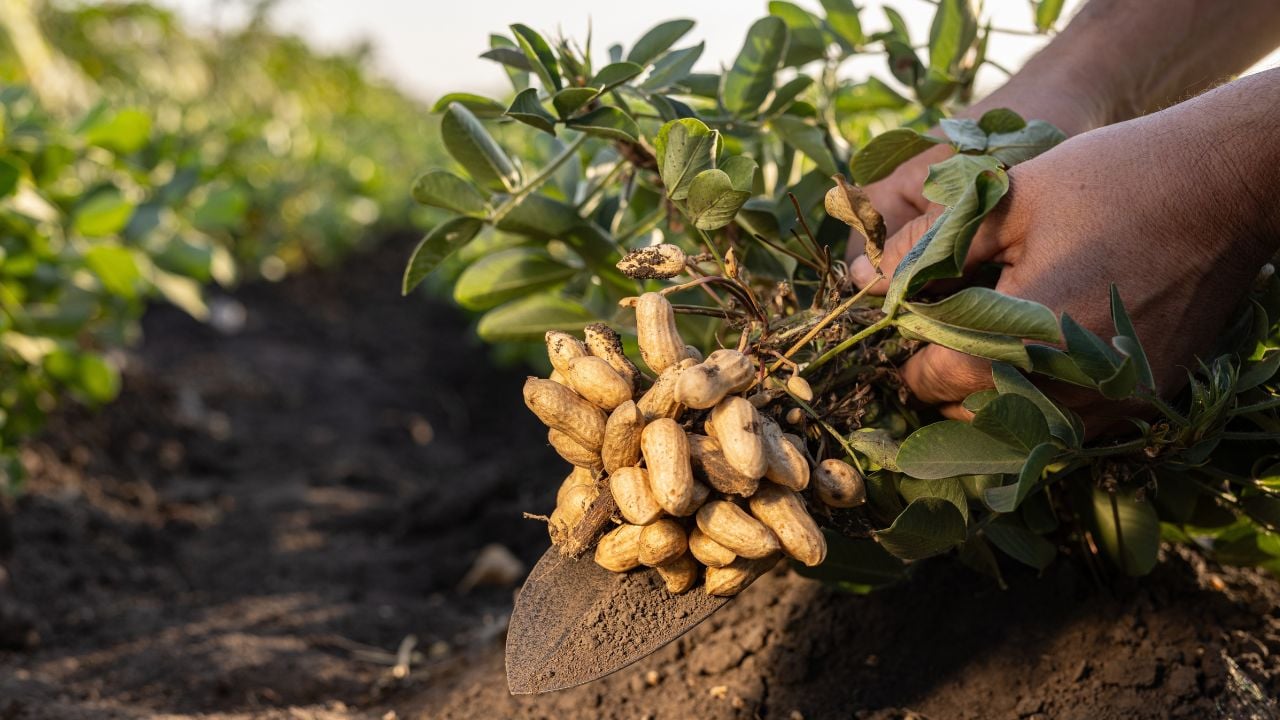
Peanuts grow underground, so a machine has to pull up the whole plant.
The pods follow.
A blade cuts the root off the bottom of each plant, and rotating spikes dig into the soil and flip the plants over.
If you walked that field right afterward, you’d see plants lying upside down.
2. Drying in the Field
Peanuts start drying in the field, right where the digger leaves them.
Freshly dug peanuts contain 25 to 50 percent moisture, and they need to dry to 10 percent or less before anyone can store them.
Virginia Tech Extension says Virginia peanuts are usually combined at 20 to 30 percent moisture, then cured in trailers until they reach 10 percent or less.
The weather decides the rest.
In a 1997 study of peanut curing in the Virginia-Carolina region, two freezing nights after digging pushed freeze damage in conventional windrows above the rejection level.
Conventional windrows are just rows of upside-down plants, and a shading layer on top gave only minimal protection.
If you’re a grower, you can’t rush the drying, and you can’t wait out a freeze.
3. Combining
A combine takes over once the plants have dried in the field.
It pulls the peanuts off the vines and helps clear away extra dirt.
The same 1997 study found that peanuts under a shading layer had a moisture content that averaged 7.3% higher at combining.
The vines stay home.
The Newsoms farmer bales that peanut hay and feeds it to cattle.
If you’re picturing sacks of peanuts, think bigger: The farm loads them into a semi-trailer and sends them off to a buying point.
Psst! How much do you know about peanuts? Take our quiz and see how many you can get right.
Quiz
Peanut Pop Quiz
Answer these questions on peanuts and the foods made from them. We bet you can’t get them all right. Prove us wrong?
About how many peanuts does it take to make a 12-ounce jar of peanut butter?
4. Buying-Point Grading
Peanuts meet an inspector at the buying point.
Virginia Department of Agriculture and Consumer Services (VDACS) inspectors are trained and employed by the state and licensed by the U.S. Department of Agriculture (USDA).
You'll find them at buying stations, and sometimes at harvest sites too.
A grade can follow USDA standards, state standards or contract specifications.
VDACS also offers aflatoxin (mold) testing for peanuts and peanut products.
USDA's inspection instructions call for at least five probes on an average load of 6 tons or less.
For Virginia-type peanuts, inspectors also sort out the extra large kernels with a shaker that has 21.5/64-by-1-inch slots.
Size is the point.
5. Shelling and Sizing
Peanuts lose their shells at a shelling mill.
USDA sorts shelled Virginia-type kernels into grades by size, and the largest is U.S. Extra Large Virginia.
Those kernels can't pass through a screen with 20/64-by-1-inch openings, and the peanuts in a batch have to average no more than 512 per pound.
If you're counting kernels, a lower number per pound means bigger peanuts.
U.S. Medium Virginia kernels can average up to 640 per pound.
U.S. No. 1 Virginia kernels can average up to 864 per pound.
Splits have a grade too.
U.S. Virginia Splits has to be at least 90 percent splits by weight.
What Virginia-Type Means
Virginia-type peanuts are the largest and crunchiest of all peanut types grown in the U.S., according to North Carolina State University's extension service.
About 90% of them are grown in Virginia and the Carolinas.
They go mainly into snack peanuts and in-shell peanut products.
A 2013 study in eastern Virginia found their kernels have almost twice the size of runner, Spanish or Valencia kernels.
6. Blanching and Frying
Hubs Peanuts says Dot Hubbard blanched the first Hubs peanuts in water and cooked them in her family kitchen in Sedley in 1954.
She skinned them by hand.
Her method came from her mother, who blanched peanuts and then fried them in oil.
The company says its peanuts are still cooked in Sedley today.
Hubs says a 1-ounce bag cost a dime that year.
Sedley is a village in Southampton County.
You can buy Hubs gift sets in 12-ounce cans, or a 20-ounce tin of the original salted peanuts in its Harvest Gold set.
Where the Crop Grows
Virginia peanuts covered 29,000 harvested acres in 2023, and the crop totaled 140.07 million pounds, according to USDA's Virginia crop estimates.
Southampton County leads Virginia in peanut production, with 57.62 million pounds in 2023.
Isle of Wight County had 27.6 million pounds, and the city of Suffolk had 23.03 million.
Greensville had 10.12 million.
If you've driven through Suffolk, you've driven through a city that harvested 4,700 acres of peanuts that year.
Mr. Peanut's Start
If you're wondering where Mr. Peanut came from, Suffolk has an answer on a historical marker dedicated in 2016.
Norfolk television station WTKR reported that the marker commemorates his birth by Suffolk native Antonio Gentile in 1916.
Planters started in Wilkes-Barre, Pennsylvania, and moved to Suffolk to be closer to peanut farms, according to the Smithsonian, which also reports a 1916 logo contest.
Accounts differ on the details.
The Suffolk News-Herald reported in 2016 that Gentile's nephew, speaking at a local talk, had never found evidence of a contest.
Planters' Amedeo Obici paid the boy $5 for the drawings, the same report says.
7 Medicare Advantage Changes Virginians Should Read Before They Renew

If your Medicare Advantage plan covers prescription drugs, the most you can pay out of pocket is going up next year.
Virginians weighing whether to renew should look at a few other changes before they decide.
7 Medicare Advantage Changes Virginians Should Read Before They Renew
9 Virginia Squatter Rules That Leave Homeowners Powerless

An empty house that's checked once a season can end up with a stranger living in it.
If that happens in Virginia, your key still working may not count for much.
