

6 Things a Wisconsin Neighbor Can’t Legally Do at Your Property Line

Have you ever spotted a metal stake or post at the corner of your yard and wondered what it was for?
If a neighbor pulls it out to make room for a new fence, it’s more serious than it sounds.
Here are the things a Wisconsin neighbor can’t legally do at your property line.
Note: This is general information, not legal advice. Property rules and fines are subject to change.
1. Cutting Your Firewood
A neighbor who cuts firewood on your side of the line is breaking Wisconsin’s timber theft law.
The law bars anyone from cutting, moving or hauling off raw forest products from your land without your consent.
That label covers logs, cordwood, fuel wood and Christmas trees.
The fine runs from $100 to $10,000.
An intentional cut can be charged as theft instead.
You can also sue for damages, and the amount depends on how careful your neighbor was about finding the line.
If your neighbor relied on a recorded survey from a licensed surveyor, damages equal only the wood’s stumpage value, even when the survey later proves wrong.
Without a survey, a court awards two times that amount if your neighbor took reasonable precautions.
Reasonable precautions mean identifying the harvest boundaries, for example with a compass and measuring device or a global positioning system, and reviewing land ownership records.
If your neighbor had no survey and took no such precautions, damages rise to four times the stumpage value or two times the fair market value, whichever is greater.
2. Removing Survey Markers
If a government survey monument or corner post sits near your line, a neighbor can’t destroy, remove or cover it.
The bar applies to you and your neighbor alike unless witness or reference monuments are erected first.
Anyone who removes, destroys or blocks access to such a marker can be fined up to $1,000 or jailed for up to a year.
That person is also liable in damages to the county where the landmark stands.
Your Neighbor and Subdivision Corner Markers
The platting law requires lot corners in a platted subdivision to be marked with iron pipes or bars at least 18 inches long.
Your neighbor can’t knowingly remove or disturb one of those markers without the governing body’s permission.
A violation can bring a fine of up to $250 or up to a year in county jail.
Each marker counts as a separate violation.
3. Building a Spite Fence
Under the spite fence law, your neighbor’s fence is a private nuisance when two conditions both hold.
The fence, hedge or similar structure has to be unnecessarily taller than 6 feet.
Your neighbor also has to have built it or kept it up maliciously, to annoy the owners or occupants next door.
Even a shorter fence can be ruled a private nuisance.
In Schultz v. Trascher, a 2001 decision, the Wisconsin Court of Appeals upheld a private nuisance finding against a 4-foot fence on ordinary nuisance grounds.
The trial court found that the fence kept the neighbor from driving on her driveway.
The court also said a lawsuit to stop or abate the injury fits a private nuisance dispute when the circumstances warrant it.
4. Blocking Your Solar Panels
Your neighbor can’t block sunlight to your solar panels if you hold a solar access permit and your neighbor was notified of your application.
Structures that were built, under construction or awaiting a building permit when the last notice went out are exempt.
Vegetation planted before the last notice is exempt too, unless a local ordinance says otherwise.
With a permit, the protected window is 9 a.m. to 3 p.m. standard time, and the bar covers a structure or vegetation on the property of neighbors who were notified.
Not every place offers that permit.
Under the access permit law, each county, town, city or village that has a zoning ordinance decides whether to provide for permits.
Psst! How much do you know about how Wisconsin’s land was surveyed? Take our quiz and see if you can ace it.
Quiz
Wisconsin Survey Trivia
Answer these questions on how Wisconsin’s land was first surveyed. We bet you can’t get them all right. Prove us wrong?
Surveyors started the original Wisconsin land survey from a mound built a few miles south of which village?
5. Trespassing on Your Land
Once you tell a neighbor to stay off your land, entering or remaining on it is trespassing.
Your notice counts if you give it to your neighbor personally, either out loud or in writing, or if you post the land.
A violation can bring a forfeiture of up to $1,000.
6. Leaving a Misplaced Fence
Under Wisconsin's fence relocation law, a neighbor whose fence went up on your land before anyone located the boundary line must move it.
The duty starts when you serve written notice personally or leave it with a family member at their home.
That law gives the fence owner 30 days after service of the notice to move it to the boundary line.
If the fence is still there after 30 days, you may relocate it to the boundary line and recover the expense from the fence owner. The law sets no fine.
You can't do that while annual crops would be damaged, unless you and your neighbor mutually agree.
An Attorney General opinion cited under the fence chapter says town supervisors aren't authorized to settle boundary disputes.
Adverse Possession Clocks
A neighbor who holds a strip of your land long enough can end up owning it through adverse possession.
You can recover your land until a neighbor has held it for 20 years without interruption.
In that time, the neighbor has to occupy the strip under a claim of title, treating it as theirs and shutting out everyone else.
The strip also has to be protected by a substantial enclosure or be land that the neighbor usually cultivates or improves.
A 10-year clock applies when the neighbor entered in good faith under a written instrument and recorded it with the register of deeds within 30 days of entry.
A 7-year clock applies when a neighbor who meets those requirements also records any conveyance of that interest within 30 days.
The neighbor also has to pay all the real estate taxes during those seven years.
Milwaukee's 2025 Flood May Be Only the Start for Wisconsinites, a Policy Forum Report Warns
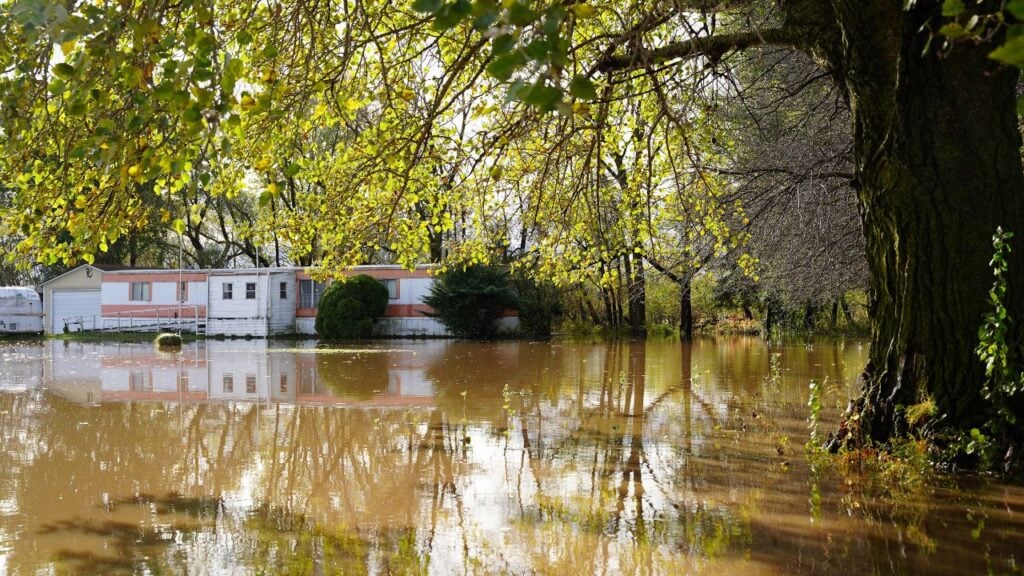
A big storm can feel like someone else's problem until the water's in your basement.
A research group looked back at Milwaukee's damaging flood and asked how ready Wisconsin communities are for more like it.
Milwaukee's 2025 Flood May Be Only the Start for Wisconsinites, a Policy Forum Report Warns
4 Things Wisconsin Cranberry Growers Do After the Bogs Are Flooded

A flooded bog full of red berries is one of fall's best sights in central Wisconsin.
For growers, that pretty picture is where some of the hardest work begins.
4 Things Wisconsin Cranberry Growers Do After the Bogs Are Flooded
