
10 California Beachcombing Rules That Can Cost Visitors a Fine

A California beach citation can start as low as $1,000 and rise past $50,000.
The amount depends on what a ranger catches you doing.
These are the beachcombing rules that can turn a fun day at the coast into a citation.
Note: This is general information, not legal advice. Beach and park rules, and the fines that come with them, are subject to change, so confirm the current regulations with the California Coastal Commission, California State Parks, or your local beach authority.
1. Diving for Abalone
California’s coast used to draw abalone divers to Mendocino and Sonoma every spring, wetsuits and pry bars in hand.
Not anymore.
Regulators closed the recreational red abalone fishery statewide in April 2018, then voted to extend that closure until 2036, largely because warming water wiped out the kelp forests abalone depend on.
Picking an abalone off a rock at low tide, even a single shell for the shelf, still counts as an illegal take.
The penalties get steep fast.
A Sonoma County man who kept 80 abalone in his possession walked away with a $40,000 fine and the loss of his fishing license.
2. Building Your Own Fire Ring
A bonfire on the sand feels like the most California way to end a beach day.
State beaches disagree.
California State Parks rules only allow fires in a fire ring or another facility the park provides, never a pit dug straight into the sand.
Break that rule, and you’re looking at a misdemeanor, the same charge attached to most posted beach violations, with a fine of up to $1,000 and up to 90 days in jail.
Most rangers won’t push it that far for a first offense.
The citation still stings.
3. Setting off Fireworks
Sparklers and bottle rockets often ride along in the same cooler as the firewood.
Skip them entirely on the sand.
No exceptions.
Every firecracker, rocket, and sparkler is banned inside California State Parks and state beaches, “safe and sane” label or not.
Local police departments layer their own fines on top.
Grover Beach, near Pismo, posted its own fine schedule this summer.
It runs $1,000 for one to 10 illegal fireworks, $3,000 for 10 to 20, and $5,000 for more than 20.
Statewide, the numbers go even higher, with a resident caught holding a large enough haul facing a fine as steep as $50,000 under California’s fireworks law.
4. Bringing Your Dog to the Sand
Your dog is welcome on many California beaches, but “welcome” comes with fine print most owners never read.
Many state beaches say no dogs at all.
Unless a beach is posted as dog-friendly, California State Parks rules keep dogs off any beach next to the water.
Even where dogs are allowed, the leash can’t run longer than six feet.
That catches people off guard.
Leaving the leash home, or letting your dog swim off it even at a beach that allows dogs, invites the same misdemeanor citation as the fire rings and the fireworks.
5. Flying a Drone Near Wildlife
Ever launched a drone off a California beach just to grab some aerial footage of the surf?
Point it at a nesting colony or a haul-out of seals, and the harmless part ends.
A drone crash near a Huntington Beach reserve once startled a colony of elegant terns badly enough that the birds abandoned 1,500 eggs, and the Animal Legal Defense Fund, a private nonprofit, offered a $5,000 reward for whoever was flying it.
Harassing wildlife, drone or no drone, is its own misdemeanor under California law.
A camera angle isn’t worth that fine.
Fly it elsewhere.
Psst! How much do you know about California’s coastline and marine life? Take our quiz and see how many you can get right.
Quiz
California Coast Pop Quiz
Answer these questions on California’s coastline and marine life. We bet you can’t get them all right. Prove us wrong?
What causes Southern California’s waves to glow electric blue at night?
6. Pocketing Shells or Rocks
A pocketful of shells or a smooth stone for the windowsill is the go-to beach souvenir.
Not on state park land.
The same rule book that governs the fire rings and the leash length also bans removing earth, sand, gravel, or rocks from state park land, shells included, unless a park authorizes something like rockhounding.
Even authorized rockhounders can't take more than 15 pounds of material a day, and historic or archaeological pieces are off-limits no matter what.
That windowsill collection could cost more than it's worth.
7. Touching a Tide Pool
Why do California's tide pools stay so full of life even with crowds climbing over the rocks all summer?
Many of them sit inside a Marine Protected Area, and that changes everything.
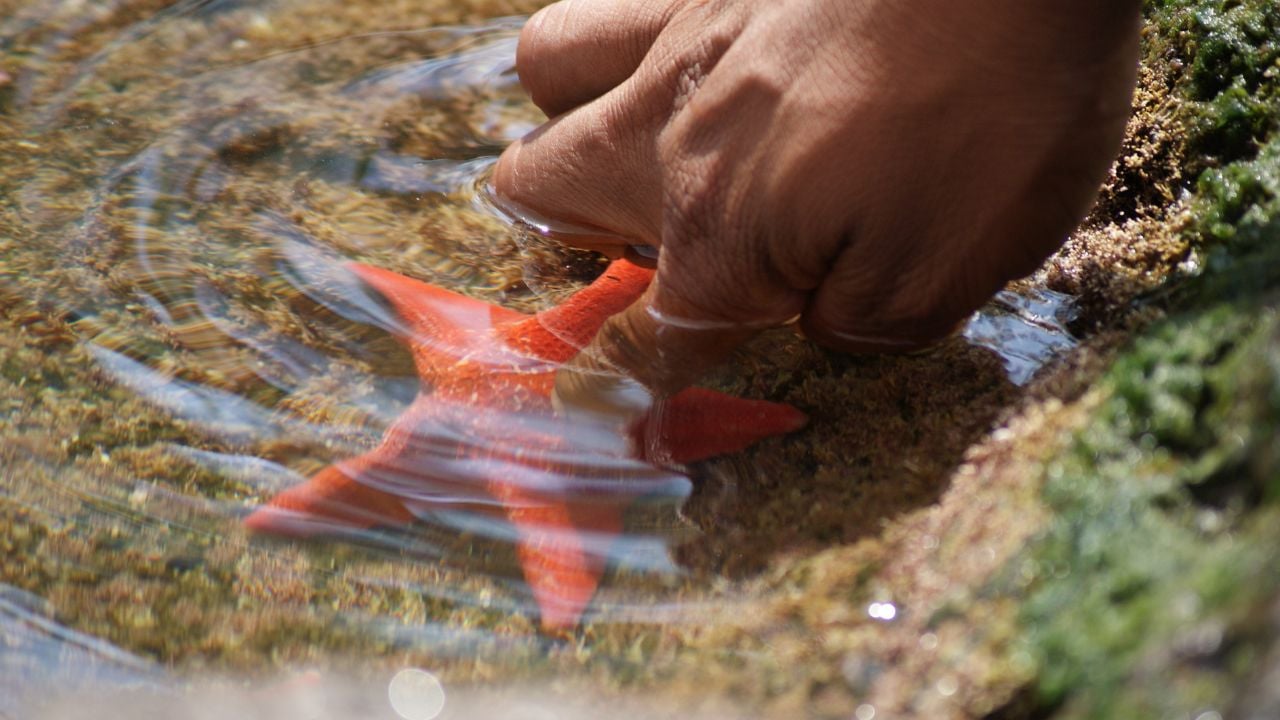
At Moss Beach's Fitzgerald Marine Reserve, and dozens of protected coves like it, picking up a starfish for a photo already counts as an illegal take, even if you set it right back down.
Fines for handling tide pool life can run into the thousands, and wardens with the California Department of Fish and Wildlife patrol the popular pools during low tides.
Look, don't touch.
8. Taking Home a Sand Dollar
California's invertebrate fishing regulations list sand dollars by name, right alongside abalone and sea urchins, as species covered by the state's tidal take rules.
Check the color before you pocket the sand dollar.
A bleached white sand dollar found above the tide line is dead and fair game almost everywhere.
A dark, fuzzy sand dollar is still alive, and anyone 16 or older needs a valid California fishing license just to take it.
Inside a Marine Protected Area, taking any sand dollar, dead or alive, is banned outright.
That's a strange rule for a beach souvenir.
Almost nobody realizes it.
9. Grabbing Driftwood or Kelp
Along stretches of the California coast like Monterey Bay, a sun-bleached piece of driftwood or a strand of kelp on the tideline looks like an easy keepsake to take home.
State parks would rather it stayed.
California State Parks rules treat driftwood the same as any other dead wood on the property, off-limits to collect unless a park posts otherwise.
Kelp and seaweed carry their own recreational limit of 10 pounds wet weight a day.
Not even the seaweed.
Three plants get zero allowance no matter the limit: Eelgrass, surfgrass, and sea palm are off the table entirely, since they anchor whole tide pool ecosystems in place.
Grab the wrong souvenir, and a ranger can write you up the same as anyone hauling off rocks.
10. Picking up an Old Artifact
Spot an old bottle, a rusted nail, or a worked stone in a coastal bluff, and the instinct is to pocket it.
California law calls it something else: Evidence.
Removing or damaging any object of archaeological, paleontological, or historical value from public land is a misdemeanor under Public Resources Code 5097.5, punishable by a fine of up to $10,000, up to a year in county jail, or both.
Evidence, not treasure.
That applies to a beach bluff exactly the way it applies to a desert dig site.
Much of the California coast still carries traces of the Chumash, Ohlone, and other Native communities who lived along it long before statehood, in the form of shell mounds and tool fragments tucked into eroding bluffs.
Spot something that looks old on a beach walk, and the safest move is a photo and a report to the park ranger on duty, not a pocket.
10 Habits That Embarrass Californians the Second They Leave the State

A Californian steps off the curb in Nashville mid-block, no crosswalk in sight, and a passing truck lays on the horn.
They don't even flinch because crossing the second the street looks clear is just what people do back home.
10 Habits That Embarrass Californians the Second They Leave the State
15 Things Californians Are Tired of Hearing From the Rest of America

A Californian mentions where they're from at a wedding reception, and the same two questions start before the appetizers even arrive.
Nobody waits for an answer before asking whether it's always sunny or if they've ever felt an earthquake.
15 Things Californians Are Tired of Hearing From the Rest of America
