
10 Everyday Businesses That Once Existed in Nearly Every Kansas Town

Kansas still had roughly 48 drugstore soda fountains pouring in the early 2000s, according to the Kansas Sampler Foundation’s count.
By 2012, there were 39.
Today, there are 21.
That curve runs through almost every business a Kansas main street used to take for granted.
These are the everyday businesses that once existed in nearly every Kansas town.
1. Five-and-Dime Store
The five-and-dime store got its start in Kansas, not somewhere back east.
Duckwall Brothers opened its first shop in Abilene in 1901, selling household goods for a nickel or a dime a piece.
The company grew into Duckwall-ALCO Stores, which later renamed itself ALCO Stores, Inc. (ALCO, for short).
The five-and-dime and general merchandise format eventually reached small towns across Kansas and 22 other states.
Then, in October 2014, ALCO filed for bankruptcy.
Every store closed within months.
All 198 locations shut down, ending a run of 113 years that started in a single Abilene storefront.
2. Corner Hardware Store
Winchester Hardware anchored its Kansas downtown for more than a century, the kind of hardware store that stocked everything from nails to garden hoses.
It closed for good in 2023.
Money did it in.
Rising property taxes, insurance costs, and the pandemic’s aftereffects added up faster than the store could keep pace.
The shelves that used to hold a little of everything went empty.
3. Shoe Repair Shop
A shoe repair shop, run by a cobbler who could resole a boot instead of throwing it out, was once a routine stop in small-town Kansas.
Shoes used to cost enough, and last long enough, that fixing a worn heel made more sense than replacing the whole pair.
That math changed.
Mass-produced shoes got cheap enough that many people replace a pair rather than repair a pair.
That shift left the shoe repair trade rare in small towns across the country, Kansas included.
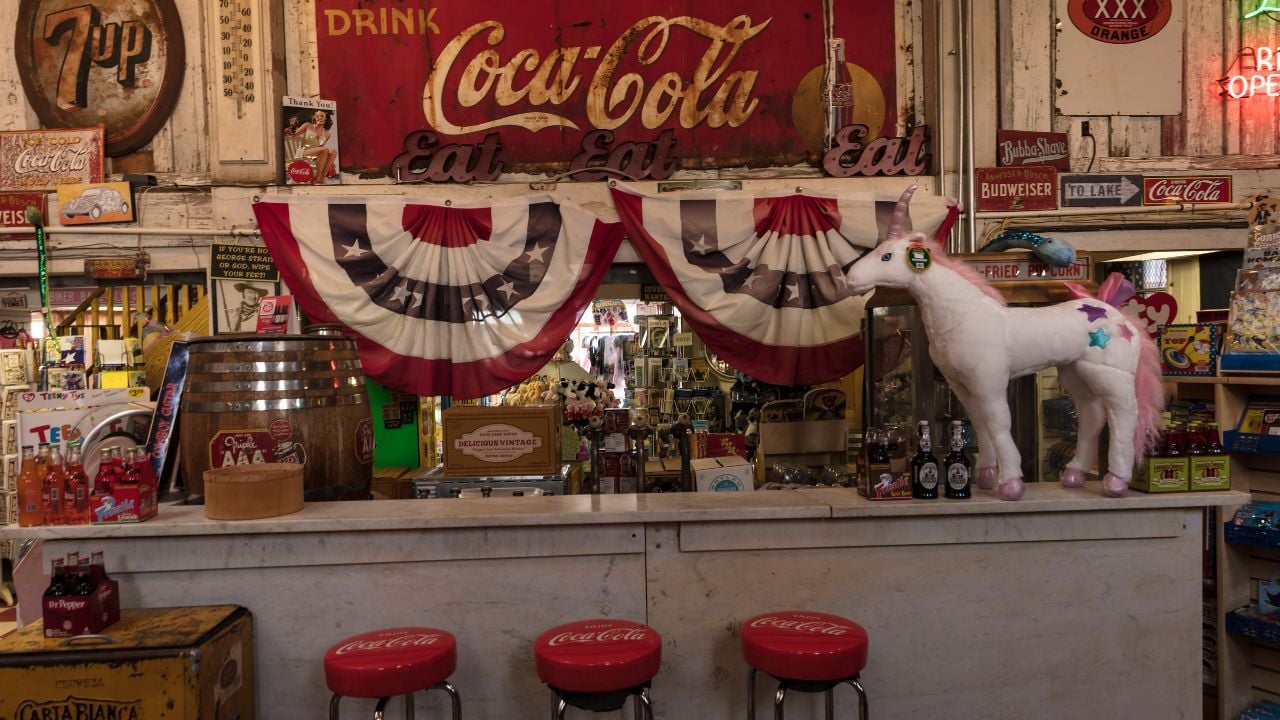
4. Drugstore Soda Fountain
Kansas had roughly 48 drugstore soda fountains still pouring drinks across the state in the early 2000s, according to the Kansas Sampler Foundation.
That number fell to 39 by 2012.
Today it’s 21.
Finding replacement parts, and someone who still knows how to install them, gets harder every year.
Topeka’s Potwin Drug, which opened its fountain in 1902, is the oldest fountain still pouring.
5. Family-Run Grocery Store
A family-run grocery store used to be the one certainty on a small Kansas town’s Main Street.
Kansas State University’s Rural Grocery Initiative found that 105 stores closed in rural Kansas between 2008 and 2018.
Half of those towns never got a new store.
The shelves just stayed empty.
A trip for milk and bread now means a drive to the next town over for many rural Kansans.
Why One New Store Can Close a Kansas Town’s Grocery
A Kansas town’s only grocery store can lose to a single new competitor down the road.
In Blue Rapids, a Dollar General opened near the town’s lone supermarket, and the supermarket closed within about three years.
Grocery stores everywhere run on thin profit margins, leaving little room to compete once a bigger retailer moves in close by.
Nationally, the number of grocery stores per person in rural counties fell 40% between 1990 and 2015.
6. Small-Town Movie Theater
Kansas towns joined a national wave of movie theaters that swept the country by 1910, according to the Kansas Historical Society.
Kansas also became a hub for drive-ins, with about 125 of them dotting the state by the 1950s.
Only four remain.
The Starlite in Wichita and the Kanopolis Drive-In are among the survivors, and even they depend on grants and repairs just to keep the projector running.
7. Train Depot
Railroads crisscrossed Kansas so thoroughly that, as the Topeka & Shawnee County Public library puts it, nearly every small town needed a train depot.
Ticket agents sold fares, handled freight, and kept the local schedule running on time.
Many of those jobs vanished.
Amtrak’s Southwest Chief is the only passenger line left, and it stops at just six Kansas towns: Lawrence, Topeka, Newton, Hutchinson, Dodge City, and Garden City.
8. Weekly Newspaper
A weekly newspaper covered the school board, the county fair, and the obituaries in nearly every small Kansas town.
Kansas counted 156 weekly papers in 2004, according to researchers at the University of North Carolina’s Hussman School of Journalism and Media.
Ten of them were gone by 2019.
That’s one weekly paper lost about every year and a half.
The trend hasn’t reversed.
9. Town Blacksmith
The Kansas Historical Society calls blacksmiths “essential members” of any community, the tradespeople who shod horses and repaired tools and wagon parts that couldn’t be bought ready-made.
Then factories caught up.
The Historical Society traces the decline to the growth of cheap, industrially produced goods, not to any single machine.
A one-person blacksmith shop couldn’t match a factory’s prices, and the trade that once anchored a Kansas town’s Main Street thinned into something rare.
Psst! How much do you know about Main Street’s history? Take our quiz and see how many you can get right.
Quiz
Main Street History IQ
Answer these questions on Main Street history and small-town America. We bet you can’t get them all right. Prove us wrong?
Frank Woolworth’s first five-cent store failed within months. Where did he open the store that finally worked, later that same year?
10. Full-Service Gas Station
A full-service gas station meant an attendant pumped the gas, checked the oil, and washed the windshield in nearly every Kansas town.
That was the nationwide standard, the same in every state.
States let self-service pumps spread through the 1970s and 1980s, and drivers increasingly chose to save the extra few cents pumping it themselves.
The attendant mostly disappeared.
One state, New Jersey, still requires someone else to pump the gas, but Kansas isn't one of them.
Many Kansas drivers today pull up, swipe a card, and never see anyone come out to check under the hood.
The full-service stop that once came standard at every corner station is now something a driver has to look for on purpose.
A few rare highway stretches still offer it.
