
10 Small Changes That Make Life Easier for Senior Pets in Maryland Homes

More than 90% of cats past age 12 show signs of degenerative joint disease.
Many of those cats never full-out limp.
A stiff jump onto the couch or a skipped trip to the litter box is often the only clue anyone gets.
These are small changes that make life easier for senior pets in Maryland homes.
1. Rugs for Slick Floors
Senior pets lose their grip on the same tile and hardwood floors they used to cross without a thought.
Arthritis stiffens the joints that once absorbed a stumble.
The senior-care guidelines published by the American Animal Hospital Association call for rugs or yoga mats on slick floors to give older joints better footing.
No renovation required.
A runner down the hallway or a mat at the bottom of the stairs does the job, and it costs a fraction of what new flooring would.
2. Raised Food and Water Bowls
A senior dog with a stiff neck or a sore hip has to bend farther than it should just to eat.
Raising the bowls a few inches takes that strain out of every meal.
Small fix.
The American Animal Hospital Association (AAHA) lists bowl elevation right alongside better footing as a standard senior-pet accommodation.
It works for cats with sore hips too.
A stack of sturdy books under the dish works in a pinch.
3. Smaller, Wetter Meals
Senior cats often lose muscle and body weight even when their appetite looks normal.
The 2023 AAHA senior care guidelines recommend smaller meals for older cats instead of one or two big bowls a day.
For dogs, the same research found that adding moisture to food improved how well an aging digestive system absorbs nutrients.
A splash of warm water or low-sodium broth stirred into the bowl does it.
Ten seconds, tops.
It costs nothing, and it happens right before dinner anyway.
4. Low-Sided Litter Boxes
A senior cat with sore joints can find the walls of a standard litter box harder to clear than they look.
That 90% figure on feline joint disease from the Merck Veterinary Manual is exactly why this box matters so much.
Cornell’s Feline Health Center points cat owners toward a box with low sides.
Cornell also flags the stairs themselves as a barrier.
A cat with painful arthritis can have trouble reaching a box at all once getting there means climbing a full flight first.
A cat that has to climb a full flight of stairs to reach the only box in the house will often just stop trying.
That’s not a behavior problem.
It’s a hip that hurts.
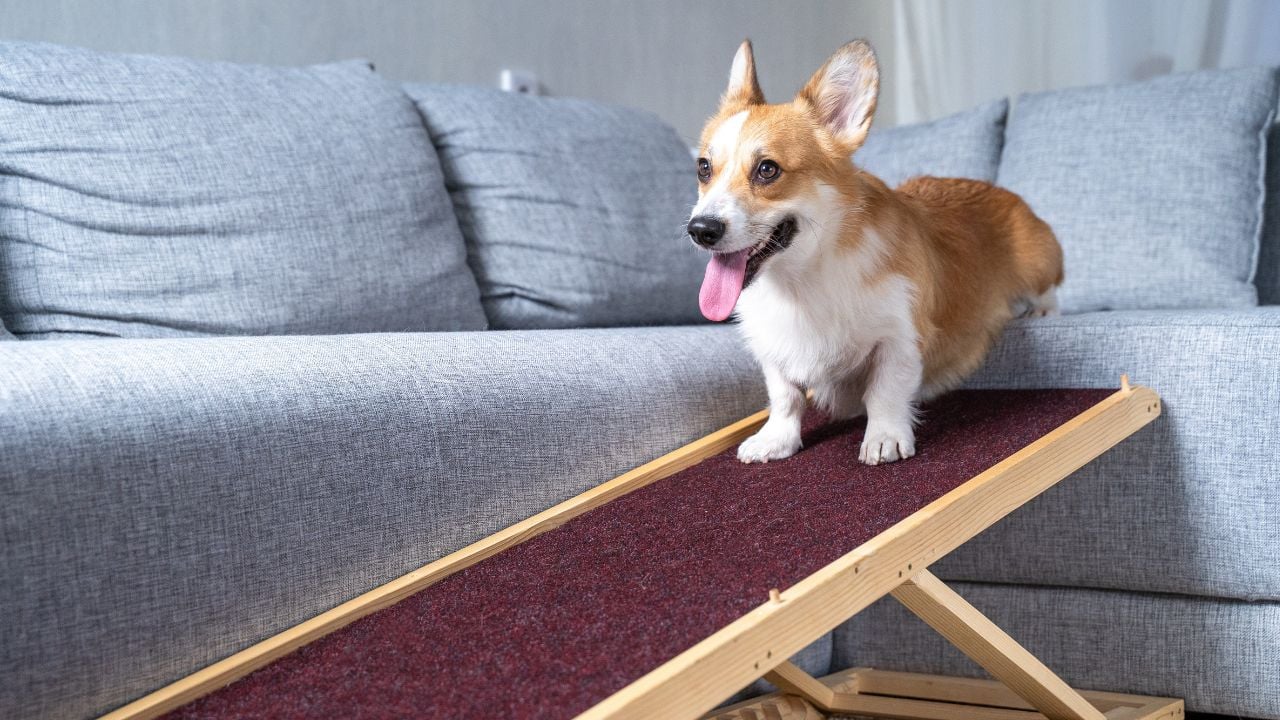
5. Ramps at the Furniture
A senior dog that used to leap onto the bed in one motion starts hesitating at the edge once arthritis sets in.
The American Veterinary Medical Association lists stairs and ramps among its standard recommendations for aging joints.
It also suggests moving a dog’s sleeping spot so it no longer has to climb a full staircase just to reach it.
No leap required.
A small ramp does the same job at a favorite couch, an armchair, or a bed frame that used to be a one-hop jump.
It folds flat and slides under the furniture when it’s not out, so it never has to become a permanent fixture in the room.
Psst! Think you know how dogs and cats age? Take our quiz and see how many you can get right.
Quiz
Senior Pet Aging IQ
This quiz covers the aging quirks that surprise even longtime pet owners. We bet you can’t get them all right. Prove us wrong?
Among its senior-pet comfort tips, what does AAHA recommend posting near the front door?
6. A Consistent Furniture Layout
A senior cat cuts the corner around the coffee table by muscle memory, then stops mid-step when the table isn't quite where it used to be.
That hesitation is a memory failing to match what's there anymore.
A dog or cat losing its eyesight learns a home by memory, not by sight.
Dr. Lucien Vallone, a clinical associate professor at the Texas A&M College of Veterinary Medicine, points to consistent locations for furniture and other obstacles.
It's one of the simplest ways to help a low-vision pet stay confident moving around the house.
Memory is the map.
The change here means committing to one layout and sticking to it, on purpose, for as long as the pet needs it, not rearranging for a fresh look.
A pet that has the floor plan memorized can still find the water bowl in the dark.
Move the couch, and the pet has to relearn the whole room.
7. Scent and Sound Cues
A senior pet with fading eyesight still reads a room through its nose and ears just fine.
Texas A&M's guidance also suggests placing air fresheners of different scents at key spots around the house.
A low-vision dog or cat can then smell its way to the food bowl or the door.
Sound works too.
In a multi-pet home, a small bell on a sighted housemate's collar gives a low-vision pet something to follow by ear instead of by sight.
Throw rugs or mats in a few well-worn spots work the same way underfoot, a tactile landmark for a paw that's already relying on everything except its eyes.
What a Senior Dog's Cloudy Eyes Mean
A senior dog's eyes turning hazy blue-gray in the center is normal aging more often than not, not a cataract.
The American College of Veterinary Ophthalmologists says the change is often seen starting after age 8 to 10.
Veterinary ophthalmologists call this nuclear sclerosis, and it comes from lens fibers packing in tighter with age, not from disease.
Nuclear sclerosis doesn't cause blindness and doesn't hurt, while a true cataract clouds the whole lens and often needs surgery.
Only a vet can tell the two apart with a dilated eye exam, so a senior dog's newly cloudy eyes are worth a visit rather than a guess.
8. New Hand Signals
A senior dog losing its hearing can't be called in from the yard the way it always has.
The American Kennel Club recommends pairing every verbal cue a dog already knows with a matching hand signal, well before hearing fades completely, so the two commands become interchangeable.
A firm stomp on the floor sends a vibration a partially deaf dog can still feel through its paws.
How you approach matters just as much.
A dog that can't hear someone coming may startle and snap purely out of surprise.
Surprise is the enemy.
The American Kennel Club's fix is heavy, deliberate footsteps on the way over, so the vibration announces a person before a hand does.
A light touch on the back works better than a hand appearing out of nowhere.
9. Nightlights and Steady Warmth
Senior pets feel a cold floor and a dark hallway more than they used to.
AAHA's guidelines list nightlights, steady room temperature, and a warm patch of sunlight among the small comforts that help an older pet after dark.
Fading vision and stiff joints both get harder to manage once the lights go off.
A plug-in nightlight near the water bowl or the litter box removes a whole obstacle course at 3 a.m.
Cheap fix.
A drafty spot by the back door stops being an acceptable bed once a pet can't easily get up and move to a warmer spot.
10. A One-Line Symptom Log
A senior pet's limp can show up on Tuesday and fade by Thursday, already forgotten by the next vet visit months away.
The American Veterinary Medical Association lists the senior warning signs worth watching for at home: A new lump, stiff sitting or standing, a sudden drop in appetite, acting confused.
Each one is obvious in the moment and blurry a month later, whenever the next vet visit happens.
Memory isn't reliable.
A sticky note on the fridge or a single running note on a phone is enough to fix that.
One line, one date, done, and a fuzzy sense of how long this has been going on turns into an answer a vet can use.
Why Vets Still Want Two Visits a Year
A healthy senior dog ages faster between checkups than a younger dog does.
AAHA's life-stage guidance recommends healthy senior dogs see a veterinarian twice a year instead of the standard annual visit.
That's the whole ask.
It's one extra appointment, and it catches the kind of slow joint or organ change that a full year of waiting can hide until it's already advanced.
A senior wellness panel usually adds bloodwork and a blood pressure check to the standard exam, catching kidney and thyroid changes months before symptoms show up at home.
None of it requires a diagnosis already in hand, just a pet old enough for the extra look.
8 Ways Out-of-Staters Break Buc-ee's Etiquette Before They Reach the Brisket

A fresh-brisket announcement crackles over the loudspeaker, and half the store turns toward the counter at once.
Regulars already know the drill, right down to never making a scene the cashiers will remember.
8 Ways Out-of-Staters Break Buc-ee's Etiquette Before They Reach the Brisket
