
10 Things That Change the Second You Cross From New Jersey Into New York

You already know the traffic gets worse the closer you get to the Hudson on a holiday weekend.
Traffic isn’t the only thing that changes at the river, and some of the differences will cost you if you don’t see them coming.
Here are the things that change the second you cross from New Jersey into New York.
Note: This is general information, not legal or tax advice. Driving rules, tolls, tax rates and wages are subject to change.
1. Self-Service Gas
Everything on this list starts at the Hudson River crossings into New York City, and the first change comes at the gas pump.
New Jersey is the only state that still prohibits self-service gas stations.
Its Retail Gasoline Dispensing Safety Act says only a trained attendant can dispense fuel, so if you fill up in New Jersey, someone else holds the nozzle.
In New York, you can.
2. One-Way Tolls
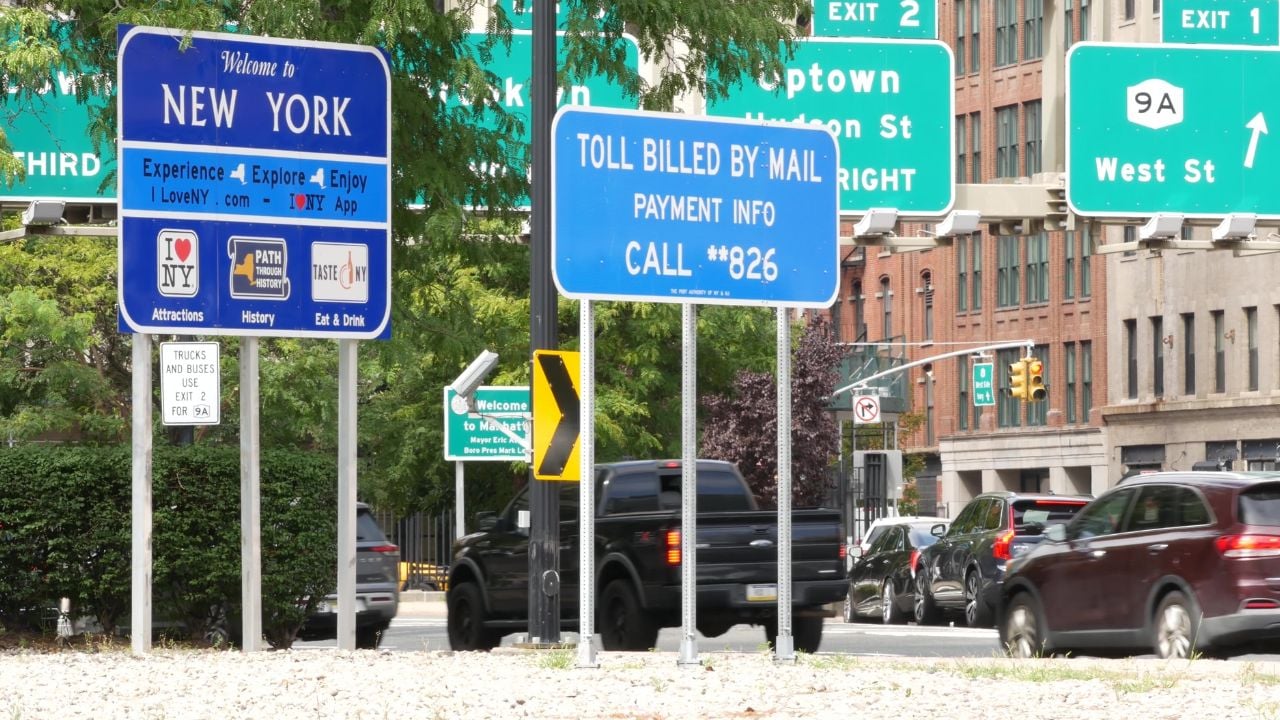
The Port Authority collects its toll at the George Washington Bridge and the Lincoln and Holland tunnels only when you drive into New York.
In 2026, a car with E-ZPass pays $16.79 at peak times and $14.79 off-peak.
Off-peak driving saves you $2.
If you skip E-ZPass, the mail option runs over $23.
Heading back into New Jersey costs you nothing at those crossings, so you only need to budget for the trip over.
3. Right Turn on Red
New York City bans a right turn on red, except at the Staten Island intersections that post a sign allowing it.
New Jersey law lets you turn right on red after a full stop, unless a sign says no.
If you make that turn out of habit at the first red light after the bridge or tunnel, you’re breaking the law.
Wait for green.
8 Things That Only Make Sense to New Jerseyans Who Grew Up Going Down the Shore

Many people who grew up going down the shore picked up a vocabulary that sounds like nonsense anywhere else.
Some out-of-staters hear a few of those words and raise an eyebrow.
8 Things That Only Make Sense to New Jerseyans Who Grew Up Going Down the Shore
4. Congestion Toll
Driving into Manhattan at or below 60th Street costs you another toll on top of the one you paid to cross the river.
That includes Midtown.
If you drive a passenger vehicle, you pay $9 at peak times and $2.25 overnight.
The toll has applied since January 2025, so a dinner or a show in Midtown now comes with two tolls.
When New York City’s Congestion Toll Applies
New York City’s congestion toll for Manhattan runs at its peak rate from 5 a.m. to 9 p.m. on weekdays.
On weekends, the peak rate runs from 9 a.m. to 9 p.m.
You pay it once per day when you enter the zone in a passenger vehicle.
Without E-ZPass, you pay the Tolls by Mail rate, which is up to 50% more.
If you have E-ZPass and enter through the Lincoln or Holland Tunnel at peak times, you can get a credit of up to $3.
The Metropolitan Transportation Authority (MTA) plans to raise the toll in 2028 and again in 2031.
5. Paper Bags at Checkout
In New York City, a paper bag at checkout costs you a nickel.
Stores there must charge a five-cent fee on each paper carryout bag, with some exceptions, such as customers paying with food-assistance benefits.
New Jersey’s rule is stricter, since a grocery store of 2,500 square feet or more can only provide or sell reusable bags.
Both states ban single-use plastic carryout bags, with limited exceptions.
Keep a tote handy.
6. Sales Tax
Sales tax costs you $2.25 more on every $100 you spend in New York City than in New Jersey.
New York City’s total rate is 8.875%, while New Jersey’s is 6.625%.
Clothing is the exception.
Most clothing and shoes are tax-free in New Jersey, and New York City matches that for clothing and footwear under $110.
So a $109 jacket is tax-free on both sides of the river.
A $200 coat is a different story, since New York City taxes it and New Jersey doesn’t.
7. Minimum Wage
New York City’s minimum wage runs higher than New Jersey’s, at $17.00 an hour in 2026.
That’s the legal minimum for most hourly workers you’ll meet there.
New Jersey’s is $15.92 for most employees, so the gap is $1.08 an hour.
Servers are different.
In New York City, tipped food service workers must get at least $11.35 an hour in cash wages, with a $5.65 tip credit.
Psst! How much do you know about the rules on both sides of the Hudson? Take our quiz and see if you can ace it.
Quiz
Hudson River Rules
Answer these questions on everyday laws in New Jersey and New York. We bet you can’t get them all right. Prove us wrong?
An adult in New York City parks the car, turns off the engine and lights up cannabis. What does the city’s Health Department say about that?
8. Jaywalking
Jaywalking stopped being a violation in New York City in 2024, so you can cross outside a crosswalk or against the signal without breaking city law.
That doesn't give you the right of way, though, since pedestrians outside a crosswalk should still yield to traffic.
In New Jersey, you risk a $54 fine if you don't yield to drivers when you cross anywhere but a crosswalk.
Look both ways anyway.
9. Speed Cameras
New York City puts speed cameras in school zones to photograph speeding vehicles, and New Jersey doesn't have speed enforcement cameras.
The cameras ticket you for going more than 10 mph over the speed limit.
On a street with the citywide 25 mph limit, 36 mph can earn you a ticket.
Watch your speedometer near schools.
10. Cigarette Tax
If you buy cigarettes in New York City, the excise tax on each pack is more than double what you'd pay in New Jersey.
New Jersey's cigarette excise tax is $3.00 a pack, while New York State's is $5.35 a pack of 20 and New York City adds $1.50 on top.
That's $3.85 more a pack.
If you smoke a pack a day, that adds up to about $1,400 more in tax a year.
What Stays the Same
Cannabis rules mostly match.
New Jersey and New York City follow the same basic rule on where you can smoke cannabis.
In New Jersey, you can smoke cannabis where cigarette smoking is allowed, unless stated otherwise.
New York City's Health Department says adults may smoke or vape cannabis wherever smoking tobacco is allowed under the smoke-free air laws, with exceptions.
Both rules carry exceptions, so check for posted signs before you light up.
9 New Jersey Myths Residents Are Sick of Correcting

Out-of-staters often arrive with a few ideas about New Jersey already in their heads.
Many New Jerseyans have heard those ideas before and are ready to set the record straight.
