
10 Washington Beach Finds Visitors Aren’t Allowed to Take Home

Washington’s coastline crosses state parks, a national park, tribal land, and protected marine sanctuaries.
Each jurisdiction sets its own rules for what you can pick up and take home.
Here’s what looks like harmless beachcombing but breaks the law in Washington.
Note: This is general information, not legal advice. Washington’s rules on beach collecting and wildlife protection are subject to change.
1. Native American Artifacts
Thousands of years of Native American history are buried along Washington’s beaches.
An arrowhead or a stone tool lying in the sand isn’t a free souvenir.
State law makes it unlawful to remove an archaeological object from a site without a permit from the Department of Archaeology and Historic Preservation.
The rule applies on private land as much as public.
That covers projectile points, tools, and carved stone scattered along tribal shorelines like the Olympic Peninsula’s outer coast.
Knowingly disturbing a grave or a burial site carries a heavier charge, a class C felony.
State law gives you a full defense if the discovery was an accident, you protect the site, and you report it.
Report it instead.
Washington’s Department of Archaeology and Historic Preservation asks beachcombers to note the location, leave the object exactly where it lies, and call it in.
2. State Park Rocks and Shells
State park rangers in Washington can write a citation over something as small as a pebble.
Pocketing a handful counts as a misdemeanor under state law.
Removing any rock, shell, or other natural object from a park beach like Cape Disappointment or Deception Pass is off limits unless a state parks rule allows it.
No such rule covers rocks or shells.
The written exceptions run to firewood, which needs a permit, and seaweed at three parks for one month each spring.
Ask a ranger first.
A ranger who spots a bucket of beach glass or a bag of shells in the trunk can write a citation.
A jar of sand from a state park beach falls under the same rule, since state law defines a natural object broadly.
3. National Park Driftwood
Every log scattered across Kalaloch, Ruby Beach, and Rialto Beach belongs to Olympic National Park.
The park protects Washington’s wildest stretch of coastline, driftwood included.
Federal rules bar taking driftwood home from a national park.
A violation can bring six months in jail and a $5,000 fine.
Olympic does let you burn beach driftwood twelve inches across or smaller at the South Beach and Kalaloch campgrounds.
It cannot leave the park.
Unoccupied seashells are the one exception, since the park superintendent allows a handful per person per visit.
A driftwood find that’s legal to load into a truck on a public tideland becomes a federal violation the moment it sits inside park boundaries.
Borders matter here.
Beachcombers sometimes cite a Washington attorney general opinion from 1952 as a green light for driftwood, but it only sorted out rights between shore owners and log salvage crews.
Federal land was never the question.
4. Sand Dollars and Sea Stars
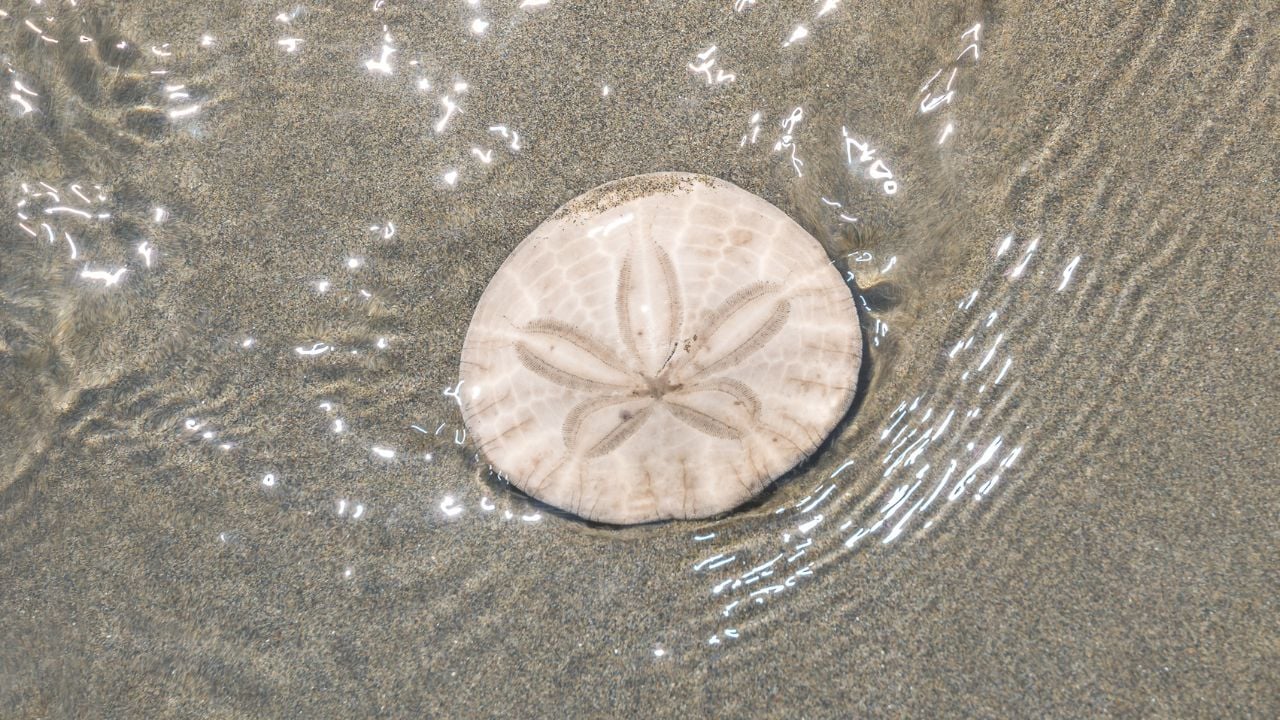
Washington’s Department of Fish and Wildlife (WDFW) closes every marine area in the state to taking sand dollars, sea stars, and dozens of other creatures.
State fishing rules group them all as closed “unclassified marine invertebrates.”
That includes moon snails, chitons, and nudibranchs alongside the tide pool classics.
Not even one.
A conviction can bring up to 90 days in jail and a $1,000 fine.
WDFW added sea stars to the closed list on its own after a wasting disease nearly wiped out entire populations along the coast.
What Washington’s Sand Dollar Rule Covers
Washington’s sand dollar rule covers far more than sand dollars.
State fishing regulations group sand dollars with sea stars, moon snails, chitons, and nudibranchs under one label, “unclassified marine invertebrates.”
Every marine area in Washington is closed to taking any of them, not just a handful of popular tide pool beaches.
A first violation is a misdemeanor, and a court can hand down up to 90 days in jail plus a $1,000 fine.
The safest habit on any Washington beach is to look at tide pool life and leave it exactly where it sits.
5. Pinto Abalone
A shell glowing with streaks of green and pink against a tide pool rock is one of the rarest sights left on the Washington coast.
That color belongs to the pinto abalone, and it hasn’t been legal to take home since 1994.
Washington closed the recreational abalone fishery statewide that year after decades of harvest pushed populations into a steep decline.
The state listed pinto abalone as endangered in 2019, after survey counts in the San Juan Islands fell more than 97 percent between 1992 and 2017.
Counts finally ticked up between the 2017 and 2024 surveys.
State biologists still recommended in 2025 that the species keep its endangered listing.
The limit is zero.
Taking one, even a single abalone pried off a rock for a closer look, is unlawful taking of endangered wildlife under state law, a gross misdemeanor.
A second conviction within five years makes it a class C felony and costs you your fishing privileges for two years.
No season has reopened it since.
6. Shipwreck Relics
The seafloor off Washington’s outer coast holds the wreckage of roughly 200 ships, lost over centuries of maritime shipping.
Storms and heavy seas grounded the Russian steamer Lamut off Teahwhit Head near La Push in April 1943.
Fragments still turn up in the sand.
The engine block of another wreck, the Skagway, sits in shallow water along the shore.
It’s nobody’s souvenir.
Olympic Coast National Marine Sanctuary regulations bar moving, removing, or injuring any sanctuary historical resource, and shipwreck debris scattered along the intertidal zone counts.
A federal permit is required for any activity otherwise off-limits inside the sanctuary, and pocketing a ship fitting or a chunk of hull iron doesn’t qualify.
The sanctuary runs roughly 135 miles along the coast, bordering Olympic National Park, the reservations of four tribal nations, and Washington’s own Seashore Conservation Area.
7. Snowy Plover Eggs
A speckled egg about the size of a golf ball sits in a shallow scrape in the dry sand, blending almost perfectly into the beach around it.
It belongs to the western snowy plover, one of Washington’s rarest nesting shorebirds.
About 123 breeding adults nested in Washington in 2024, the first year the state count passed 100.
They stick to a handful of beaches in Pacific and Grays Harbor counties, mainly Leadbetter Point, Connor Creek, Midway Beach, and Empire Spit.
Washington listed the species as state endangered in 1981, and federal law has protected it as threatened since 1993.
Neither law carries an exception.
Picking up or disturbing a nest or an egg violates both laws, and WDFW, Washington State Parks, and the U.S. Fish and Wildlife Service close stretches of beach around nesting areas every spring and summer to keep visitors clear.
Some of those closures run from mid-March into late September, exactly when many beach trips happen.
8. Wild Bird Feathers
A stray feather is one of the most common things a visitor pockets on a Washington beach.
Federal law says not to.
The Migratory Bird Treaty Act bans possessing any feather from a protected native bird, seagulls included, whether it was plucked or simply found lying in the sand.
A conviction can carry six months in jail and a fine of up to $15,000.
A few familiar birds fall outside the law, since starlings, house sparrows, and city pigeons are all non-native.
Bald eagle feathers carry an extra layer of protection under a second federal law, with penalties that add up to a year in prison.
Finding it doesn’t help.
Psst! How much do you know about Washington’s coastline and tide pools? Take our quiz and see how many you can get right.
Quiz
Washington Coast & Tide Pool Trivia
Answer these questions on Washington’s coastline and tide pools. We bet you can’t get them all right. Prove us wrong?
Which point on the Washington coast is the northwesternmost spot in the entire contiguous United States?
9. Marine Mammal Bones
Washington's outer coast washes up seal, sea lion, and occasionally whale bones.
On much of that coastline, none of them are legal souvenirs.
The Marine Mammal Protection Act bars taking or possessing marine mammals.
One narrow federal rule does let beachcombers keep bones, teeth, or ivory from an animal that died on its own.
You have to register the find with a NOAA Fisheries regional office within 30 days, mark it, and never sell it.
Species listed under the Endangered Species Act are off the table entirely.
Here is the catch.
Olympic National Park and the coastal national wildlife refuges cover much of Washington's outer coast, and federal park rules bar possessing any animal part inside them.
A bleached vertebra half buried at Rialto or Ruby Beach is off limits, full stop.
Report it instead of pocketing it.
The National Oceanic and Atmospheric Administration (NOAA) Fisheries office asks beachcombers to call in a find so researchers can log it.
10. Marine Sanctuary Souvenirs
A handful of Washington beaches ban collecting anything at all, dead or alive.
Edmonds' Brackett's Landing is the best known example.
Other no-take zones exist.
The city and WDFW jointly protect Brackett's Landing Shoreline Sanctuary as a no-take zone, so shells, rocks, driftwood, and marine life all stay exactly where they land.
The rule covers roughly 25,000 divers who visit every year, plus every beachcomber walking the shoreline above them.
WDFW protects nine spots around Puget Sound as conservation areas, where harvesting any marine life is off limits.

There should be a sign posting this info at every beach access including info pamphlets at each state park. Also required at each lodging.
State needs to INFORM the public.
Some of the items on the list make sense, a Native American artifact, for example. But how many people can spot the difference between a rock rounded down from ocean forces vs a rock rounded by hand and used as a game stone? And a potential $15,000 fine for a feather you picked up? Completely unreasonable! I’m an artist, found object sculptures are something I have focused on for a couple years. I, admittedly, have broken the law and was unaware these things were illegal in the first place! One only needs to walk a shoreline and can spot washed up and bedraggled bird feathers, broken shells, bits of crab shells and fish bones washed shoreline with the caps, plastic, chip bags, and other garbage. What happens when beach clean up groups pick these things up to dispose of? Is the feather, bone and broken shell police sifting through the volunteers’ trash bags? Of course not! If we’re expected to follow rules, the rules should make sense and should be posted! I’m all for following the rules and those who break the law should suffer the consequences, myself included, but a seagull feather washed ashorse or a small broken shell no one wants, including the ocean which tossed it ashore, shouldn’t land you in jail with exorbitant fines! I know I’ll not be picking things up from the beach anymore for fear of arrest and a criminal record!