

10 Ways Georgia Families Beat the Summer Heat Before Anyone Had Air Conditioning

Air conditioning didn’t reach most Georgia homes until the 1960s.
Families from Macon down to the Wiregrass country had a whole playbook for surviving July.
These are the ways Georgia households handled a long, hot summer before electricity did the work.
Houses Built for the Breeze
The oldest Georgia farmhouses were designed around the heat, not against it.
Take the dogtrot, a cabin split into two halves with an open, roofed hallway running straight through the middle.
The breezeway was the point.
Wind funneled through that shaded passage and pulled a draft across every room that opened onto it.
Cotton farmers in the Piedmont dozed through the worst of the afternoon in the center hall while the dogs stretched out in the shade of it.
No wiring and no filters, just a floor plan shaped to catch whatever wind the day offered.
The Sleeping Porch
When the house held the day’s heat long past sundown, Georgia families carried the bed outside.
The sleeping porch was a screened room off the back or the upstairs, open to the night air on two or three sides.
Everyone slept out there.
Kids lined up on cots, the screens held the mosquitoes back, and the first cool breath of morning came free.
The habit reached the very top, and President William Howard Taft had a sleeping porch built at the White House to survive the swampy capital summers.
It beat a stuffy bedroom.
Ceilings Made for Heat
Step into an old Georgia house and the first thing you notice is how far away the ceiling is.
Builders ran ceilings ten, twelve, even fourteen feet high on purpose.
Heat rises.
All that hot air drifted up and pooled overhead, leaving the breathable layer down where people lived.
Over every doorway sat a transom, a little hinged window you cranked open to let air slide from room to room even with the doors shut.
A Savannah row house could move a draft from the front parlor clear to the back bedroom without anyone touching a door.
Shade Trees and a Well-Placed Porch
Georgia families planted their shade the way you’d plant a garden, with a plan.
A live oak or a pecan tree on the south and west sides of the house took the worst of the afternoon sun before it hit the walls.
Savannah laid out whole squares around its oaks for the same reason.
The porch did the rest.
A deep porch roof and a wide overhang threw shade across the windows all day long.
Builders faced the house to catch the prevailing summer breeze, whether it rolled off the coast or down a river valley.
Magnolias did the same work, their broad leaves holding shade right through the dog days.
A Wet Sheet in the Window
On a dead-still July afternoon, Georgia families reached for the simplest trick they had.
They soaked a bedsheet in cool well water, wrung it damp, and hung it across an open window.
Any breeze that pushed through gave up its heat to the evaporating water and came into the room a few degrees cooler.
It helped.
Folks did the same with the long cotton curtains, wetting them down at dusk so the night air came in softer.
A washtub of water set in the doorway added just enough damp to take the edge off a breathless afternoon.
Psst! How much do you know about Georgia beyond the summer heat? Take our quiz and see if you can ace all nine.
Quiz
Georgia History Pop Quiz
Answer nine questions on Georgia’s history, land, and claims to fame. We bet you can’t get them all right. Prove us wrong?
What famous soft drink was first mixed by an Atlanta pharmacist in 1886?
A Fan in Every Pew
No Georgia church in July was complete without a rack of hand fans tucked in the pews.
They were stiff cardboard on a flat wooden stick, printed with a Bible scene on one side and the name of the local funeral home on the other.
The undertaker paid for them.
A whole congregation fanning at once stirred a genuine breeze through the sanctuary.
The same fans turned up at ballgames, funerals, and front porches all across the state.
Folks could keep a fan going for an hour without seeming to think about it.
The Springhouse Out Back
Before the icebox, a Georgia family with a cold spring on the property had a refrigerator built by nature.
They stacked stones into a low springhouse right over the flowing water.
Down in the current sat the crocks of milk, butter, and buttermilk.
The spring ran cool and steady year-round, cold enough to keep cream sweet through a heat wave.
No icebox required.
Families without a spring dug a root cellar instead, down where the packed earth stayed cool no matter what the thermometer read on the porch.
Up in the north Georgia hills, you can still find stone springhouses standing over creeks that never quit running.
Waiting on the Iceman
The iceman was a fixture of Georgia summers well into the 1940s.
He hauled a heavy block of ice up to the house on a horse cart, later a truck, gripped in a pair of iron tongs.
You left a printed card in the front window telling him how many pounds you wanted that day.
Twenty-five pounds, please.
The block went into the top of an oak icebox, and the cold sank down over the food on the shelves below.
Kids trailed the ice truck down the street, begging for the slivers that chipped off in the summer heat.
A nickel's worth of ice turned a pitcher of well water into sweet tea worth sitting down for.
Down to the Creek
Once the house could no longer keep the heat out, Georgia families headed for moving water.
Every county had its swimming hole, a bend in the creek or a deep spot under a railroad trestle where the water stayed cool.
The Chattahoochee, the Flint, and the Oconee ran full of kids all summer long.
Some spots were famous.
Radium Springs near Albany, one of the largest natural springs in Georgia, stayed a constant 68 degrees and drew crowds from all over the southern half of the state.
A dip after supper cut the day's heat better than anything with a plug.
The Porch After Dark
The Georgia front porch was the coolest room in the house from June to September.
Families waited out the evening in rocking chairs while the house slowly cooled off through the open windows behind them.
Nobody sat inside.
There was sweet tea, a hand fan, and whoever happened to wander by on the sidewalk.
Neighbors called back and forth from porch to porch because the bedrooms wouldn't cool down until close to midnight.
By the time the boards had cooled and the crickets took over the yard, the rooms upstairs were finally bearable enough to sleep.
10 Georgia Sayings That Confuse Everyone Else
A tourist rolls into a Macon gas station and asks the clerk for the fastest way north.
She answers in plain English that somehow leaves him more lost than before, and that is just an ordinary Georgia exchange.
10 Georgia Sayings That Confuse Everyone Else
8 Georgia Foods Newcomers Always Order Wrong
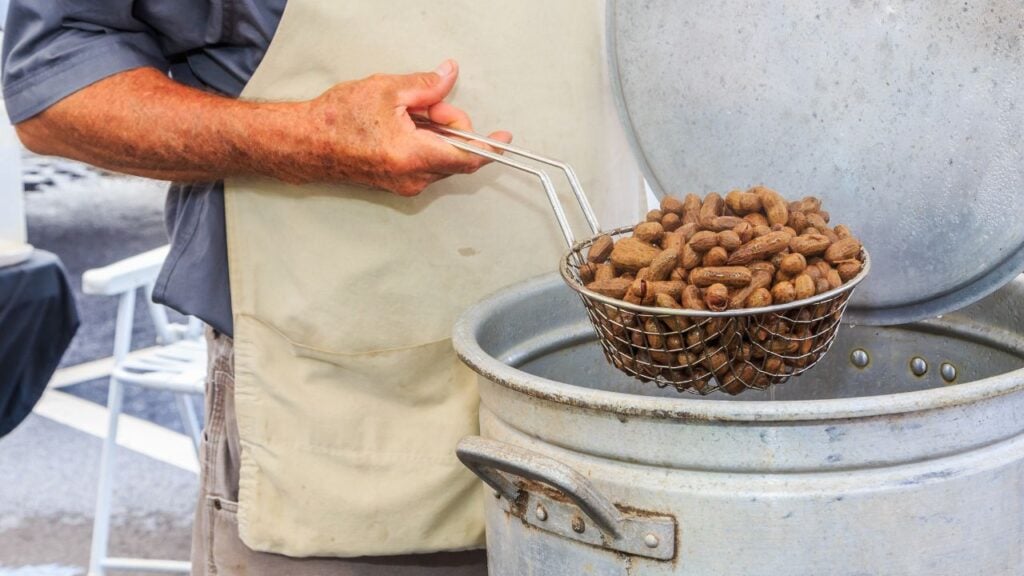
Georgia will feed you like family, right up until you order something the wrong way.
Then the whole table goes still, and somebody's grandmother leans over to fix your plate before you embarrass yourself further.
