
11 Hurricane Prep Mistakes Florida Newcomers Make Every June

Welcome to Florida, where the first of June doesn’t mean summer. It means hurricane season.
If you moved down here from somewhere that doesn’t get these storms, your instincts are about to lead you wrong in a few important ways.
The good news is that every one of these mistakes is easy to avoid once a Floridian sets you straight.
Consider this your crash course before the first cone shows up.
You’re Watching the Wind, Not the Water
The first thing a newcomer does is fixate on the category.
Is it a Cat 1, a Cat 3? How strong is the wind?
Here’s what the old-timers know: The wind gets the headlines, but the water does the killing.
According to the National Hurricane Center, around 9 out of 10 deaths in U.S. tropical storms and hurricanes come from water, the storm surge and flooding, not the wind.
Only about 1 in 10 comes from wind itself.
A so-called weak storm dumping two feet of rain or pushing a wall of seawater inland is plenty deadly.
So when you hear a storm’s “only” a Category 1, don’t let your guard down.
You Don’t Know Your Evacuation Zone
Ask a longtime Floridian what zone they’re in, and they’ll tell you without blinking.
Ask a newcomer, and you’ll get a blank stare.
Florida assigns every address an evacuation zone based on how likely it is to flood from storm surge. When officials call an evacuation, they call it by zone, not by city.
Look yours up now, on a calm sunny day, on your county’s website.
Don’t wait until the warnings are blaring.
If you’re in a low-lettered surge zone near the coast, you need a plan to get out.
If you’re high and dry inland, you may be safer staying put.
You’re Reading the Cone Wrong
That cone graphic on the news trips up every newcomer.
The cone shows the probable path of the storm’s center, nothing more. It doesn’t show how big the storm is or where the damage will land.
Nasty weather reaches far outside those lines.
And being outside the cone doesn’t mean you’re safe. Plenty of flooding and wind happen well away from that skinny center line.
Don’t get hypnotized by the spaghetti models either, all those colorful lines showing different forecasts.
Watch the official forecast and listen to your local emergency folks.
The cone is a guide, not a promise.
You Wait Until the Last Minute to Stock Up
By the time that cone includes your county, it’s too late to shop in peace.
The water’s gone from the shelves. The bread aisle looks robbed. The Publix deli has a line out the door because everybody had the same idea about grabbing Pub Subs for the storm.
The gas stations run dry. The plywood and batteries vanish.
Floridians who’ve been through it keep a stash ready when the season opens June 1, and they top off early when something’s brewing out in the Atlantic.
Beat the rush by a few days, and the whole thing gets a lot less stressful.
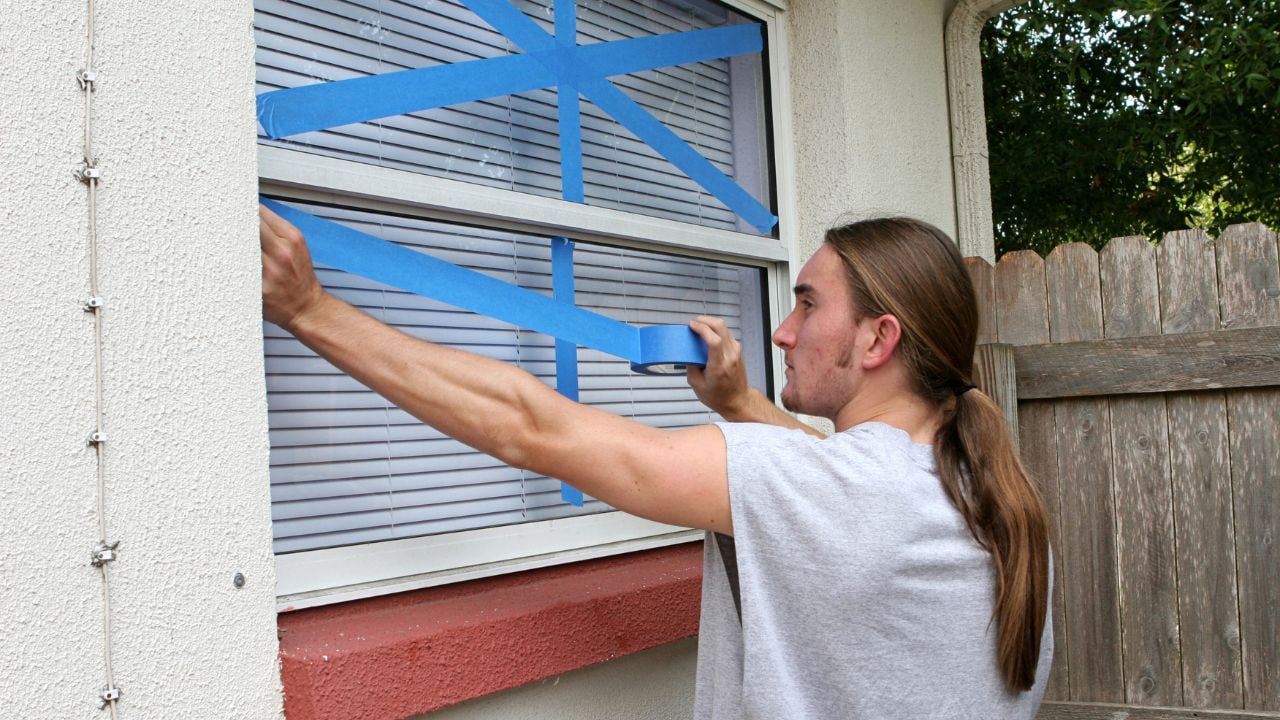
You Tape an X on Your Windows
Somewhere along the line, somebody decided that taping a big X across your windows protects them. It doesn’t.
The tape does nothing to stop a window from breaking, and it can turn a shattered pane into bigger, nastier shards of glass flying around.
What protects your windows is hurricane shutters, impact-rated glass, or plywood cut and mounted the right way.
If all you’ve got is a roll of painter’s tape, you’ve got decoration, not protection.
Skip the X and put your energy into real coverings for the glass.
You Leave the Lanai and Yard Full of Missiles
Out-of-towners don’t realize that anything loose in their yard becomes a flying weapon in hurricane winds.
Their patio furniture, the grill, potted plants, garbage cans, and the kid’s trampoline.
In a strong blow, all of it can sail through a window, yours or your neighbor’s.
Before a storm, bring it all inside, into the garage, or sink the lighter stuff in the pool to weigh it down.
Clear off that lanai and screened porch completely. A pool cage gives you shade, not armor, and screens won’t hold up to flying debris.
The rule of thumb: If it isn’t bolted down, it comes inside.
You Think Your Homeowners Insurance Covers Flooding
This is the assumption that wrecks people, and newcomers make it constantly.
Your homeowners policy covers wind damage. It doesn’t cover flooding or storm surge.
Those need a separate flood insurance policy, through the National Flood Insurance Program or a private insurer.
Here’s the part that stings: Flood insurance usually has a 30-day waiting period before it kicks in.
Buy it when a storm’s already named, and you’re out of luck.
The time to call your agent about flood coverage is now, not when the forecast turns ugly.
Storm surge counts as flooding, by the way, no matter how the water got to your living room.
You Run Your Generator in the Wrong Place
A generator is a lifesaver when the power’s out for a week. It’s also a killer when you use it wrong.
Running a generator inside the garage, the house, or too close to a window fills your home with carbon monoxide, a gas you can’t see or smell.
This is no small thing.
In the 2020 hurricane season, more people died from generator carbon monoxide poisoning than from storm surge.
Put your generator well away from the house, outdoors, never enclosed. And get one before the season, because they sell out the second a storm is on the way.
A carbon monoxide detector with battery backup is cheap protection.
You Fill the Tank and Hit the ATM Too Late
When a storm’s coming, gas stations often run dry and then lose power, so the pumps quit working altogether.
The same goes for cash.
When the power’s out, ATMs go dark, and card readers stop working.
Suddenly, that crumpled twenty in your wallet is like gold.
Floridians fill every vehicle and a few gas cans days ahead. They pull out cash while the machines still work. They refill prescriptions before the pharmacy closes up.
Do all of it early, before the run starts.
Showing up to a dead pump with an empty tank is a rookie move you only make once.
You Prep for the Storm and Forget the Week After
Newcomers brace for the wind and rain, then get blindsided by what comes next.
The storm passes in a day. The aftermath can last weeks.
No power, no air conditioning, in the thick of a Florida August.
That heat is its own danger. Post-storm heat and the cleanup that follows hurt and kill people every season, well after the skies clear.
So stock the things that get you through the days after.
Ice and coolers, food that needs no cooking, battery fans, water for drinking and flushing, a charged power bank, your medications.
The storm is the easy part. Surviving the powerless week behind it is where the veterans earn their stripes.
You Run When You Should Hide, and Hide When You Should Run
Floridians have a saying: Run from the water, hide from the wind.
It means you don’t flee the whole state for a storm that’s mainly a wind event if you’re not in a flood or surge zone.
Pack up and sit in bumper-to-bumper gridlock on I-75, run out of gas on the shoulder, and you’ve put yourself in more danger than the storm.
But if you’re in an evacuation zone and the order comes to leave, you go. That water is what the warning is about.
Know which situation you’re in.
Listen to your county’s emergency managers, not the panic online.
Get that one right, and you’re already ahead of half of Florida newcomers.
7 Florida Towns Retirees Are Moving To In 2026 (And Why They Stay)
Retirees have chased Florida sunshine for generations, but the map is shifting.
Here’s where retirees are landing across Florida and what keeps them from ever leaving.
7 Florida Towns Retirees Are Moving To In 2026 (And Why They Stay)
8 Florida Perks Nobody Tells You About Until You Turn 60
Too many Floridians approach 60 without knowing about the perks Florida offers seniors.
Don’t be among those finding out late.
