
11 Things Floridians Do in August Without Realizing It’s Not Normal Anywhere Else

A surfer paddles out at New Smyrna Beach every August morning past a stretch of water Volusia County has logged more recorded shark bites in than anywhere else on Earth.
The lineup still fills up by 7 a.m.
These are the daily trade-offs Floridians make every August that aren’t normal in most other parts of America.
1. Racing Lovebugs
Lovebugs first turned up in Florida’s Escambia County back in 1949.
The state has lived through two annual swarms ever since, one in the spring and one in August.
Floridians know to clean their cars fast after driving into a swarm of lovebugs.
Lovebug residue turns acidic once the sun bakes it onto hot paint, and a windshield or grille left coated for a day or two can etch the clear coat permanently.
Nobody wants that bill.
Car washes across the state see a rush of regulars every August who never have to explain what they’re scrubbing off.
The whole cycle starts over again each spring.
2. Starting School in August
Classrooms fill back up in the first half of August, weeks before most of the country buys a single pencil.
State law sets the earliest day a district can open, and for the 2026-27 year that date landed on Aug. 10.
Thirty-eight of Florida’s 67 counties picked that exact date.
That’s an early start.
Districts pack in enough instructional days to finish the fall semester before winter break, so summer effectively ends in Florida while kids in most other states still have three or four weeks left.
Football practice, band camp, and full class schedules all start in the thick of the year’s hottest stretch.
Nobody in Florida blinks at a first-day-of-school photo taken in 95-degree heat.
3. Switching to Turtle-Safe Lights
Once August rolls around, beach towns dim their lights every night, and it has nothing to do with the electric bill.
Sea turtle nesting season runs statewide from May through October.
It starts even earlier, in March, along six Atlantic Coast counties stretching from Brevard down through Broward.
Eggs laid in July and August still hatch by night in the thick of the season.
A hatchling instinctively crawls toward the brightest horizon it can find.
That’s supposed to be moonlight over open water, not a streetlamp.
That’s the wrong direction entirely.
A porch light, a hotel sign, or a phone flashlight can send a whole nest crawling toward a parking lot instead of the surf, so state law requires coastal communities to regulate beachfront lighting.
Many coastal counties switch to amber, turtle-safe bulbs and ask beachgoers to skip the flashlight after dark.
The switch stays flipped through October, until the last of the season’s nests hatch.
4. Checking the Red Tide Map
Gulf Coast beachgoers check one more thing before packing the cooler in August: The state’s red tide tracker.
Karenia brevis, the organism behind red tide, blooms most often in the warmer months and can turn a beach day into a coughing fit fast.
The Florida Fish and Wildlife Conservation Commission posts daily bloom maps, and Mote Marine Laboratory runs a separate, beach-by-beach conditions report on top of it.
Check first, pack second.
A bad bloom can close a beach to swimming, kill off fish by the thousands, and leave the air over the sand irritating enough to trigger a cough in anyone standing nearby.
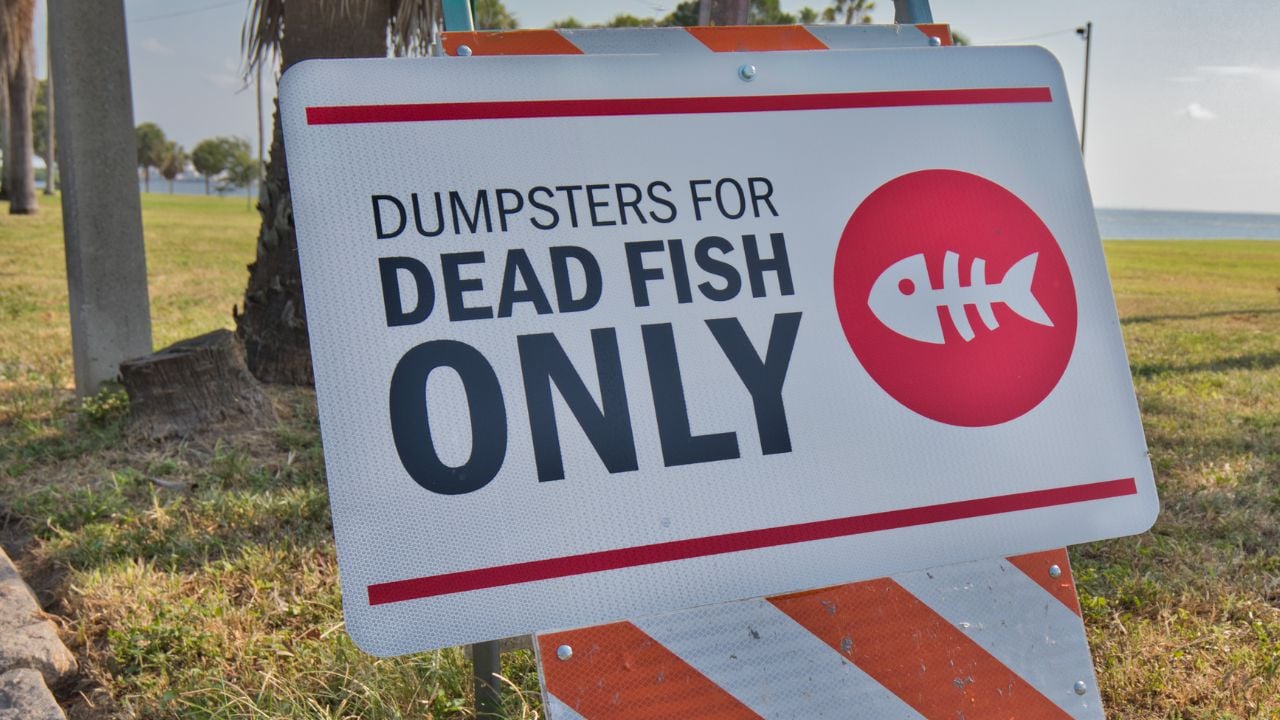
Some cities even have dumpsters specifically for discarding dead fish from the red tide.
Regulars check the map before every single trip, not just once a season.
5. Buying Flood Insurance, Always
Homeowners treat flood insurance as a given, even on a street that’s never flooded.
The National Flood Insurance Program counts more policies in Florida than any other state, holding roughly a third of every flood policy written nationwide, more than a million and a half of them.
No contest.
Every other state splits the rest.
Standard homeowners insurance never covers flood damage, in Florida or anywhere else, so residents add the flood policy as its own line item and budget for it every year.
A single named storm can push several feet of water through a neighborhood that sits nowhere near a river or the coast.
That’s why even inland buyers add the policy, not just the homeowners near a canal or the coast.
6. Eyeing the Retention Pond
Suburban retention ponds, the small manmade lakes tucked behind nearly every subdivision, draw the closest watch of the year every August.
Alligator eggs laid back in early summer hatch from mid-August through early September.
Mother gators stay within a few feet of the nest and treat anything that gets close as a threat.
She won’t wander far.
A dog off leash near the bank, or a kid chasing a ball into the shallows, can trigger aggression from a female guarding hatchlings, even in a pond barely bigger than a parking lot.
Longtime residents already scan the bank out of habit before letting a pet near the water.
Somebody who just moved from a state without alligators has no idea a drainage pond needs the same respect as a swamp.
7. Planning Around the Afternoon Storm
A daily storm pattern sets the schedule locals plan around without ever writing it down.
Warm air rolls off Florida’s coastlines from both sides and collides somewhere over the interior most afternoons all summer, building a thunderstorm almost daily between about 2 and 6 p.m.
The stretch between Tampa and Orlando gets hit hardest, so often that meteorologists call it Lightning Alley, the most lightning-dense corridor in the country.
Errands happen before noon.
Tee times book up at dawn, pool days end by early afternoon, and many Floridians unplug a computer or step out of the shower the moment thunder rolls in, since Florida leads the nation in lightning deaths.
By 6 p.m. the sky clears, and the rest of the evening belongs to whoever waited it out.
8. Swimming the Shark Capital
New Smyrna Beach carries a nickname most towns would run from: Shark bite capital of the world.
Volusia County has logged more recorded shark bites than anywhere else on Earth, several hundred since 1882, and still averages only about half a dozen to nine bites a year.
Nobody’s died from a bite.
The inlet’s murky water and heavy baitfish traffic put surfers and sharks in the same few feet of water constantly, and many bites turn out to be a shark grabbing an ankle it mistook for a fish.
Surfers keep paddling out anyway, board to board with a fish most of the country pays an aquarium to see.
A visitor hears the nickname and pictures a horror movie.
A local hears it and grabs a board.
9. Filming the Waterspouts
The Keys turn into the waterspout capital of the world every summer, and August sits right in the middle of the season.
Key West sees somewhere between 100 and 500 a year, most forming within about 35 nautical miles of town between May and September.
A waterspout is a tornado over water, spinning up fast along the same sea-breeze boundary that fuels the afternoon storms.
No panic required.
Locals grab a phone instead of a shelter.
Charter captains and dock regulars treat a distant funnel as a photo opportunity, not an emergency, since many stay offshore and fade out before ever reaching land.
A weak waterspout that does wander ashore can still snap patio umbrellas and rattle a boat in its slip, so nobody stands directly underneath.
Tourists who spot their first waterspout tend to call 911.
Psst! How much do you know about Florida’s history and geography? Take our quiz and see if you can ace it.
Quiz
Sunshine State IQ
Answer these questions on Florida history, geography, and hurricane season firsts. We bet you can’t get them all right. Prove us wrong?
Florida’s deadliest disaster on record killed more than 2,500 people in 1928 near which lake?
10. Paying a Percent Deductible
Percentage-based deductibles put homeowners insurance on different math than a policy almost anywhere else in the country.
Most home insurance deductibles are a flat dollar figure, the same $1,000 or $2,500 whether the claim is a cracked window or a collapsed roof.
Florida requires insurers to also offer a hurricane deductible priced as a percentage of the home's insured value, usually 2%, 5%, or 10%.
On a $400,000 house, a 5% hurricane deductible runs $20,000 out of pocket before the rest of the coverage kicks in.
That's a shock.
Homeowners pick the percentage when they buy the policy, trading a lower monthly premium for a bigger bill if a storm hits.
Many homeowners gamble on the lower percentage's cheaper premium anyway, betting the next storm skips their block.
11. Dodging the Spray Truck
A mosquito control truck rumbles down the street at dusk most nights in August, a soundtrack most of the country has never heard.
More than 40 mosquito control programs operate statewide, and many run truck-mounted foggers through neighborhoods on a set schedule all summer.
Residents know the routine.
Windows shut, pets inside, bikes off the sidewalk, all before the truck turns onto the block.
The fog knocks down adult mosquitoes carrying everything from dog heartworm to rarer mosquito-borne illness, and many districts post the spray schedule online so nobody's caught off guard mid-cookout.
Kids in some neighborhoods used to chase the truck through the mist before anyone explained what was in it.
Now most residents just glance at the district's online schedule and decide whether the porch furniture needs to come in first.
11 Things Floridians Stay Calm About in Hurricane Season That Terrify Everyone Else
A hurricane in the forecast sends most tourists straight to their suitcase.
It sends Floridians reaching for a second cup of coffee instead, calm about the exact things that leave visitors white-knuckled.
11 Things Floridians Stay Calm About in Hurricane Season That Terrify Everyone Else
9 Underrated Florida Day Trips Locals Take All Summer

Florida's best day trips skip the mouse-ear logo and the velvet rope entirely.
They run down a two-lane road to a spring or a roadside curiosity that never made it onto a single billboard.
