
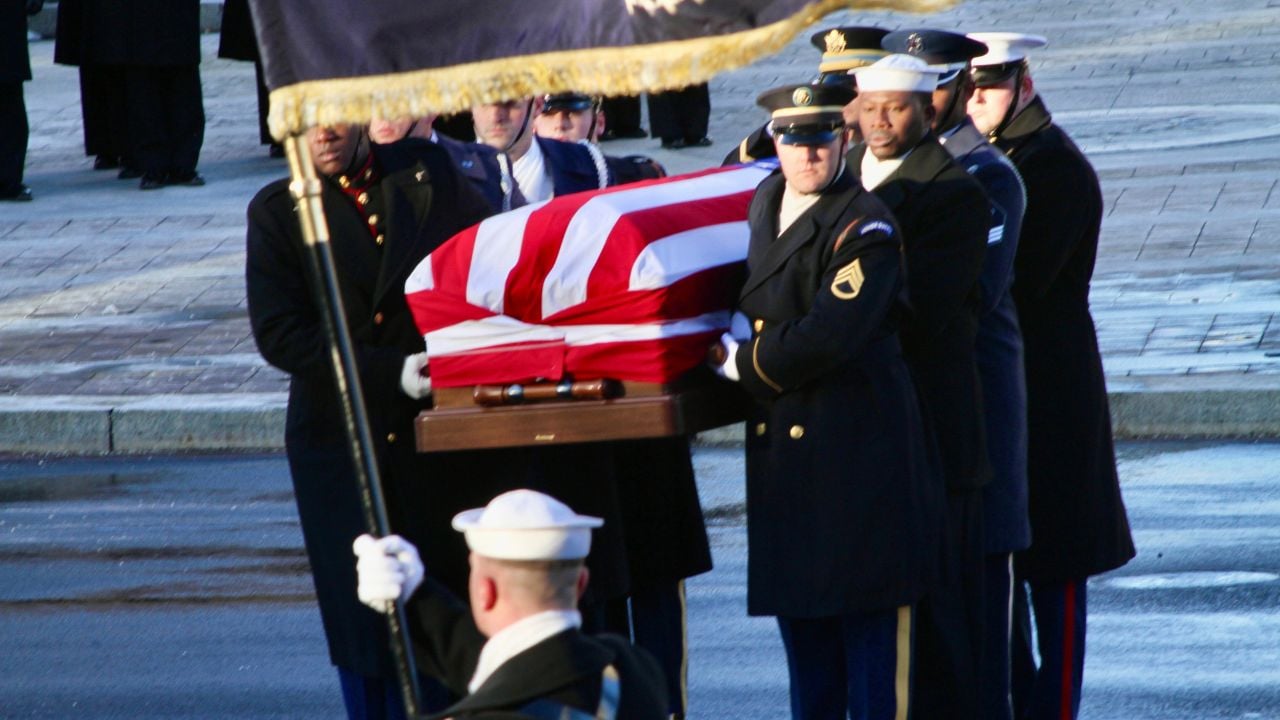
11 Things That Happen When a President Dies. Do You Know the Process, Pennsylvanians?

Forty U.S. presidents have died. Eight of them died in office.
Each death triggers a sequence of national protocols that have been refined over almost 200 years, starting with William Henry Harrison in 1841 and most recently honed during the state funeral of Jimmy Carter in January 2025.
Here are 11 things that happen when a U.S. president dies.
How much of the process are you familiar with, Pennsylvanians?
The Vice President Becomes President Immediately
If a sitting president dies, the Vice President becomes President the second the death is confirmed.
This isn’t a recommendation or a ceremony. It’s constitutional law under the 25th Amendment, Section 1.
The Vice President doesn’t have to wait for a swearing-in to inherit the powers and duties of the office. The transfer happens automatically.
The new president takes the oath of office as soon as possible after, but the legal transition is instantaneous.
Lyndon Johnson was sworn in aboard Air Force One in 1963, just hours after Kennedy’s assassination.
The country doesn’t go a single second without a president.
The President’s Death Triggers a Presidential Proclamation
The sitting president, whether the newly sworn-in successor or a current incumbent reacting to a former president’s death, issues an official proclamation announcing the death.
The proclamation sets the tone for what follows.
It typically orders all U.S. flags on federal buildings, military installations, and U.S. embassies worldwide to fly at half-staff for 30 days.
It authorizes the closure of federal offices on the funeral day. It declares a National Day of Mourning.
When Jimmy Carter died on December 29, 2024, President Biden issued the proclamation within hours.
The 30-day half-staff tradition dates to the formalization in 1969 after Dwight Eisenhower’s death.
A National Day of Mourning Gets Declared
The president declares one specific day, usually the day of the funeral, as a National Day of Mourning.
Federal offices close. Federal employees get the day off, treated like a federal holiday. The stock markets often close. Banks, federal courts, and post offices shut down.
For Carter’s death, the National Day of Mourning fell on January 9, 2025, the day of his funeral at Washington National Cathedral.
The country effectively pauses for one day to mark the loss.
This tradition was formalized in 1969 after Eisenhower’s death, when Nixon declared the funeral day a National Day of Mourning and closed all federal departments.
The Body Travels by Special Air Mission
The military, specifically the 89th Airlift Wing at Joint Base Andrews, handles the transport of the casket.
The aircraft used is typically one of the two Boeing VC-25 jets that normally serve as Air Force One when a sitting president is aboard.
Here’s the protocol detail most Americans don’t know: When a deceased president’s body is on the plane, the aircraft isn’t called Air Force One.
That call sign is reserved exclusively for any U.S. Air Force aircraft carrying a sitting, living president.
Instead, the flight gets a Special Air Mission designation.
Carter’s body flew aboard Special Air Mission 39, named for his presidential number.
The Casket Is Carried by a Caisson and Horses
Six horses pull the caisson, with three saddled riders, and a separate riderless horse called a caparisoned horse follows behind.
The caparisoned horse carries a pair of boots reversed in the stirrups.
Abraham Lincoln was the first U.S. president officially honored with a caparisoned horse at his 1865 funeral. Every state funeral since has continued the tradition.
The empty boots facing backwards symbolize a fallen leader looking back at his troops one last time.
The image is one of the most striking visuals in any state funeral.
For Carter’s funeral, the caisson moved his casket from the U.S. Navy Memorial to the U.S. Capitol.
The President Lies in State in the Capitol Rotunda
The casket sits in the U.S. Capitol Rotunda for public viewing, typically for 24 to 48 hours.
This is called “lying in state,” and it requires a concurrent resolution agreed to by both the House and the Senate, since the Rotunda is jointly controlled by both chambers.
Twelve presidents lye in state in the Rotunda before Carter, dating back to Lincoln in 1865, who was the first.
Members of the public line up for hours, sometimes overnight, to walk past the casket and pay respects.
The casket rests on the Lincoln Catafalque, the same wooden platform built for Lincoln’s body in 1865 and used for nearly every president since.
The military honor guard stands watch around the clock for the entire lying-in-state period.
A National Funeral Is Held at the Washington National Cathedral
The national funeral service almost always takes place at the Washington National Cathedral in northwest Washington, DC.
The event is part religious service, part state ceremony, and part public spectacle.
Current and former presidents attend, along with foreign heads of state, royalty, members of Congress, the Supreme Court, and family.
The seating follows a strict diplomatic protocol established in 1908 during the Roosevelt administration.
The State Department’s Order of Precedence governs who sits where.
For Carter’s funeral on January 9, 2025, every living former president attended, along with the sitting president and vice president.
The cathedral closes the surrounding neighborhood for days during preparations and security.
Members of Every Branch of Government Attend the Lying in State and Funeral
The funeral and lying-in-state period draw the most powerful figures in the U.S. government into one room.
The Supreme Court justices attend, often in full robes. Cabinet members attend. The Joint Chiefs of Staff attend in full military dress.
The Sergeant at Arms of the Senate and the House issues formal guidance to members on attendance, dress code, and seating. For Carter’s funeral, this guidance was distributed on January 2, 2025.
Foreign delegations arrive from dozens of countries. The protocol office at the State Department handles their travel, security, and seating.
It’s one of the few moments in American politics where every branch of government and most of the world’s heads of state are physically in the same room.
Military Honors Include 21-Gun Salutes and Flyovers
The military honors at a presidential funeral are some of the most elaborate ceremonial events the U.S. armed forces conduct.
The day after a president dies, military guards fire rifle salutes every 30 minutes from sunrise to sunset.
On the funeral day itself, military units fire a 21-gun salute beginning at noon and a 50-gun salute, one for every state, when the flag is lowered.
A U.S. Air Force flyover takes place during the funeral procession.
For Lyndon Johnson’s funeral in 1973, the Air Force performed a flyover during the Capitol procession. The same has happened for Reagan, Ford, George H.W. Bush, and Carter.
The bugle plays “Taps” at the final committal service.
The Body Goes to the Presidential Library or Hometown for Burial
After the national funeral, the casket travels to the president’s final resting place.
Most modern presidents choose to be buried at their presidential library or in their home state.
Reagan was buried at the Reagan Library in Simi Valley, California.
Ford was buried at the Gerald R. Ford Presidential Museum in Grand Rapids, Michigan.
George H.W. Bush was buried at the Bush Library in College Station, Texas.
Carter was buried at his home in Plains, Georgia.
Two presidents are buried at Arlington National Cemetery, both because of their military service. William Howard Taft (a Chief Justice as well) and John F. Kennedy.
Nixon broke tradition entirely and declined a state funeral in 1994. His family held a private ceremony at the Nixon Presidential Library, citing concerns about Watergate dominating the coverage.
The Country Pauses for One Day, Then Moves On
The state funeral ends. The flags stay at half-staff for the full 30 days. The library archives open, and the country slowly returns to normal.
In the weeks that follow, the new president (if a sitting president died) settles into the role. The presidential library plans permanent exhibits on the deceased president’s life and tenure.
Books get written. Documentaries get made.
The Cabinet is sworn in or stays in place.
The vice presidency, if vacated when a sitting president dies, gets filled through nomination and Senate confirmation under the 25th Amendment, Section 2.
For a former president, the transition is largely ceremonial. For a sitting president, the country has a new leader in place by the time the funeral ends.
Life moves forward, but the imprint of the state funeral and the 30-day mourning period stays in the national memory for decades.
10 Things U.S. Presidents Have to Pay for on Their Own That Americans Are Clueless About
Living at 1600 Pennsylvania Avenue has obvious perks.
But the president of the United States still receives a monthly bill from the White House usher’s office, and what’s on that bill catches many Americans off guard.
10 Things U.S. Presidents Have to Pay for on Their Own That Americans Are Clueless About
13 Government Benefits You May Qualify for Without Knowing

Federal and state benefit programs are notoriously bad at promoting what they offer.
These are the government benefits that many Americans qualify for without even realizing it.
