

11 Things That Only Make Sense If You Grew Up in Kentucky

In recent years, Kentucky governors have signed off on 4,000 to 6,000 new Colonel commissions a year.
Plenty of the people holding one never bring it up.
That’s the pattern with a lot of what Kentucky hands its kids. Nobody explains it, and nobody has to.
These are the things that only make sense if you grew up in Kentucky.
1. Ale-8-One
Ale-8-One has been bottled at the same plant in Winchester, Kentucky, since 1926, when a bottler named G.L. Wainscott ran a naming contest just to settle what to call his new soda.
Nobody outside the region grows up drinking it.
That’s by design.
The ginger soda with a hint of citrus still sells mostly in Kentucky and the states that touch it.
Kids don’t realize that until college, when a gas station two states over doesn’t carry it.
2. Hot Brown
A Kentucky diner treats the Hot Brown like anything else on the menu: Turkey and bacon buried under cheese sauce, ordered open-faced with a fork and knife instead of hands.
Natives order it on a random Wednesday.
Nobody explains it first.
Out-of-state visitors expect a hotel specialty and are surprised to find it two hours from Louisville, ringing up next to a burger basket.
Chef Fred Schmidt invented the open-faced sandwich at Louisville’s Brown Hotel in 1926, feeding dancers who wanted more than the usual midnight ham and eggs.
Kids who grow up ordering it that way never think to ask why a hotel invented their weeknight dinner.
3. Being a Kentucky Colonel
Kentucky Colonels never served a day in uniform to earn the title.
Any sitting governor can commission them, no military background required.
Recent governors have signed off on 4,000 to 6,000 new Colonels a year.
Your Sunday school teacher might hold the title.
So might the guy who runs the hardware store.
Harland Sanders picked up a Kentucky Colonel commission from Governor Lawrence Wetherby in 1955, and it wasn’t even his first commission.
What a Kentucky Colonel Commission Doesn’t Include
A Kentucky Colonel commission carries no rank, no salary, and no chain of command to report to.
Nobody can nominate themselves, either.
A friend, an employer, or a state official has to submit the request through the governor’s office.
The review takes four to six weeks before the office approves a name.
4. Kentucky’s 120 Counties
Kentucky counts 120 counties, the third-most of any state behind only Texas and Georgia.
They average out to the second-smallest size in the country, trailing only Rhode Island.
County identity runs deeper than the map alone explains.
Many Kentuckians introduce themselves by county before they ever name a town.
School zones and court dockets run by county instead of city limits.
So do sheriff’s races.
5. NTI Days Instead of Snow Days
Kentucky schools started swapping snow days for NTI (non-traditional instruction) days back in a 2011 pilot program, years before the rest of the country knew what remote learning was.
It means schoolwork done from home instead of a day off.
Districts can use up to ten of them a year under state approval.
No snow gear required, just a laptop or a packet.
It still counts as school.
Kids growing up in Kentucky settled into the routine years before the 2020 pandemic made it familiar everywhere else.
6. Corvette Plant in Bowling Green
Bowling Green, Kentucky has built every Chevrolet Corvette sold anywhere since 1981, all off the same single assembly line.
One city, one assembly plant, every single car.
Kids who grow up near Bowling Green take that as a given, the same way other towns have a paper mill or a shipyard down the road.
Locals grow up knowing the plant runs public tours of the line, the same casual field-trip destination another town might have with a museum instead.
Outsiders still guess Detroit.
They’re off by more than four decades.
Someone who grew up near the plant never has to guess.
Psst! How much do you know about Kentucky? Take our quiz and see how many you can get right.
Quiz
Kentucky IQ
These are Kentucky facts even lifelong residents miss. We bet you can’t get them all right. Prove us wrong?
In February 2014, a sinkhole opened up inside a Kentucky museum and swallowed eight of what?
7. Bordering Seven Other States
Kentucky touches seven other states, the same count as Colorado.
Only Missouri and Tennessee border more, with eight apiece.
A short drive out of many Kentucky towns crosses a state line before lunch.
Growing up near one of those lines means a trip to Ohio, Indiana, or Tennessee stops feeling like leaving home at all.
Welcome signs become wallpaper.
8. Wet, Dry, and Moist Counties
Kentucky's counties split into wet, dry, and moist, and that split decides whether the store down the road can sell beer at all.
About 39 counties still ban retail alcohol sales outright.
That number keeps shrinking every time a county votes again.
A moist county means the county stays dry overall while one city, restaurant, or distillery inside it has voted itself wet on its own.
Many Kentuckians have driven ten extra minutes to a wet town without thinking twice about why.
Explaining the map to a visitor takes longer than the drive does.
Natives don't look it up.
They just know which town to drive to.
9. Fried Chicken's Actual Hometown
Kentucky Fried Chicken isn't a marketing name borrowed for flavor.
It's literal.
Harland Sanders first served his fried chicken from a roadside restaurant he opened in Corbin in 1937.
A fire destroyed that original building two years later, and Sanders rebuilt it, reopening the restaurant and motel on July 4, 1940.
The 1940 building is the one still standing today, restored and listed on the National Register of Historic Places.
Many kids end up there on a school trip at some point.
10. Sweet Sixteen
The Sweet Sixteen is Kentucky's state basketball tournament, run as a single class with no separate bracket for small schools and big ones.
Every public high school in the state chases the same trophy, regardless of enrollment.
Kentucky and Delaware are, for now, the only two states still running it that way.
Delaware's athletic association voted to end that format starting with the 2027-28 season, which will leave Kentucky as the country's lone holdout.
Everywhere else split into classes by school size decades ago.
Kentucky never did.
The Sweet Sixteen means a small county school can end up playing a school ten times its size for the state title.
Small-school kids grow up believing they can beat anybody because sometimes they do.
11. Kentucky's Two Time Zones
Kentucky splits between two time zones, and the line runs right through the middle of the state.
Louisville and Lexington run on Eastern time.
Paducah and Bowling Green run an hour behind on Central.
Calling family on the other side of the state means doing the math first.
It confuses out-of-state relatives.
Natives learn early which relatives to call an hour later.
Cross the line without checking your phone, and you'll show up to a family dinner an hour off, one way or the other.
9 Things That Change the Second You Cross From Ohio Into Kentucky
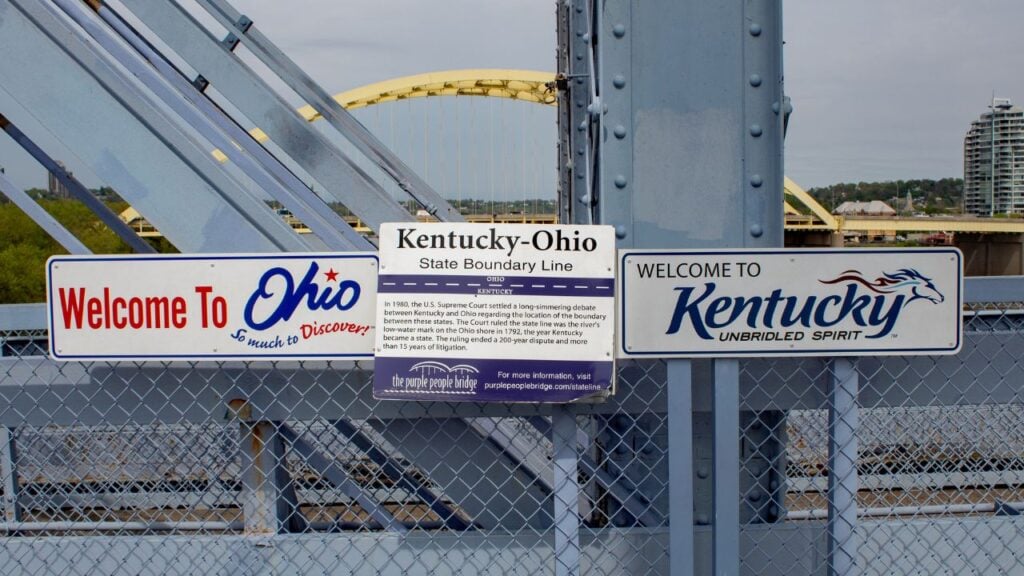
Drive across the Roebling Suspension Bridge from Cincinnati, and Covington, Kentucky appears on the other side, looking like nothing at all has changed.
The tax on your receipt, the price at the pump, and what's riding in your glovebox all became different the moment your tires crossed the state line.
9 Things That Change the Second You Cross From Ohio Into Kentucky
