
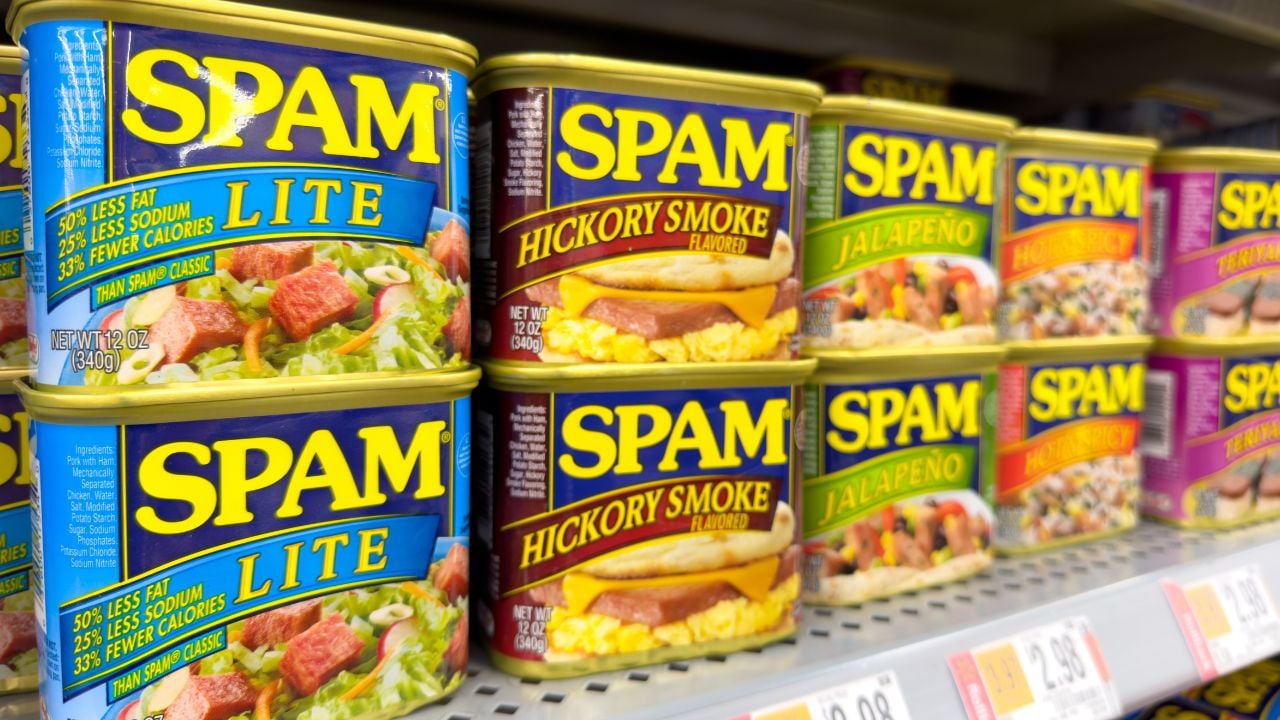
12 Spam Facts That Make Minnesotans Proud and Out-of-Staters Confused

Spam gets more than its share of jokes in much of the United States.
But Minnesotans have a soft spot for it, and the story behind that little can goes well beyond the punchlines.
Here are some Spam facts that could turn a doubter into a fan.
1. Free Admission at the Spam Museum
The Spam Museum is in downtown Austin, Minnesota.
Admission is free, and the museum’s website lists hours of 10 a.m. to 4 p.m. every day.
If you go, photos on the site show a timeline, a Provision Market exhibit and a Spamalot exhibit.
Other photos show a Sir Canalot statue and a display that asks how many cans tall you are.
George A. Hormel founded his company in Austin in 1891.
Many Minnesotans are proud of the museum, and some out-of-staters leave with more questions than they came with.
2. Six Ingredients
Spam Classic has six ingredients on its label.
Those are pork with ham, salt, water, modified potato starch, sugar and sodium nitrite.
Check a can of Spam Classic, and you’ll find pork with ham listed first.
3. Hawaii’s Reported 7 Million Cans
In 2015, Hormel said that people in Hawaii ate more Spam than any other state, at nearly 7 million cans a year.
A 2018 New York Times article put Hawaii’s average at about five cans per person.
Spam in Hawaii goes back to World War II, when Hormel started shipping it to military personnel stationed in the islands.
Spam didn’t need refrigeration, so it could reach the islands without spoiling.
Spam musubi is a snack of Spam, rice and seaweed.
If you visit, many McDonald’s restaurants in Hawaii serve Spam breakfast platters.
Breakfast is covered.
4. Guam’s Estimated 16 Cans
Guam residents eat more than 16 cans of Spam per person each year, by one estimate.
Some Guam families buy Spam by the case of 24 cans.
Depending on how you prepare it, one can is enough to feed two people or a family of 10.
In 1997, after Super Typhoon Paka, Hormel donated 40,000 cans of Spam to be distributed by the Salvation Army.
5. $100 Naming Contest
Spam got its name from a $100 offer Jay Hormel made at a New Year’s Eve party in 1936.
Kenneth Daigneau, brother of a Hormel vice president, came up with the name Spam.
If you’ve heard the name comes from spiced ham, Hormel’s FAQ calls that one popular belief.
Only a small group of former executives knows the answer.
6. Lend-Lease Shipments
Under Lend-Lease, a wartime aid program, Great Britain and the Soviet Union received shipments of Spam.
A 2018 New York Times article says cooking the meat inside the can increased its shelf life and made it useful in battle.
Hormel’s Lend-Lease Output
Spam’s Lend-Lease shipments followed the Lend-Lease Act, which became law on March 11, 1941.
Hormel says it shipped up to 15 million cans of meat per week overseas after the act passed.
7. Eisenhower’s Letter
Former President Eisenhower wrote Hormel a letter about Spam in 1966, and you can still read it today.
The letter marked Hormel’s 75th anniversary.
He wrote that he felt a certain kinship with the company.
He had eaten his share of Spam along with millions of other soldiers.
As a former commander in chief, he could still forgive Hormel’s only sin.
That sin was sending the troops so much Spam.
Troops were seemingly served Spam three times a day, and they got thoroughly sick of it.
In 1945, Jay Hormel told The New Yorker that he kept a file of abusive letters from troops.
8. Korea’s Army Base Stew
Budae-jjigae, which means army base stew in Korean, includes Spam.
If you make it at home, one version adds ham, sausage, baked beans, kimchi and gochujang.
A 2023 Smithsonian photo shows containers of Spam being processed at a factory in Jincheon, South Korea.
In South Korea, Spam gift sets are popular during the annual harvest festival.
9. Okinawa’s Cookbook
How many ways to cook with Spam could you name?
Okinawa Hormel published a cookbook, Love! Spam, with 100 different recipes.
Okinawans have worked Spam into local dishes such as chanpuru, a stir-fry, and poku tamago, an egg and pork dish.
10. Monty Python Sketch
A 1970 Monty Python sketch about Spam is believed to have inspired the first use of the word “spam” for unwanted messages.
That first use came on an internet forum in 1993.
If your email has a spam folder, its name likely traces back to that sketch.
The Oxford English Dictionary added the lowercase word in 1998.
11. Pumpkin Spice Spam
On September 23, 2019, Hormel launched a limited edition Spam Pumpkin Spice.
A two-pack cost $8.98 on Walmart.com and Spam.com.
It sold out in less than seven hours, so if you wanted one, your window was short.
Psst! How much do you know about canned food? Take our quiz and see if you can ace it.
Quiz
Canned Food IQ
Answer these questions on canned food history, Green Giant and wartime rationing. We bet you can’t get them all right. Prove us wrong?
Before the can opener, what tool did early can makers recommend for opening their cans?
12. Billionth Can
Hormel sold its billionth can of Spam in 1959.
As of 2023, it had sold more than 9 billion cans.
Hormel's FAQ lists over a dozen varieties sold in more than 50 countries, so you may spot Spam on your travels.
3 Coborn's Deals Minnesotans Only Get If They Order Ahead
Minnesota shoppers have a few ways to save at Coborn's before they ever walk in.
It all starts with ordering ahead.
3 Coborn's Deals Minnesotans Only Get If They Order Ahead
7 Ways Minnesota Treats High School Hockey Differently Than the Rest of the Country

Minnesota takes high school hockey seriously, and the state tournament shows it.
Hockey fans will want the whole list.
7 Ways Minnesota Treats High School Hockey Differently Than the Rest of the Country
