

12 Things Idahoans Are Tired of Explaining to Out-of-Staters

Visit Idaho and say “Moscow” like the Russian capital, and you’ll probably get corrected before you finish the sentence.
Spend more time there and you’ll hear about reactors in the desert, two time zones and a federal government that administers most of the state’s land.
Here’s what Idahoans are tired of explaining, so you won’t be the one asking next time.
1. The Potato Stereotype
Many locals hear about potatoes first when they say where they live.
Idaho ranks first nationally in potatoes, barley, peppermint oil, alfalfa hay, and trout.
Sugar beets and hops rank second.
If potatoes are the first thing you think of, the dairy numbers tell a different story.
U.S. Department of Agriculture data put Idaho’s 2025 milk production at about $3.8 billion, against about $1.1 billion for potatoes.
That’s more than triple the potato crop.
2. Where ‘Idaho’ Came From
Idaho isn’t a Native American word, despite the theory that it means “gem of the mountains” or “sunrise.”
Boise State Public Radio traces the name to George Willing, a Philadelphia-born doctor who won an election as a delegate from the territory that later became Colorado.
The results were never certified, and he never took office.
Willing’s idea for naming the territory Idaho reached the U.S. Senate in 1860.
Idaho came out of that bill at the last minute, and the area became Colorado Territory instead.
Idaho Territory broke off from Washington Territory just a few years later, and its officials embraced the name.
If someone tells you Idaho means gem of the mountains, you can correct them.
It’s a made-up word.
3. Boise’s Pronunciation
The Idaho Statesman reported in 2022 that people not from Boise tend to say BOY-zee, while many locals favor BOY-see.
The name is French for “wooded,” and it appears to refer to the trees that lined the Boise River.
Today’s pronunciation has little connection to the original French word.
How you say Boise is often used to tell who’s local and who’s a recent arrival.
4. Two Time Zones
Department of Transportation rules put Idaho in two time zones, Mountain and Pacific.
The dividing line starts at the Canadian border and runs south along the Montana border.
It turns southwest along the line between Idaho County and Lemhi County, then follows the Salmon River west to the Oregon border.
Pacific time covers the northern part of the state, and Mountain time covers the southern part.
If you drive south from Canada to Nevada, you’ll switch from Pacific time to Mountain time.
5. Pronouncing Moscow and Pend Oreille
Moscow, in Latah County, is pronounced MOSS-koe, but out-of-staters often say it like the Russian capital.
Lake Pend Oreille is pronounced pond-oh-RAY.
The French name means “hangs from ears.”
There’s also a town called Ponderay that’s pronounced the same way.
If you can say Ponderay, you can say Pend Oreille.
More Idaho Place Names
Pocatello, in Bannock County, is pronounced poe-kuh-TELL-oh.
Kamiah, in Lewis County, is pronounced KAM-ee-eye.
Kooskia, in Idaho County, is pronounced KOOS-kee.
If you’re driving to Dubois, in Clark County, you’ll say DOO-boyss, even though the name began as a French surname.
6. Hells Canyon
Hells Canyon, on the Idaho-Oregon border, is deeper than the Grand Canyon.
The Grand Canyon reaches 6,000 feet from rim to river at its deepest.
Hells Canyon reaches a maximum depth of 7,900 feet, and Britannica calls it the deepest gorge on the North American continent.
Along 40 of its 125 miles, the canyon is more than a mile deep.
If you picture the Grand Canyon as the deepest canyon around, Idaho has a deeper one.
Psst! How much do you know about Idaho? Take our quiz and see if you can ace it.
Quiz
Idaho Trivia
Answer these questions on Idaho’s towns, symbols, and landmarks. Think you can get them all right?
Mackay, in Custer County, is pronounced how?
7. Craters of the Moon
Despite the name, Craters of the Moon National Monument and Preserve is a landscape of lava and sagebrush in southern Idaho.
Its Broken Top Flow came from the most recent volcanic eruption in Idaho, about 2,100 years ago.
Two lava tube caves, Indian Tunnel and Dewdrop Cave, open seasonally.
You need a free cave permit from the visitor center, and the permits are meant to protect bats from white-nose syndrome.
Taking rocks from the park is illegal.
8. Nuclear Reactors in the Desert
You'll find more than farmland in Idaho's desert.
Since 1949, Idaho National Laboratory has had 55 reactors built and operated on its 890-square-mile site.
The Department of Energy says one of Idaho's reactors, Experimental Breeder Reactor-I, became the first power plant to produce usable electricity through atomic fission.
It did that on December 20, 1951, and powered four 200-watt lightbulbs.
In 1955, another Idaho reactor, Borax-III, generated enough electricity to power the nearby town of Arco.
9. Shoshone Falls
Shoshone Falls, on the Snake River near Twin Falls in southern Idaho, has a 212-foot drop.
Niagara Falls measures 188 feet at the Horseshoe Falls and 190 feet at the American Falls.
If you're comparing the two, Shoshone Falls is taller than both.
Early settlers called it the Niagara of the West.
The falls have lost much of their volume because water upstream is diverted for irrigation.
10. State-Run Liquor Stores
Distilled spirits are sold only through state-operated liquor stores and contract retail stores authorized by the Idaho State Liquor Division.
If you want a bottle of whiskey, you'll buy it at one of those stores.
Bars and restaurants buy their spirits from the state's retail stores too.
Beer and wine are different.
The division doesn't oversee them, and private distributors handle them.
From 2015 through 2025, the division contributed nearly a billion dollars to the state, cities, and counties.
11. Population Growth
Idaho had 2,029,733 people on July 1, 2025, according to Census Bureau estimates.
If you last visited in the spring of 2020, Idaho had 190,610 more people by July 2025.
Idaho grew 1.4% between July 2024 and July 2025, against 0.5% for the nation.
Only South Carolina grew faster.
12. Public Lands
Idaho's land rises from 738 feet above sea level in Lewiston to 12,662 feet on Mount Borah.
Five federal agencies administer 61.9% of the state's acres, according to the Congressional Research Service's 2024 table.
If you pick a random acre of Idaho, it's more likely to be federal land than not.
The Bureau of Land Management manages nearly 12 million acres, nearly one-fourth of the state's land area.
The Frank Church-River of No Return Wilderness covers nearly 2.4 million acres, all in Idaho.
It's the largest contiguous unit of the National Wilderness Preservation System in the Lower 48.
9 Things That Only Make Sense to People Who Grew Up in Idaho
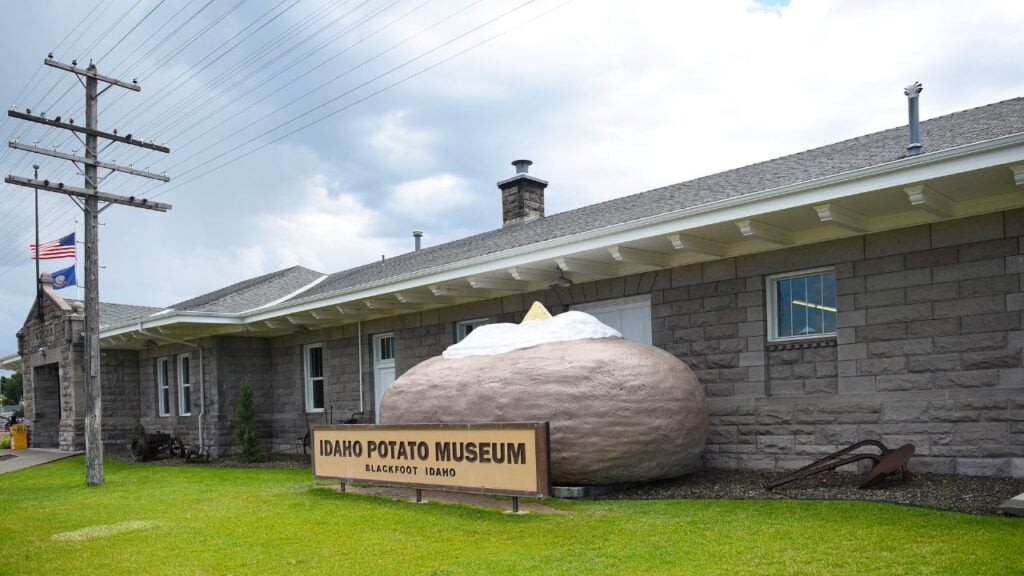
Tell someone from Idaho that the state has a seaport, and they probably won't blink.
Tell someone from almost anywhere else, and you'll get a very different reaction.
9 Things That Only Make Sense to People Who Grew Up in Idaho
9 Idaho Habits That Give Away Which Valley Someone Grew Up In
Nothing makes you notice a hometown habit faster than meeting someone who doesn't share it.
In Idaho, that person might have grown up just a few valleys away.
9 Idaho Habits That Give Away Which Valley Someone Grew Up In
