
12 Weather Events That Terrify Floridians (But No One Else)

There’s a saying in Florida that goes something like this: if it’s not trying to soak you, sting you, blow you over, or wash you away, it’s about to.
Florida is gorgeous. It also has more weird weather phenomena per square mile than just about anywhere in the country.
Some of what scares Floridians sounds normal to outsiders.
A cold front? Big deal.
A summer thunderstorm? Who cares.
But ask a Floridian about the cone of uncertainty or a tropical wave near Cape Verde, and watch their face.
The Cone of Uncertainty
To anyone who doesn’t live near the coast, a cone of uncertainty looks like a suggestion.
To a Floridian, it’s the worst chart on television.
The cone is the National Hurricane Center’s projection of where a storm’s center might travel over the next five days.
The wider the cone, the less certain forecasters are. When that cone shows up on the news with Florida tucked inside it, every grocery store in the state runs out of bottled water by sundown.
Outsiders think the cone tells you exactly where the hurricane is going.
It doesn’t.
The cone shows where the center could go, and the storm itself is much larger than the cone. So even being “outside the cone” doesn’t mean you’re safe.
A “Wobble” in the Track
When a meteorologist says a hurricane has “wobbled,” everyone outside Florida hears a cute weather word.
Floridians hear a potential death sentence for their home.
A wobble is when the eye of a hurricane shifts off its predicted path by a few miles.
That sounds harmless to outsiders. It isn’t.
A 30-mile wobble can be the difference between a Category 3 hitting Tampa and a Category 3 hitting Sarasota.
It can move the eye of the storm from one county to another in a matter of hours, and it can happen with almost no warning.
This is why Floridians don’t relax when they’re “not in the path.”
Hurricanes aren’t trains. They don’t follow tracks. They wobble, jog, stall, and sometimes pull a U-turn.
The whole state has watched a forecast that was supposedly coming for one city pivot at the last minute and crush a different one.
Nobody trusts the line.
A Tropical Wave off Africa
When a meteorologist says, “We’re tracking a tropical wave off the coast of Africa,” everyone north of Georgia tunes out.
Floridians pay attention.
Tropical waves are the seedlings that eventually become hurricanes.
Most fizzle out. Some grow into massive storms that take ten days to cross the Atlantic and slam into the Gulf Coast or the southeast coast.
Floridians have learned to watch them from the moment they leave the African coast, because by the time they’re a named storm, you’ve already lost a week of prep time.
Cape Verde, the chain of islands off West Africa, is basically the maternity ward for the worst hurricanes Florida has ever seen.
Hurricane Andrew, Hurricane Irma, and Hurricane Ian all started as little tropical waves rolling off that coast.
Most Americans don’t know where Cape Verde is. Most Floridians can point to it on a map.
Storm Surge
Ask anyone outside Florida what scares them about a hurricane, and they’ll say the wind. Ask a Floridian, and they’ll say storm surge.
Storm surge is the wall of ocean water that a hurricane pushes inland when it makes landfall.
It can rise 15 feet or higher in a matter of minutes.
It doesn’t care how strong your roof is. It comes through the front door and the back windows at the same time, with debris, sea creatures, and sometimes entire boats riding along.
Hurricane Ian killed more than 100 people in Florida in 2022, and most of those deaths came from storm surge, not wind.
The storm pushed a wall of water into Fort Myers Beach that swallowed homes whole.
When evacuation orders go out before a hurricane, it’s almost never strictly about the wind. It’s about the surge.
The wind will rip up your roof, but the surge will take your whole house.
The First Afternoon Thunderstorm of Summer
In most of the country, a thunderstorm is just weather.
In Florida, the first big afternoon thunderstorm of summer is the official start of six months of getting hammered every day at 3 p.m.
From late May through October, central and south Florida get daily thunderstorms that roll in like clockwork.
The east coast and west coast sea breezes collide over the middle of the state, and the result is an afternoon downpour with wind, hail, and enough lightning to power a small country.
The first one always sneaks up on people. One day it’s a regular sunny May afternoon, and the next day, there’s a wall of black clouds eating the sky from the west.
Tourists run for cover. Floridians do, too, but with the knowledge they’ll be doing so every day for the next many months of the rainy season.
Waterspouts Spinning Offshore
Picture a tornado, but on the water, and very close to the beach you’re sitting on.
That’s a waterspout, and Florida sees more of them than any other state in the country.
Waterspouts form off Florida’s coasts almost every summer day, especially around the Keys and the Gulf Coast.
Most are the “fair weather” variety, which are weaker and shorter-lived.
The other kind, called tornadic waterspouts, are tornadoes that formed over land and walked out over the water, or thunderstorm waterspouts that can pack winds over 100 mph.
A waterspout that stays over the water is mostly a problem for boats.
A waterspout that crosses onto land becomes a tornado, and that’s when things get serious for more people.
Florida has had waterspouts come ashore during summer storms and rip apart beachfront homes.
Out-of-towners see one and grab their phone for video. Floridians see one and pack up the cooler.
Red Tide
If you’ve never lived near a red tide, the name probably sounds like the title of a thriller novel.
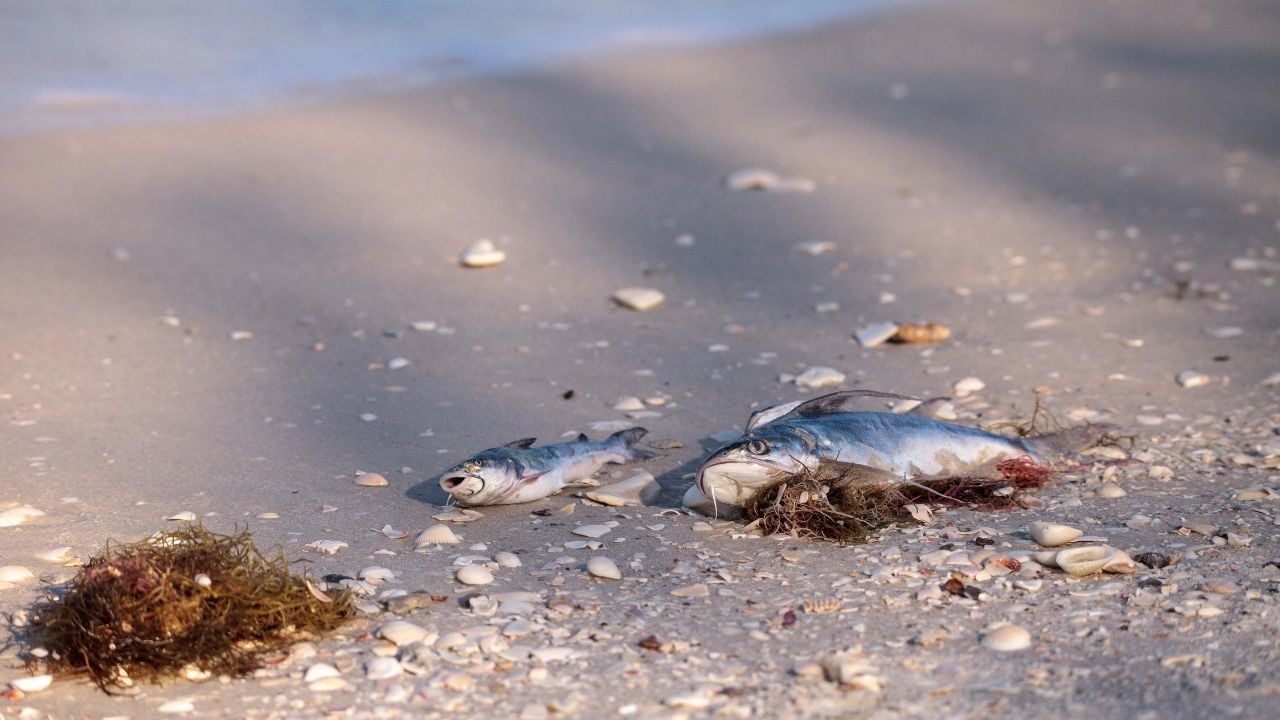
It’s actually an algae bloom that turns the water rust-colored and makes the air around the beach genuinely hard to breathe.
The culprit is Karenia brevis, an algae found in the Gulf of Mexico that produces a neurotoxin.
When the algae blooms in concentrations close to shore, the toxin gets carried by ocean breeze onto the beach, where it irritates eyes, throats, and lungs. People with asthma and respiratory issues can have severe reactions.
It also kills marine life by the thousands, leaving beaches lined with dead fish, sea turtles, and sometimes manatees and dolphins.
The smell is unforgettable, and the cleanup can take weeks.
Florida red tides have been documented since the 1840s, but they’ve gotten more frequent and more severe in recent decades.
Tourists from up north have been known to book a beach vacation, drive 18 hours, and arrive at a coastline that smells like a dumpster behind a seafood restaurant.
Sargassum Heading for Shore
In 2023, a 5,000-mile-wide patch of seaweed started drifting across the Atlantic toward Florida.
People in Iowa didn’t notice. People in Miami panicked.
Sargassum is a brown floating seaweed that exists naturally in the Atlantic Ocean.
The problem is that the bloom has been getting bigger, and when it washes ashore on Florida beaches, it piles up in mounds several feet thick.
As it rots, it releases hydrogen sulfide gas, which smells like rotten eggs and can cause respiratory problems for people nearby.
Beach towns spend millions of dollars each year trying to scoop the stuff up before it ruins tourist season.
Some hotels have stopped advertising certain weeks because they can’t predict when the seaweed will roll in.
It looks like brown shag carpet on the sand. It smells like a chemistry experiment gone wrong. And it can show up overnight.
A Cold Snap Below 40 Degrees
When the temperature drops to 38 degrees in Buffalo, nobody notices.
When it drops to 38 degrees in Miami, the National Weather Service issues a falling iguana warning.
This isn’t a joke. The Miami office of the NWS has issued official “falling iguana” alerts when temperatures dip into the low 40s, because the cold-blooded reptiles lose their grip on tree branches and tumble out of the canopy.
They look dead but usually walk away once they warm back up.
The bigger issue with a cold snap in Florida is that the entire state is built for heat.
Houses don’t have insulation. Pipes run through unheated attics. Tropical landscaping dies. Citrus farmers lose entire orchards in a single night.
A 40-degree morning in Naples is the equivalent of a snowstorm in Boston.
Everything stops.
King Tides and Sunny Day Flooding
In most of the country, flooding requires a storm.
In Miami and Fort Lauderdale, the streets can flood on a perfectly clear afternoon for seemingly no reason at all.
This is called sunny day flooding, and it happens during king tides, which are extra-high tides that occur a few times a year when the moon, sun, and Earth line up just right.
As sea levels rise, these tides have started reaching higher than they used to, and water now bubbles up through storm drains in coastal neighborhoods even on cloudless days.
You’ll see fish swimming down the street. Cars get stranded in standing water. Pelicans hang out in parking lots.
The whole thing looks completely normal to a Floridian and completely unhinged to anyone visiting from Kansas.
Some neighborhoods in South Florida flood multiple times a year now from king tides alone. The water always recedes.
It also always comes back.
A Hurricane That Starts With the Letter “I”
Floridians have a superstition about I-named hurricanes, and the data backs them up.
The letter I has had more retired hurricane names than any other letter in the alphabet, with 14 storms so deadly or destructive that the World Meteorological Organization pulled their names from the rotation forever.
Just look at the list: Irma, Ian, Ida, Ivan, Ike, Irene, Inez, Ingrid, Iris.
Every one of them caused massive damage, and many of them hit Florida directly.
Hurricane Irma in 2017 killed 129 people in the U.S. Hurricane Ian in 2022 killed more than 100 people in Florida alone.
There’s a reason this happens.
The ninth named storm of the season usually arrives around the peak of hurricane season, when ocean temperatures are at their warmest and storms can grow into monsters.
So, when Floridians see “I” coming up on the name list in late August, the entire state collectively holds its breath.
The next time you hear about a tropical storm getting an “I” name, watch what Floridians do. They start filling their gas tanks before the storm even has a track.
Lightning From a Regular Afternoon Storm
Most of the country sees lightning a few times a year. Florida sees lightning the way other states see rain.
It’s just there, all summer long, every afternoon, sometimes for hours.
Florida has been called the lightning capital of the United States for decades, and while a 2025 study handed that title to Oklahoma based on flash density, Florida still leads the entire country in lightning fatalities.
Since 2006, Florida has had 97 lightning deaths, more than double the next state on the list.
The reason is simple: the same daily thunderstorms that produce all that lightning also happen during the busiest beach, fishing, and outdoor activity hours.
A regular afternoon storm in Florida can throw down hundreds of cloud-to-ground strikes in a single hour.
The local saying is “when thunder roars, go indoors,” and Floridians take it seriously.
If you see Floridians clearing out of a pool the second they hear distant thunder, that’s why.
They’ve all known someone or known someone who knew someone.
4 Florida Conspiracy Theories That Are Just That: Conspiracies

Florida is known for its sunshine and beaches, but, like any state, it’s also a hotspot for some seriously wild conspiracy theories.
These are some of the wildest tall tales and why they’re not true.
4 Florida Conspiracy Theories That Are Just That: Conspiracies
24 Facts No One Knows About Florida

Ask any American to describe Florida, and their responses will vary according to their experience or what they’ve heard.
But these are some of the biggest things many people don’t know about Florida.
Some are great, some aren’t ideal, and some are perfect for trivia night.
