

13 TV Remote Struggles Only Virginia Baby Boomers Remember

Family movie night in 1950s and ’60s Virginia used to sound like this: “Where’s the remote?” “It’s not working!” “Who sat on it?”
Before remotes were slim, sleek, and rechargeable, they were clunky rectangles of mystery. Owning one was a luxury, and losing one was a full-blown household emergency.
These are the TV remote struggles that baby boomers now somewhat fondly remember.
Getting Up to Change the Channel Anyway
Even when people owned a remote, it didn’t always work. Batteries died, the signal got blocked, or the family dog decided the remote was a chew toy.
More often than not, someone still had to get up and press the buttons manually, defeating the entire purpose.
In the 1960s and 1970s, many households had TVs with clunky dials that turned like combination locks. If you wanted to go from Channel 3 to Channel 10, you twisted and twisted until your wrist cracked.
Remote or not, it was cardio.
And when the remote did work, you had to aim it perfectly. One inch off and you might as well have been changing your neighbor’s channel instead.
The “Clicker” That Actually Clicked
The original Zenith Space Command, introduced in 1956, wasn’t electronic. It was mechanical.
Each button made a sharp click that triggered a sound frequency the TV recognized. Every press echoed through the room like a stapler going off in surround sound.
That satisfying click became iconic. Kids loved pressing it just for fun, usually mid-show, while their parents yelled from the couch.
The clicker was futuristic but noisy, unpredictable, and nearly indestructible.
If you dropped it, it didn’t break. It dented the floor. That thing could have survived the moon landing.
Aiming Like a Sniper to Get It to Work
Infrared remotes brought convenience, but with conditions. To work properly, they required a perfect line of sight to the TV sensor.
Anything in the way, like a coffee mug, a toddler, or a lazy cat, interrupted the beam completely.
People developed precision aim. You’d lean off the couch, tilt your wrist, and try again.
Sometimes you’d stand up entirely, stretch out your arm, and press with theatrical determination.
When it finally worked, it felt like victory.
The Endless Button Confusion
By the late 1980s, remotes had evolved into button jungles.
Power, volume, mute, channel, input, sleep, VCR, cable, and AUX; half the buttons didn’t even connect to anything you owned.
Families would stare at the remote like it was written in hieroglyphics. “Don’t touch the top half,” Dad would warn. “That’s for the VCR.”
The universal remote promised to simplify life. But it mostly created chaos.
Every living room had that one moment when someone pressed the wrong button and the entire TV setup went dark. And, of course, no one knew how to fix it.
The Batteries That Died at the Worst Possible Time
You’d be halfway through Dallas or Cheers when the remote suddenly stopped responding.
Cue the classic troubleshooting ritual: flipping the batteries, smacking the remote against your hand, or yelling “work!” as if it could hear you.
Not everyone had spare batteries on hand. The emergency fix was to steal them from another device, usually the smoke detector or the flashlight.
That’s why many 1980s households had at least one fire alarm that was “not working right now.”
The irony was rich. We were surrounded by technology, yet powerless without AA batteries.
The Remote That Went Missing for Days
The great TV remote hunt was a rite of passage. It always disappeared right before your favorite show started.
Families tore apart couch cushions, lifted rugs, and blamed each other like suspects in a crime drama.
Sometimes it turned up in the kitchen, the bathroom, or under the dog. Other times, it vanished for good, only to resurface months later during spring cleaning.
Losing the remote was universal frustration long before “Find My Device” existed.
There was always that one family member who’d smugly suggest, “Why don’t we just get up and change the channel?” They earned the side-eye.
The Couch Cushion Bermuda Triangle
Couch cushions devoured remotes with alarming consistency. You could hear them slide between the cracks, taunting you as you reached around blindly.
Finding the remote often involved pulling the couch away from the wall and discovering ancient popcorn and missing Lego pieces along the way.
This was back when furniture was heavy—real wood, not particleboard. So, “just lift it” was an event. The remote always turned up after you gave up, wedged under something that made no sense.
Even today, every lost remote owes its disappearance to that original Bermuda Triangle of living room furniture.
The Battle for Remote Control Power
Once families got used to the convenience of remotes, the real struggle began: who got to use it.
The person holding the remote was basically the ruler of the household. Kids fought for it like it was Excalibur.
Dads were notorious for channel-surfing during commercials, never staying on one program longer than thirty seconds.
Moms would sigh, siblings would protest, and the phrase “Hey, I was watching that!” echoed nightly across America.
Control of the remote wasn’t just about TV. It was about dominance, and nobody gave it up easily.
Static, Snow, and Channel 3
You couldn’t just turn on your TV and expect a clear picture. You had to switch to Channel 3, or sometimes 4, to get the VCR to connect.
If the screen filled with static, you fiddled with cables, yelled “try it now,” and sometimes gave the TV a good smack.
This ritual was so common it became muscle memory. You knew which channel to leave it on, which cord not to bump, and exactly how to twist the antenna for better reception.
When it worked, you felt unstoppable. When it didn’t, you settled for fuzzy reruns anyway because that’s just how life was.
The “TV/VCR” Button Nobody Understood
For a glorious few years in the 1980s, the “TV/VCR” button was the most confusing thing ever invented.
Press it once, and your picture vanished. Press it again and it might come back… or not. Nobody knew why.
Every living room had someone shouting, “Don’t touch that button!” like it triggered a self-destruct sequence.
It was supposed to help you switch between watching cable and your VCR, but it mostly helped you lose patience.
Even the family tech expert, usually a teenager, avoided that button like it was cursed.
The Giant RCA Remotes from Sears
In the 1990s, RCA and Sears sold remotes that were roughly the size of a brick. They had huge rubber buttons, weighed half a pound, and doubled as self-defense tools.
They were also easy to find—impossible to lose under the couch because they were the size of the couch cushion.
Some people loved the simplicity. Others joked that it was less “remote control” and more “remote confrontation.”
Still, those bulky remotes worked. They might not have been sleek, but they were reliable.
And if one broke, you could use it as a doorstop.
The Mysterious “Sleep Timer”
Few baby boomers actually set their remotes’ sleep timer on purpose. Instead, they pressed it accidentally and spent the next fifteen minutes trying to figure out why the TV kept turning off.
The concept was ahead of its time: your TV would shut itself off so you wouldn’t waste energy.
The execution was confusing. People thought the TV was haunted, cursed, or “just acting up again.”
It was the kind of feature you’d discover by accident and immediately regret touching.
Learning to “Fix” It with a Whack
Before remotes were digital, the universal fix for everything was a firm tap. You’d smack the remote against your palm or knock it against your knee like a baseball bat warming up.
Miraculously, it often worked.
No one knew why. Maybe the batteries shifted, maybe fate intervened, but that gentle whack was magic.
Every household had its own technique, some gentle and some aggressive, but it usually got results.
It’s hard to imagine doing that to a smart remote today without it filing for early retirement.
When Losing the Remote Meant Finding Yourself
Before streaming and voice control, the TV remote was a simple symbol of comfort, family, and control.
It made families gather, argue, and laugh together over the nightly battle for the couch.
Boomers remember the days when technology was clunky but charming, when even the frustrations came with a side of nostalgia.
The remote may have tested patience, but it also gave people something rare in modern life: shared moments.
After all, nothing brought a family together like shouting, “Who had the remote last?”
15 Timeless 1950s Favorites Baby Boomers Can’t Forget

For many people, the 1950s conjure images of poodle skirts and soda fountains. Whether you lived through this decade or you’ve only heard stories about it, here’s a trip down memory lane about this period of American culture.
15 Timeless 1950s Favorites American Baby Boomers Can’t Forget
11 Ways Kids Passed the Time After School in the 1950s
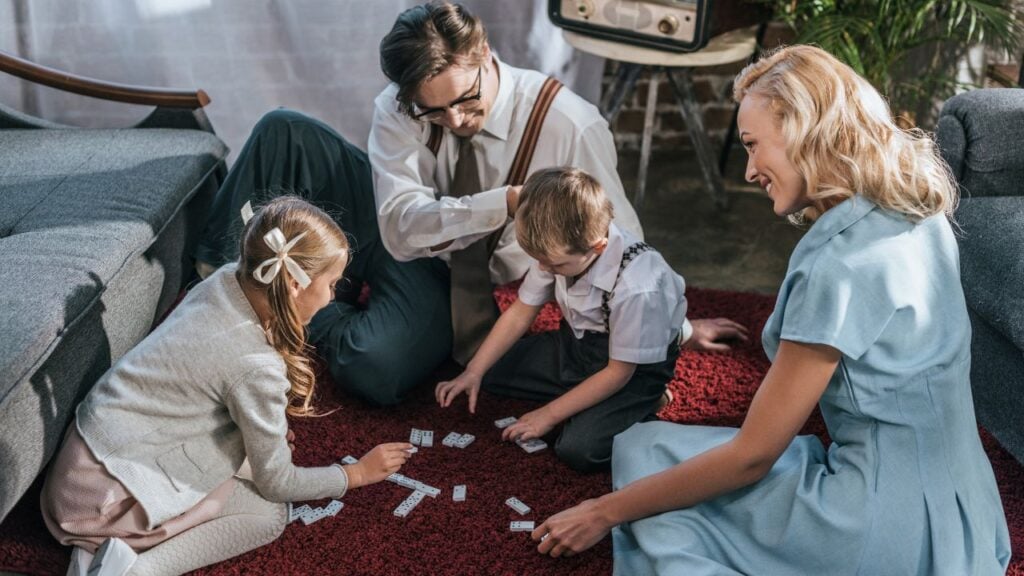
In the ’50s, there were no smartphones to scroll through, no streaming shows waiting to autoplay, and no video games with headsets and online battles.
Kids got a lot more creative when passing the time after school… after doing their homework, of course.
11 Ways Kids Passed the Time After School in the 1950s
Think You Belong in a Different Decade?
From big bands to big hair, our playful Decade DNA Quiz reveals which classic American era fits your personality best. It’s fast, fun, and full of vintage flair.
Meet Your Match. Discover Your Decade DNA. (Your Vintage Roots Are Showing)

