

14 Words New Yorkers Use That Out-of-Staters Don’t Understand

Where does upstate begin?
Ask around New York, and you’ll hear more than one answer.
“Upstate” isn’t the only word that’s confusing in New York. These are the words that leave many out-of-staters lost.
1. Kill
If you see kill on a map, you’re looking at a creek.
Many out-of-staters see a kill on a highway sign and expect trouble.
It’s only a creek.
The word sits inside Fishkill, Peekskill and other Hudson Valley place names.
Dutch settlers left it behind, and place names in Delaware and Pennsylvania use it too.
English speakers have used the word since at least 1669.
2. Stoop
A stoop is the entrance stairway at the door of a house, from the Dutch word stoep.
That Dutch word is related to the Old English word for a step.
Brownstoner reports that the classic brownstone stoop reached its peak by the 1870s.
You may know stoop as something you do with your back.
Your back is safe.
3. Line
Do you wait in line or on line?
Waiting in line is much more common across the country, but Merriam-Webster calls on line a phrase largely local to the New York City region.
Merriam-Webster traces that New York link to at least 1962, when Margaret Bryant covered the topic in Modern American Usage.
It also cites a 1981 New York Times column by William Safire that noted the New York version in a parenthetical.
Some out-of-staters hear on line and think of the internet.
You don’t need Wi-Fi.
4. Spiedie
Spiedies are skewered chunks of marinated meat, a Broome County specialty that dates to as early as 1938.
The Pomeroy Foundation’s marker says people of Italian ancestry are believed to have brought them to the area.
The marker’s write-up says they’re usually served on Italian bread.
In 2006, Binghamton University’s student newspaper, Pipe Dream, traced the name to a skewer called a spiedini.
You can try a spiedie at Binghamton’s Spiedie Fest, which began in 1983 and returns to Otsiningo Park each August.
To some visitors, the spelling looks like a typo.
It isn’t a typo.
5. Regular
Order a regular coffee in New York City, and you typically get a ten-ounce cup with milk and two sugars, according to City Lore.
Many out-of-staters expect regular to mean plain black coffee.
When Boston.com reporters phoned Dunkin’ shops in Massachusetts, Connecticut, Rhode Island and New York in 2014, New England answers were largely consistent, but New York’s varied.
A Dunkin’ in Brewster told the reporters its staff ask customers whether they want cream and sugar.
They ask first.
6. Bodega
A bodega is a usually small grocery store in an urban area, often one that specializes in Hispanic groceries.
The word began as Spanish for a storehouse where wine matures.
Merriam-Webster’s first known English use is from 1656, in that wine sense.
Today, you’ll find groceries.
Smithsonian Magazine links New York City’s bodegas to Puerto Ricans, many of whom migrated to the city after gaining U.S. citizenship in 1917.
Psst! How much do you know about New York’s landmarks and firsts? Take our quiz and see if you can ace it.
Quiz
Empire State Trivia
Answer these questions on New York landmarks, firsts and geography. We bet you can’t get them all right. Prove us wrong?
How many islands are in the Thousand Islands region of the St. Lawrence River?
7. Weck
Ask for beef on weck, and you get roast beef on a roll called kummelweck, which has a hard outside topped with salt and caraway seeds.
Weck is short for kummelweck.
The name comes from German, where kummel means caraway seed and weck means a bread roll.
Where did it start?
The Pomeroy Foundation's marker calls the origin uncertain, though local legend credits a German baker named William Wahr with bringing the roll to Buffalo.
Buffalo's 1901 Pan-American Exposition introduced many visitors to it.
8. Schmear
A schmear is a layer of a spreadable food, especially cream cheese.
The word comes from Yiddish shmir, meaning smear.
By 1909, schmear also meant a group of related things.
Ask for the whole schmear, and you're asking for all of it.
That includes the cream cheese.
The Forward reported in 2014 that a New York City delicatessen asked cheesemaker William Alfred Lawrence for a rich new cheese in 1873, which led to the cream cheese product.
9. Upstate
Upstate is the chiefly rural part of a state when the major metropolitan area is in the south.
Where it starts is disputed.
Many people argue about the line, and if you ask around, you'll hear more than one answer.
A 2018 poll found no majority for any one line.
Where Upstate New York Begins
No answer topped 29% when the poll asked respondents where upstate New York begins.
That leading answer put the line north of Westchester County.
A quarter of respondents would start upstate north of the Bronx, and 22% would wait until north of Poughkeepsie.
Another 7% also chose Poughkeepsie but wanted the Buffalo area left out, and 16% named some other spot.
10. Garbage Plate
Order a garbage plate in Rochester, and you get short-order meat or eggs with two sides, such as home fries and macaroni salad.
Nick Tahou Hots opened in 1918, and during the Great Depression its owner devised hots and potatoes.
The name came later.
By the 1980s, Saveur reports, college students were asking for a plate with all the garbage on it, and the phrase stuck.
Nick Tahou Hots, Inc. registered Garbage Plate as a trademark in 1992 and renewed it in 2022.
11. Hero
If you ask for a hero, you get a large sandwich on a long split roll with any of a variety of fillings.
Dictionary.com says the term was once largely associated with the New York City and Northern New Jersey area.
Elsewhere, the same sandwich can be a sub, a grinder, a hoagie or a wedge.
It's lunch, not a person.
12. Borough
If you live in Brooklyn, you live in a borough, one of five political divisions of New York City.
Elsewhere, it means something else.
In New Jersey and Minnesota, for example, a borough is a municipal corporation equivalent to an incorporated town or village in other states.
In Alaska, it's a civil division that corresponds to a county in most other states.
Manhattan, Brooklyn, the Bronx, Queens and Staten Island joined as one city on January 1, 1898.
The consolidation vote was close, 64,744 to 64,467.
13. Hamlet
Merriam-Webster defines a hamlet as a small village.
In New York, it's different.
The Town of Babylon says a hamlet is an unincorporated community inside a town, with no separate government.
If you live in a hamlet in the Town of Babylon, the town handles services such as garbage pickup and building codes.
The town's page adds that a hamlet has no official boundaries and no legal definition under New York State law.
14. Straphanger
A straphanger is a standing passenger on a subway, streetcar, bus or train who clings for support.
The word dates to 1896.
Stand on a New York City subway car and hold on, and you're a straphanger.
The Straphangers Campaign formed in 1979 during a low point for subway service, according to the New York Public Library.
12 Questions About New York City That Make Residents Roll Their Eyes
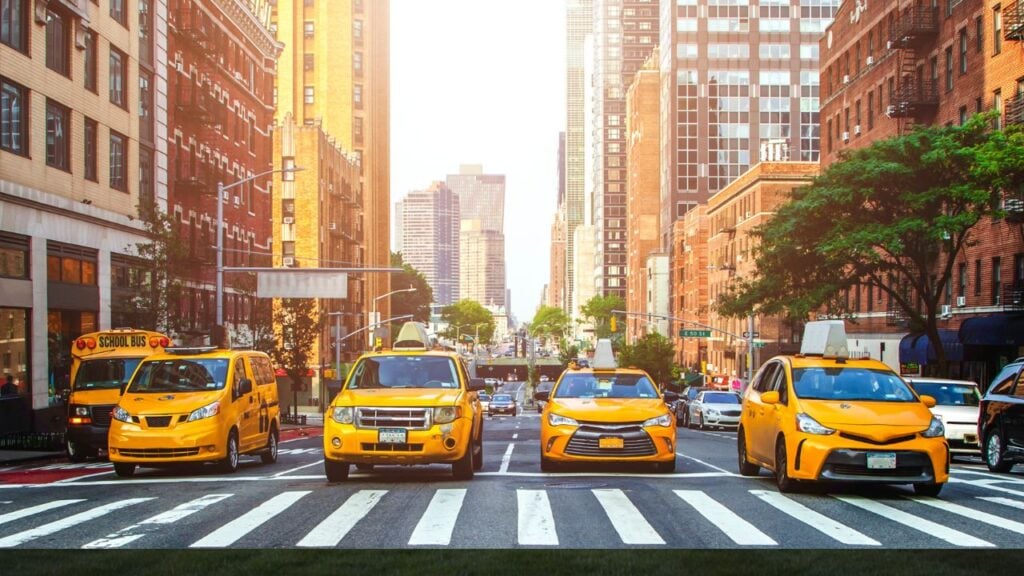
A hopeful tourist leans over the counter at a Midtown bodega and asks a question many New Yorkers have heard before.
Residents have a short list of questions that make them roll their eyes.
12 Questions About New York City That Make Residents Roll Their Eyes
7 Things That Happen in New York City on Halloween That Shock the Rest of New York
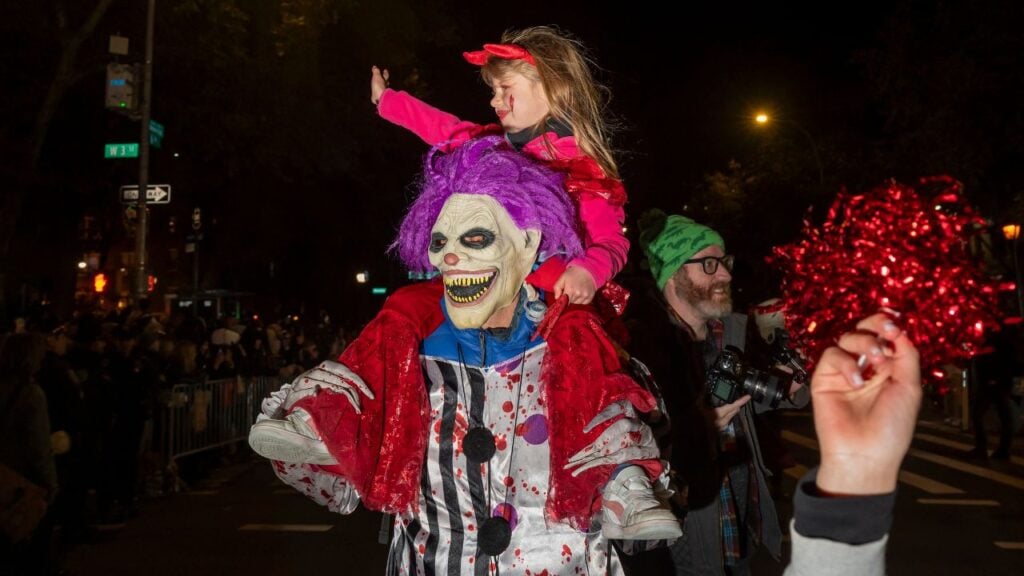
Halloween in a small New York town often means a porch light, a bowl of candy, and a few trick-or-treaters.
In New York City, though, Halloween looks very different.
7 Things That Happen in New York City on Halloween That Shock the Rest of New York
