
2 Arkansas Town Squares That Never Recovered From Their Biggest Closure

Not every Arkansas town gets its factory back.
International Paper shut down its Camden, Arkansas paper mill for good in January 2001, after 73 years of operation.
The jobs never came back.
These are the Arkansas town squares that never recovered from their biggest closure.
1. Mountain Pine
Dierks Lumber and Coal Company built Mountain Pine from nothing, breaking ground on a mill town in January 1927.
The mill was running by 1928, and it employed more than 300 workers at the peak, with another 125 men logging the timber that fed it.
Weyerhaeuser bought the operation in 1969 and ran the veneer and plywood mill for almost four decades.
Then it closed.
Weyerhaeuser shut the plant down for good on November 29, 2006, cutting about 340 jobs in one announcement.
Mountain Pine’s population fell from 770 residents in 2010 to 585 by the 2020 Census.
By January 2017, Mountain Pine couldn’t afford a police department anymore.
The city council voted to disband it and let the Garland County sheriff patrol the town instead.
Mountain Pine has a police department again today.
Police Scorecard lists it as active, with the sheriff’s patrol years behind it.
A window manufacturer, Morfe Manufacturing, bought part of the old mill site later that year.
Its co-owner and chief executive, Morgan Wiles, framed it as a five-year vision for as many as 200 jobs, not a fixed number the company owed the town.
By 2023, Arkansas Business reported the company employed 50 workers, about one for every seven jobs the mill cut loose in 2006.
Weyerhaeuser had donated the empty mill buildings and eighteen acres to the city back in 2007, but nothing filled them for a decade.
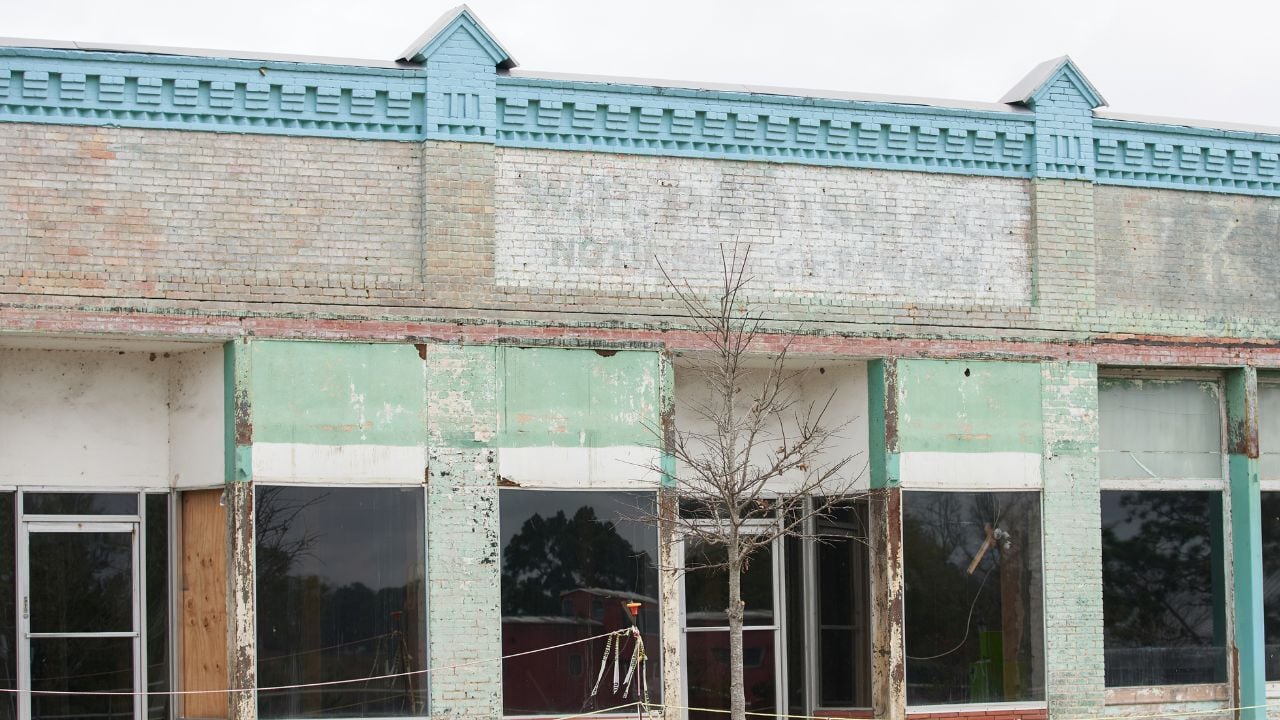
Mountain Pine’s downtown today is small enough to take in at a glance.
A city hall, a bank, a post office and a single store make up the whole business district.
2. Camden
Before it closed, International Paper’s mill in Camden produced kraft paper, the heavy-duty stock used in shipping bags and sacks.
The mill had been running since 1928, long enough to employ generations of Camden families.
The shutdown cut 580 jobs at once, the Camden News reported.
That was the second time in a decade International Paper had cut jobs in Camden.
In 1997, the company sold off a smaller packaging line, and 191 jobs went with it, but it kept the main paper mill running.
The 2001 shutdown was different.
It closed the whole mill, and this time nothing reopened in its place.
Camden’s population has fallen almost every year since, the Camden News reported.
The U.S. Census Bureau puts today’s estimate at 10,127 residents, down from 13,154 in 2000.
The area has leaned on a different industry to fill the gap.
Highland Industrial Park, built on the old Shumaker Naval Ammunition Depot outside town, held between 2,500 and 3,000 defense jobs pretty consistently for over a decade.
Its president said as much in a 2015 interview, the most recent count on record.
Those jobs sit outside Camden’s downtown, on an industrial park several miles removed from Main Street.
Camden’s downtown still carries two federally listed historic districts, the Clifton and Greening Streets Historic District and the Washington Street Historic District.
Blocks of early-1900s storefronts fill both districts, built back when the mill’s payroll filled Main Street too.
Camden’s 23% Population Drop
Camden’s population has dropped 23% since the mill’s closure.
That’s roughly one in four people who lived in Camden the year the mill was still running, gone from the town today.
Brinkley’s Turnaround
Brinkley shows what a closure doesn’t have to do to a downtown.
Walmart closed its store in Brinkley on May 30, 2009.
The store had brought in about $175,000 of the city’s roughly $1.3 million in annual sales tax revenue the year before, Arkansas Business reported.
Sales tax didn’t drop.
The next month, Brinkley’s sales tax revenue rose 2.66% over May, city figures showed.
Dollar General expanded its Brinkley store to 9,000 square feet, the outlet reported.
Fred’s Inc. opened two pharmacies in town.
Together, the two chains replaced much of what Walmart’s store had offered, pharmacy included.
Brinkley’s mayor at the time said the closing didn’t hurt the town’s finances.
A closure doesn’t always sink a downtown the way it did in Camden and Mountain Pine.
Psst! How much do you know about Arkansas towns and their Main Street history? Take our quiz and see how many you can get right.
Quiz
Arkansas Main Street IQ
Many Arkansans miss at least two of these. See where you land.
In 1832, Congress set aside land around one Arkansas town as the country’s first federally protected reservation, four decades before Yellowstone. Which town?
Bauxite's Different Ending
Bauxite is a different kind of town square.
Workers found bauxite ore near Little Rock in 1887.
The community changed its name from Perrysmith to Bauxite in 1903, after the first ore-drying plant went up.
Alcoa built Bauxite as a company town, complete with housing, a hospital, a school, and a clubhouse for its workers.
Production peaked during World War II, when the mines produced more than 6 million tons of ore a year, up from under 400,000 tons before the war.
The pullback started once the war ended.
Alcoa demolished the clubhouse in 1955 and the theater in 1966.
By 1960, the town's population had fallen to 885 people, down from 2,495 just a decade earlier.
Reynolds Metals eventually shut down and dismantled its Hurricane Creek plant.
Mining didn't stop there.
Smaller operations kept working bauxite ore in Saline County into the early 1990s, according to the Arkansas Geological Survey's history of the industry.
Bauxite incorporated as a town on January 16, 1973, while Alcoa was still years from its final shutdown.
Today, the Almatis plant processes imported alumina on part of the old Alcoa site.
The town of Bauxite has stayed small, with 629 residents counted in the 2020 Census.
But its school district, stretching into the fast-growing suburbs around it, now enrolls more than 1,000 students, more people than live in the town.
