
20 Phrases Californians Say Without Realizing Nobody Else Does

Spend enough time in California, and you’ll pick up a new way of talking that sounds totally normal.
But cross a state line, and the blank looks start.
If you grew up in the Golden State, we bet you’ve said many of these without a second thought.
The 405
Ask a Southern Californian for directions, and you’ll hear it.
Take the 5. Avoid the 405. Hop on the 101.
The rest of the country says “5” or “I-95.” No “the” in front.
It traces to Los Angeles’ early freeways, built in the 1940s before most cities had any.
Northern California drops the “the.”
Say “the 80” in Sacramento, and you’ve outed yourself as an outsider.
Hella
This one is pure Northern California.
Hella means a lot.
Hella good. Hella far. Hella people.
It started in the Bay Area and stayed.
Say it anywhere else in America, and you’ll get some strange stares.
June Gloom
Summer on the West Coast doesn’t guarantee sunshine.
Late May and June bring a thick gray cloud layer that sits over the shore until afternoon.
Locals call it June Gloom.
Or May Gray. Or, when it drags on, No-Sky July.
The culprit is the marine layer, cool ocean air trapped under warmer air above.
Tourists who booked a beach day get a chilly surprise.
Sigalert
Hear this on LA radio, and you know traffic’s bad.
A Sigalert means an unplanned event has closed a lane for a serious stretch of time.
Here’s the part that catches people off guard: The name comes from a real person.
Loyd Sigmon, a radio executive, built the alert system in the 1950s.
The name caught on. Now it’s in the dictionary.
The Grapevine
Drive Interstate 5 between Los Angeles and the Central Valley, and you’ll climb a steep, twisting grade.
That stretch is the Grapevine.
The name comes from the wild grapevines that tangled across the old wagon road.
Californians check whether it’s open before a long winter drive.
Snow or wrecks can shut it and strand you for hours.
To everyone else, it’s a mountain.
Santa Ana Winds
Every fall, hot, bone-dry winds blow from the desert toward the coast. These are the Santa Ana winds.
Some Californians call them the devil winds.
The weather service describes them as strong, hot winds that drop to the Pacific Coast from inland desert regions.
They dry out the brush and feed wildfires.
Earthquake Weather
Catch a still, warm, eerie day in California, and someone will mutter it: “Feels like earthquake weather.”
There’s one problem.
It isn’t real.
The USGS finds the same odds of a quake on hot, cold, and rainy days.
Animal Style
Order this at In-N-Out, and you mark yourself as a true Californian.
Animal Style means mustard-grilled patties, extra spread, pickles, and grilled onions.
Get the fries Animal Style and they show up buried in cheese and onions.
Regulars rattle off the whole order without a glance at the board.
Out-of-staters blink at the cashier, trying to understand what it could possibly mean.
The Valley
Say “the Valley” in Los Angeles, and everyone pictures the same place.
It means the San Fernando Valley, the sprawl north of the hills.
It comes with its own reputation, its own heat, and its own accent.
Valley Girl talk started here. Like, for sure.
PCH
No local says Pacific Coast Highway. They say PCH.
It’s the coastal route that hugs the ocean from San Diego past Malibu.
Drivers give directions by it.
Some of the most filmed shoreline on earth runs beside it.
They’re three letters that every Californian knows.
The Inland Empire
East of Los Angeles sits a giant region most outsiders can’t name.
Californians call it the Inland Empire, or the IE.
It covers Riverside and San Bernardino, miles of suburbs and warehouses.
People there claim it with pride.
The 909, they’ll tell you.
Surface Streets
Stuck in freeway traffic, a Californian has a backup plan.
Take surface streets.
It means the regular roads, the ones with stoplights instead of on-ramps.
Most of the country says back roads or side streets.
In California, the freeway is the default, so the rest gets its own name.
NorCal and SoCal
California is two states pretending to be one: NorCal and SoCal.
People argue the line, but the rivalry is real.
Burritos, sports teams, beaches, attitude.
Northerners think Southerners are all freeways and traffic.
Southerners think Northerners are cold and smug.
Pick a side. Everyone has.
The Bay
In Northern California, “the Bay” stands for a whole region.
It means the San Francisco Bay Area, all nine counties.
You’re from the Bay, you root for the Bay, you move home to the Bay.
Outsiders hear it and picture a harbor.
Gnarly
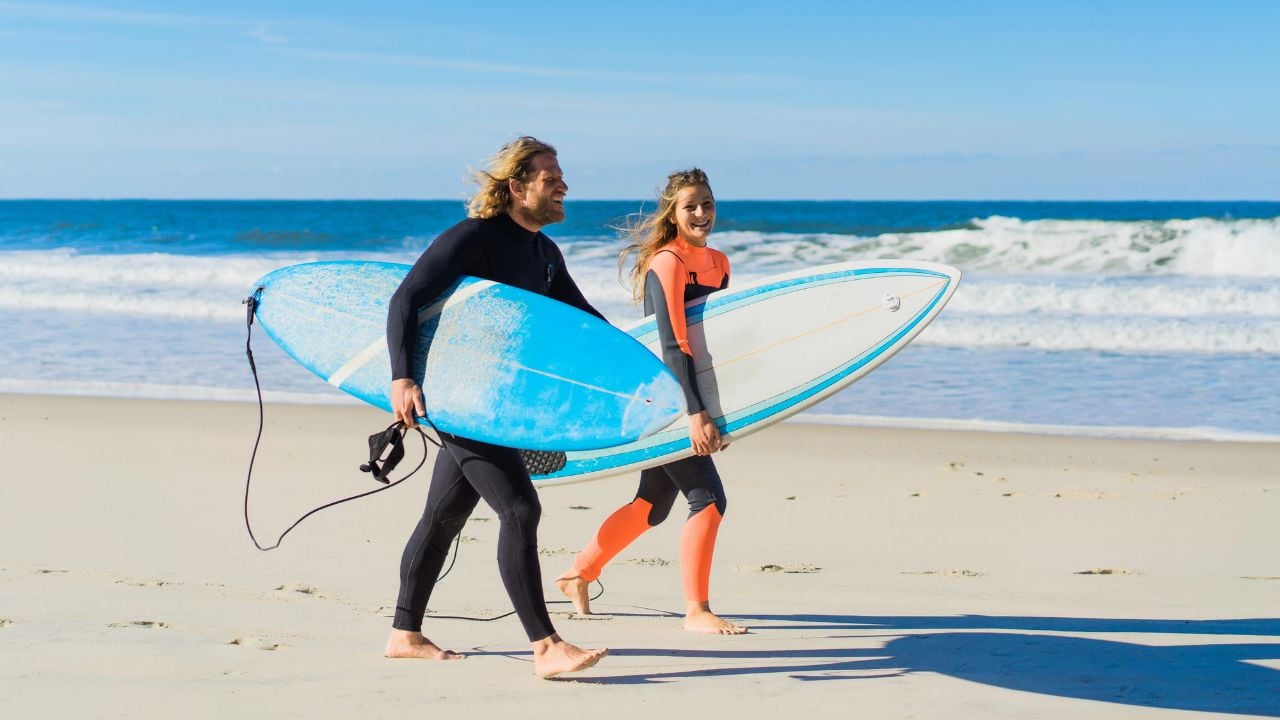
This one rode in on a surfboard.
Gnarly can mean dangerous, extreme, or impressive.
A gnarly wave. A gnarly wipeout. A gnarly scar.
California surf culture sent it across the country, but it belongs to Cali kids raised near the water.
Stoked
Few words are more Californian than this one.
Stoked means thrilled, pumped, excited.
So stoked for the weekend. Stoked you came.
Surfers spread it, and it stayed.
The City
In the Bay Area, “the City” means one place.
San Francisco. Capital C.
Not Oakland. Not San Jose. San Francisco.
Tell someone you’re headed to the City, and the locals know where.
Try that in many other states, and you’ll field follow-up questions.
California Burrito
Order this in San Diego, and you get something glorious and strange.
A California burrito packs carne asada, cheese, and french fries into one tortilla.
Yes, fries. Inside a burrito.
It’s a regional staple practically unknown beyond California.
San Diegans would defend it with their lives.
Granola
In California, “granola” describes a person, not a cereal.
Call someone granola, and you mean crunchy, earthy, and eco-minded.
Picture reusable everything, hikes on weekends, and a garden in the yard.
It lands as half tease, half compliment.
Peak Northern California.
Hecka
Meet the polite cousin of hella.
Hecka means the same thing, a lot, minus the cursing.
Kids who couldn’t say hella said hecka.
Teachers, parents, and church crowds approved. It’s pure California compromise.
18 Foods Californians Grew Up With in the ’70s That Disappeared

Some of the best foodie things about a California childhood in the ’70s no longer exist.
Here are the foods that vanished, and the memories that didn’t.
18 Foods Californians Grew Up With in the ’70s That Disappeared
Retirees Are Leaving California For These 6 Cheaper States
Why sit on $833,000 of equity in a state that taxes your retirement income when you can move inland or east, buy a comparable home for half the price, and pay no income tax at all?
Thousands of California retirees are running exactly that calculation, and these states keep coming out on top.
Retirees Are Leaving California For These 6 Cheaper States (It’s Hard To Blame Them)
