
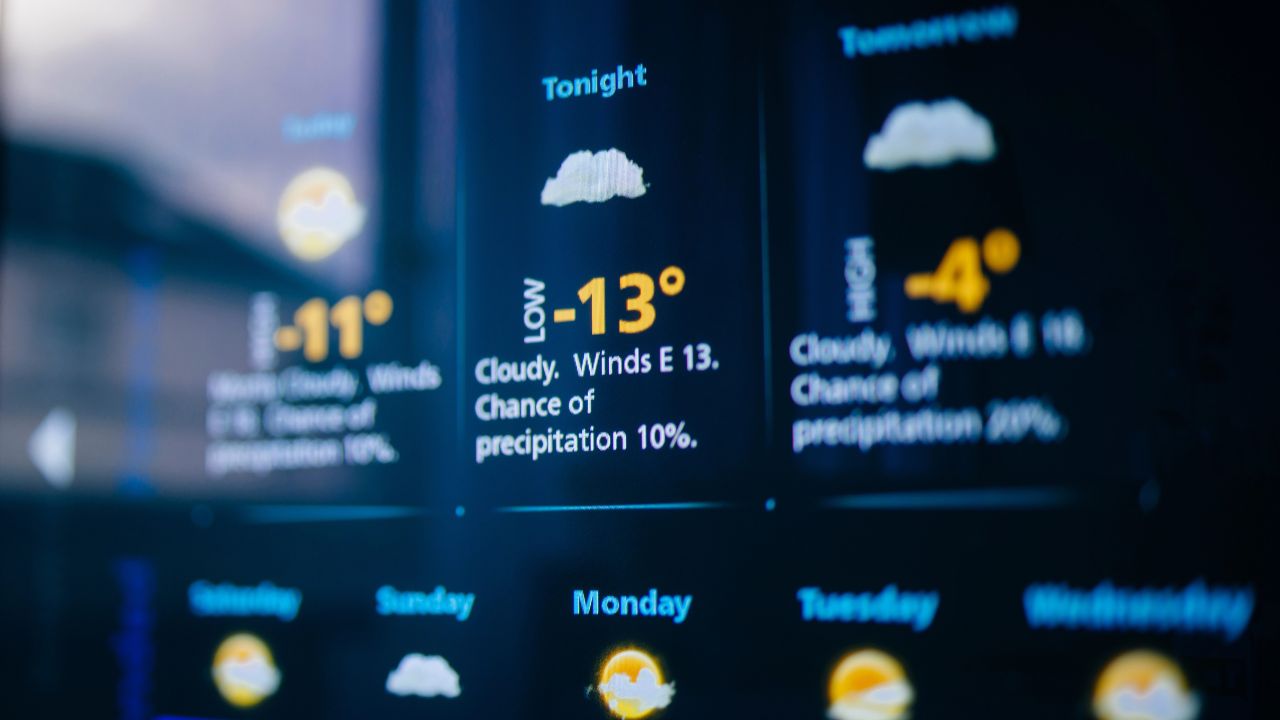
26 Weather Forecast Terms Iowans Think They Understand But Don’t

Be honest: How many times have you nodded at the weather report without actually knowing what it meant?
Between “isolated showers” and “feels like temperatures,” forecasts can sound more like riddles than help.
Let’s break down the weather lingo that Iowans and Americans across the country pretend to understand but really don’t.
Chance of Precipitation
You’d think “30% chance of rain” means it’ll rain for 30% of the day. Wrong. It actually means there’s a 30% chance rain will happen somewhere in the forecast area.
So yes, your neighbor’s yard might get soaked while your barbecue stays bone dry.
Weather math, folks.
This is why people are perpetually betrayed by picnic plans. The number isn’t about time, it’s about odds.
So next time, maybe keep that umbrella in the car, just in case.
Feels Like Temperature
The “feels like” temperature factors in humidity, wind speed, and how miserable you’ll be walking to your mailbox.
Eighty-five degrees with 90% humidity doesn’t “feel” like 85. It feels like stepping into a wet wool blanket.
Meanwhile, a cold day with high wind makes it feel ten degrees colder, which is why Chicagoans consider “wind chill” their sworn enemy.
It’s not just a number. It’s how much nature wants to mess with you that day.
Wind Chill
Speaking of which, wind chill isn’t just about the wind. It measures how quickly heat leaves your body when wind meets skin.
That’s why “32°F feels like 20°F” makes sense. The wind steals your body heat faster than you can say “I should’ve worn gloves.”
Meteorologists calculate this with formulas that sound like sorcery, but the takeaway’s simple: wind equals pain.
If it’s windy, it’s colder than you think. Period.
Dew Point
If humidity had a personality, it’d be called the dew point.
It’s the temperature at which air becomes saturated and dew starts forming. Basically, the higher the dew point, the stickier and sweatier you’ll feel.
When that number hits 70°F or more, every person from Florida to Ohio starts muttering, “It’s not the heat, it’s the humidity.”
So yes, if the dew point’s up, your hair doesn’t stand a chance.
Relative Humidity
This one sounds fancy, but it just means how full of moisture the air already is compared to how much it could hold.
At 100%, the air is basically a sponge that can’t take any more. Cue the rain.
At 50%, it’s tolerable. At 80%, your clothes start sticking in ways no one enjoys.
Relative humidity tells you whether it’s “a nice day for a walk” or “a bad day to wear gray.”
Barometric Pressure
Ah, yes. The secret code for “something’s coming.”
When barometric pressure drops, storms are brewing. When it rises, things calm down.
People swear they can feel it in their joints. Grandma might not be a meteorologist, but she’s probably right.
Think of it as the atmosphere’s mood ring: falling pressure means cranky skies ahead.
Cold Front
A cold front is when a mass of cold air pushes warm air out of the way, kind of like a rude guest kicking everyone off the dance floor.
This often brings wind, storms, and a sudden drop in temperature.
You’ll know a cold front passed when yesterday’s shorts weather turns into today’s jacket emergency.
It’s nature’s way of saying, “Don’t get too comfortable.”
Warm Front
The opposite of a cold front, but somehow sneakier.
A warm front brings steady rain and gray skies before temperatures slowly rise. It’s less dramatic, more like a gloomy guest who overstays their welcome.
When the meteorologist says “a warm front is moving in,” expect a soggy day that feels like a lukewarm bath.
Sunshine comes after the moodiness passes.
Stationary Front
This is when warm and cold air masses meet, and neither one wants to leave.
It’s the weather version of a standoff, and the rest of us get stuck in the middle with endless clouds and drizzle.
It can last for days, making you wonder if the sun has moved to another zip code.
Stationary fronts are the “are we done yet?” of weather systems.
Polar Vortex
Sounds like a superhero villain, and honestly, it acts like one.
The polar vortex is a swirling mass of cold air around the North Pole that occasionally escapes south, right into the U.S.
When it does, temperatures plunge, people panic, and newscasters start using the phrase “life-threatening wind chills.”
If you remember the winter of 2014, you remember the polar vortex. It was the one time everyone agreed it was too cold to go outside.
Nor’easter
This one haunts the East Coast every winter like clockwork.
A Nor’easter is a powerful storm that brings heavy snow, rain, and winds blowing from the northeast.
It’s basically a blizzard with personality, and a bad one at that.
If you live from Virginia to Maine, you’ve probably had your plans ruined by one.
Squall Line
Sounds harmless, but a squall line means a band of severe thunderstorms marching through like an angry parade.
Expect lightning, gusty winds, and rain that makes you question your roof’s integrity.
Meteorologists love to say “squall line,” while you’re inside, hoping your lawn chairs survive.
It’s short-lived but memorable, like nature’s jump scare.
Watch vs. Warning
The eternal confusion: what’s the difference?
A “watch” means conditions could happen. A “warning” means it’s happening right now.
If there’s a tornado watch, keep your eyes open. If it’s a tornado warning, get to the basement.
In short: watch = possible. Warning = run.
Microburst
Not a fun new beverage. A microburst is a sudden downdraft of air that slams into the ground, spreading outward with destructive force.
It can cause damage similar to a small tornado, but without the swirling funnel.
They’re short, sneaky, and often strike during summer thunderstorms.
If your patio umbrella ends up two houses away, that was probably a microburst.
Inversion
Temperature inversions happen when warm air traps cool air near the ground, basically flipping the usual order.
This keeps pollution and fog stuck low, creating that hazy, smoggy look cities dread.
It’s why Los Angeles sometimes looks like it’s hiding under a dusty blanket.
Inversions don’t just ruin sunsets. They can worsen air quality fast.
Isolated vs. Scattered Showers
You’ve heard both. You’ve misunderstood both.
“Isolated” means only a few spots might get rain, like that one neighborhood that always does.
“Scattered” means more areas will see rain, but it’s still hit or miss.
So if your weather app says “scattered,” keep the umbrella close. If it says “isolated,” maybe just risk it. Maybe.
Wintry Mix
This is meteorologist code for “we have no idea what’s about to fall.”
It’s part rain, part sleet, part snow, and entirely inconvenient.
Wintry mix days start with wet roads, turn into ice rinks by noon, and end with chaos at the grocery store.
If you hear “wintry mix,” cancel plans and grab snacks.
Sleet
It’s not snow. It’s not rain. It’s frozen raindrops that bounce when they hit the ground.
That’s why your car sounds like it’s under attack when sleet hits the windshield.
It’s slippery, noisy, and almost never fun to drive in.
Think of sleet as winter’s way of saying, “Surprise! You’re late for work.”
Freezing Rain
Unlike sleet, freezing rain starts as rain, but freezes on contact with surfaces.
That’s how you get icy driveways, power outages, and trees snapping like twigs.
Meteorologists love to warn about it, and they’re right. This one’s dangerous.
When the forecast says “freezing rain,” stay indoors and admire your new front-yard ice sculpture from afar.
Heat Index
The summer version of “wind chill.”
It combines temperature and humidity to show how hot it feels, not just what the thermometer says.
That’s why 95°F in Arizona feels bearable, but 85°F in Alabama feels like you’re melting.
If the heat index crosses 100°F, outdoor plans should include shade, water, and minimal ambition.
Air Mass
An air mass is just a large blob of air with consistent temperature and moisture.
When one moves, it changes the weather, like swapping out your blanket for something either heavier or lighter.
Cold, dry air from Canada? Expect crisp blue skies. Warm, humid air from the Gulf? Expect sweat and mosquitoes.
Air masses are the behind-the-scenes cast of every weather change you feel.
Tropical Depression vs. Tropical Storm
Before a hurricane gets its big debut, it starts as one of these.
A tropical depression has winds below 39 mph, basically, a storm in training.
Once it crosses that 39 mph mark, it graduates to tropical storm status and earns a name.
So if you hear “Tropical Storm Betty,” know it’s getting serious, but not yet catastrophic.
Hurricane Categories
You’ve seen the 1–5 scale, but most people don’t know what separates them.
Category 1: messy. Category 5: catastrophic. The numbers are based on sustained wind speed, not rain or flooding.
So yes, a “weaker” storm can still flood your neighborhood.
When meteorologists say “Category 3,” don’t get hung up on the number; just know it’s time to stock up on batteries and snacks.
Gusts
You know when wind suddenly slaps you in the face? That’s a gust.
It’s a brief, stronger burst of wind on top of the steady flow.
So if it’s “15 mph winds with 30 mph gusts,” your hair will understand the difference.
Gusts make doors slam, hats fly, and every umbrella on the block turn inside out.
Severe Weather Outlook
Ever seen “marginal risk” or “enhanced risk” on those colorful weather maps? Those are levels of storm potential from the Storm Prediction Center.
“Marginal” means maybe a few storms. “Enhanced” means buckle up.
It’s basically the weather version of a traffic light: green, yellow, red, and sometimes purple if things are really bad.
When in doubt, if it’s on the map, charge your phone.
Sunny Intervals
Sounds lovely, but it’s actually code for “you’ll get a little sun before clouds ruin it.”
It’s the polite way of saying, “Don’t cancel your plans, but don’t expect perfection either.”
A day with sunny intervals might start cheerful and end moody, much like most Americans before coffee.
Take it as a sign to enjoy the good patches while they last.
17 Decor Items That’ll Make Your Home Look Cheap

No one wants to hear their home looks cheap. But sometimes, a cheap-looking home doesn’t reflect what you spent on it. It reflects the decor you chose.
17 Decor Items That’ll Make Your Home Look Cheap
Remember When Everything Had Color? These 18 Things Definitely Did

There was a time when even the most ordinary things were bursting with color.
But now?
We’ve swapped charm for minimalism, and for some reason, we all agreed to pretend it’s better. Here are some everyday things that used to be colorful but aren’t anymore.
Remember When Everything Had Color? These 18 Things Definitely Did
Think You Belong in a Different Decade?
From big bands to big hair, our playful Decade DNA Quiz reveals which classic American era fits your personality best. It’s fast, fun, and full of vintage flair.
Meet Your Match. Discover Your Decade DNA. (Your Vintage Roots Are Showing)

