
3 Connecticut Covered Bridges Nutmeggers Still Argue About

Connecticut’s covered bridges look peaceful enough to belong on a postcard.
Spend a few minutes talking to the Nutmeggers who know them, though, and the quiet New England charm gives way to disagreements that have lasted for years.
These are the Connecticut covered bridges Nutmeggers still argue about.
1. West Cornwall Covered Bridge
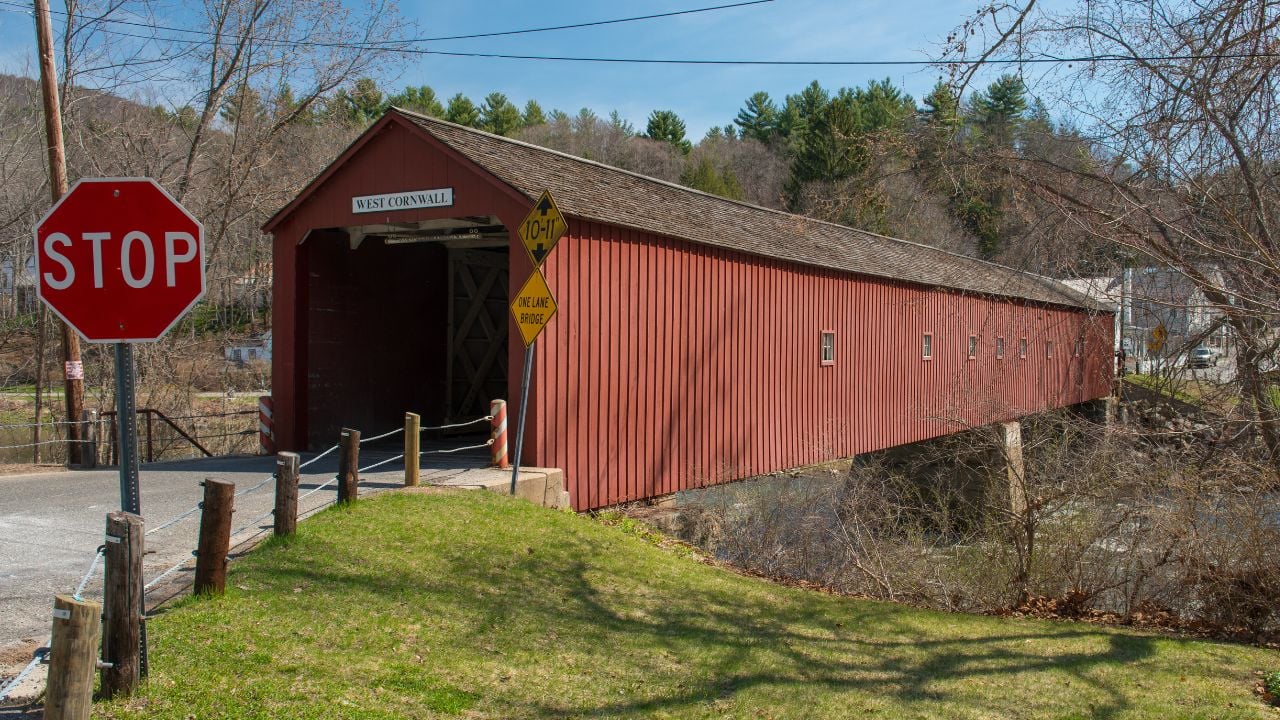
West Cornwall Covered Bridge still carries daily traffic across the Housatonic River on Route 128, the same red lattice-truss span it’s carried since 1864.
The span runs 172 feet long and 15 feet wide, built from red spruce more than a century and a half ago.
A 1973 renovation added a hidden steel support deck underneath the wood, work the Federal Highway Administration later called an outstanding example of historic preservation.
A weight limit and a low center clearance are supposed to keep the big rigs out.
They don’t always.
Trucks have caused trouble here before.
A 20-ton oil truck fell through the bridge’s floor back in 1945, decades before anyone worried about laser sensors.
Then, in December 2022, a truck towing a backhoe hit the bridge’s roof bracing, and Connecticut closed the span for a week of emergency repairs.
Two intersections got detours for that whole week: Route 125 and Route 128, plus Route 7 and Route 4.
A landscaping truck got stuck inside it again in early April 2025.
It picked up only minor damage that time, Cornwall’s first selectman said.
It also wasn’t West Cornwall’s first close call.
Selectmen spent an April 15 meeting arguing over how to stop the next one.
They weighed brighter warning signs, a laser system that flags oversized trucks, flashing lights, and metal barrier rails.
The bridge’s spot on the National Register limits what the town can bolt onto it.
Cornwall hadn’t settled on a fix as of that meeting, and residents along Route 128 aren’t shy about which fix they’d pick.
The dispute heats up every fall, when Connecticut’s foliage season peaks between Oct. 3 and Nov. 8.
Route 128 fills with sightseers and delivery trucks at the same time.
2. Bull’s Bridge
Bull’s Bridge still hauls one lane of traffic over the Housatonic River in Kent, a few hundred yards from the New York line.
Nobody can pin down how old it is.
Many guides print 1842.
A structural survey behind its listing on the National Register found no way to confirm that date and said the bridge might date from the 1870s instead.
The two dates can’t both be right.
Connecticut hasn’t settled the argument.
Local lore says George Washington once crossed the unfinished bridge, before some of its timbers were even bolted down, with the builder walking alongside to steady his horse.
That detail can’t be confirmed either, but Kent tells it anyway.
Bull’s Bridge remains one of just two Connecticut covered bridges that still carry cars, along with West Cornwall’s.
Crews reinforced Bull’s Bridge with steel girders in 1969 and West Cornwall’s bridge in 1973, so 1800s wood could keep carrying modern traffic.
Psst! How much do you know about covered bridges beyond Connecticut’s arguments? Take our quiz and see how many you can get right.
Quiz
Covered Bridge IQ
Answer these questions on how covered bridges get built and why. We bet you can’t get them all right. Prove us wrong?
Covered bridges earned what nickname from courting couples who lingered inside them out of sight?
3. Comstock's Bridge
Comstock's Bridge crosses the Salmon River on foot only now, closed to cars since the state routed traffic onto a concrete bridge nearby.
The Salmon River marks the boundary between East Hampton and Colchester, and Comstock's Bridge sits right on top of it.
The National Register's survey can't pin down a firm birth year.
It allows only that the Howe-truss design couldn't exist before 1840, and that a bridge stood there by 1868.
That's a 28-year window behind a bridge everyone dates to 1873.
Its truss combines diagonal wood with iron tie rods, a hybrid the National Register nomination itself flags as unusual for the era.
The Civilian Conservation Corps installed new gates, windows, and floor supports in the 1930s, decades before anyone questioned the bridge's age.
The main span runs 80 feet, just wide enough for one lane.
A shorter 30-foot section on the eastern end may or may not belong to an even older bridge.
Even the National Register's survey calls that part "conjecture."
Nobody can prove otherwise.
Decades of rot left Comstock's Bridge sagging and close to collapse.
The state closed it in March 2009 for a $1.1 million rebuild.
About half of today's wood is original 1873 material, the Chatham Historical Society says, the rest replaced during that restoration.
What Makes a Connecticut Bridge Historic
Connecticut's covered bridges aren't all the same kind of old.
Bull's Bridge, West Cornwall's bridge, and Comstock's Bridge are the only three that carried horse-drawn traffic, and all three sit on the National Register of Historic Places because of it.
Every other covered bridge standing in the state today went up decades after cars took over the roads, some as recently as the early 2020s.
They use the same old joinery and timber, just without the wagon-era history underneath.
How Many Covered Bridges Are Left
Connecticut has more covered bridges standing right now than many Nutmeggers realize.
The list runs past three.
A public defender spent 25 years chasing the idea before hiring a New Hampshire crew to raise a bridge on his Norwich farm in 2015.
The finished 60-foot lattice-truss span went up with oxen from Stonington pulling it into place.
A mill village in East Haddam got a 1976 replacement, built from salvaged old lumber using both arch and king-post trusses, long after Johnsonville stopped running as a working town.
Avon, Brooklyn, Somers, and Ellington each added smaller covered bridges between 1968 and 2021, mostly over ponds and brooks on private land.
Those four towns join Norwich and Johnsonville on the list, and together the six span five counties without a single 1800s original among them.
10 Things Connecticut Residents Are Tired of Explaining to Everyone Else

Ask a Connecticut resident what county they live in, and watch the pause that follows.
Connecticut towns handle much of the work a county handles everywhere else, and that's just one thing Nutmeggers are tired of explaining.
10 Things Connecticut Residents Are Tired of Explaining to Everyone Else
15 Cities With Names So Misleading They've Fooled Many Connecticut Travelers

Some destination names sound like a tropical escape or a glamorous city, right up until a traveler arrives.
These are the misleading city names that have caused disappointment once travelers finally see them.
15 Cities With Names So Misleading They've Fooled Many Connecticut Travelers
