
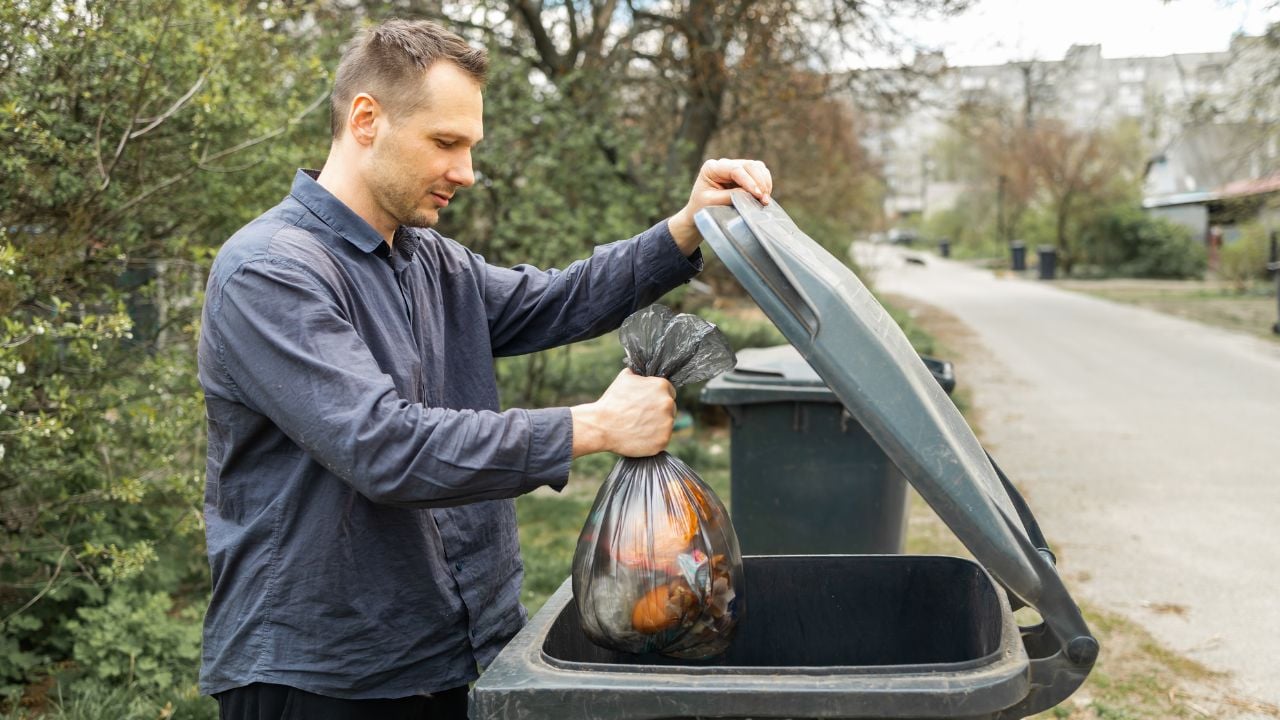
3 Things Californians Can Be Fined for Tossing in a Household Garbage Bin

Some California cities pay close attention to what you toss, and the wrong item can cost you.
Here are the things Californians can be fined for tossing in a household garbage bin.
Note: This is general information, not legal advice. Waste rules and fines vary by city and are subject to change, so confirm the current details with your city’s public works department.
1. Food Scraps
Food scraps don’t belong in your garbage bin once your city offers organic waste collection.
That service comes from California’s 2016 organic waste law, passed to reduce methane pollution.
The state regulations then tell you to subscribe to your city’s service and follow its requirements.
Which bin takes what depends on your city’s program under the state’s container rules.
Laguna Hills’ city FAQ, written before 2024, says that continuing to put food scraps in the trash cart can bring city fines.
Fines wouldn’t begin until 2024.
In San Clemente, an ordinance requires residents to sort food scraps into green containers.
Its fines were set to begin May 1, 2023, at $50 for a first violation, $75 for a second and $100 for a third.
What State Rules Require of Cities
California’s organics regulations set a base penalty of $50 to $100 for a first violation.
A second violation carries $100 to $200, and a third or later violation carries $250 to $500.
Cities and counties must adopt an ordinance or other enforceable mechanism to carry those penalties.
For a wrong item in a container, the regulations tell the city to notify the generator of the violation.
The chapter doesn’t require a city or county to impose administrative civil penalties on generators who break the prohibited container contaminants rule.
CalRecycle’s enforcement page says container contamination is enforced through route review or waste evaluation notices, and other violations get a Notice of Violation requiring compliance within 60 days.
2. Yard Trimmings
Do your grass clippings belong in a household garbage bin?
Not under the state’s definition of organic waste, which lists green material along with landscape and pruning waste.
Laguna Hills sends grass clippings, leaves, tree and brush trimmings, weeds, and dead plants to its green organics cart.
Yard waste in the trash cart can bring city fines there too.
The listed fines are up to $50 for a first conviction, $100 for a second within a year and $250 for a third or any later conviction.
Those fines were adopted into the city’s municipal code, and its hauler was to audit a random sample of homes once a quarter.
Psst! How much do you know about your state’s recycling and waste laws? Take our quiz and see if you can ace it.
Quiz
Your State’s Waste IQ
Answer these questions on your state’s recycling, bottle and waste laws. We bet you can’t get them all right. Prove us wrong?
Which 2024 law ended the reusable grocery bag requirements that Senate Bill 270 created?
3. Hazardous Household Products
Paint, paint thinners, cleaners, and solvents count as household hazardous waste in Los Angeles.
Its sanitation department says you should never put those products in regular trash, and not in the black or blue bin.
In Santa Cruz, the municipal code makes it unlawful to place hazardous waste in refuse carts.
Hazardous waste there includes hazardous materials in consumer products used by the general public.
A violation of the chapter can bring an administrative citation.
Base penalties are $100 for a first violation, $200 for a second and $500 for a third or later violation.
Warning Tags Before Fines
Brea's "Oops" tag on a household bin is a warning and educational piece, not a fine.
Getting one doesn't mean you'll also be fined.
Residents with multiple warnings and no compliance may receive a Notice of Violation letter, and if contamination or noncompliance continues, a fine may be issued.
Separately, Brea's code sets administrative fines of $50 to $100 for a first violation, $100 to $200 for a second and $250 to $500 for a third or later violation.
Santa Cruz's code has the city issue a notice of violation, by cart tag or other communication, when it finds prohibited container contaminants.
If it finds them on more than three consecutive occasions, the city may assess contamination processing fees or penalties.
Other Banned Items
Your garbage bin can't take everything on CalRecycle's list of banned wastes, which includes all batteries, fluorescent lamps and tubes, televisions, mercury-added thermostats, and motor oil and filters.
Tires aren't hazardous, but they're banned from the trash to avoid mosquito breeding and tire fires.
In San Mateo County, the health department calls improper disposal of used oil a crime.
No person or business may put any type of universal waste in the trash.
In Sonoma County, home-generated sharps can't go in your garbage or recycling cart.
Penalties Aimed at Cities
Households aren't the only ones who face fines.
Your city can face penalties under California's organics regulations.
Under section 18997.3, those penalties run from $500 to $10,000 for each violation, each day, depending on how serious the violation is.
12 Things Californians Do That Out-of-Staters Always Get Wrong

Californians do a dozen ordinary things every day that make out-of-staters do a double take.
None of it is showing off.
12 Things Californians Do That Out-of-Staters Always Get Wrong
7 In-N-Out Drive-Thru Habits That Are Second Nature to Californians
In-N-Out's drive-thru comes with habits that Californians learn without thinking.
Some of them might surprise you.
7 In-N-Out Drive-Thru Habits That Are Second Nature to Californians
