
4 Things That Happen on Maine’s Wild Blueberry Barrens After the Harvest

If you drive Down East this late in the year, the blueberry barrens might look like they’re lying low until summer.
Growers are still out there, though, long after the last berry’s picked.
Here’s what happens on Maine’s wild blueberry barrens after the harvest.
1. Fall Color
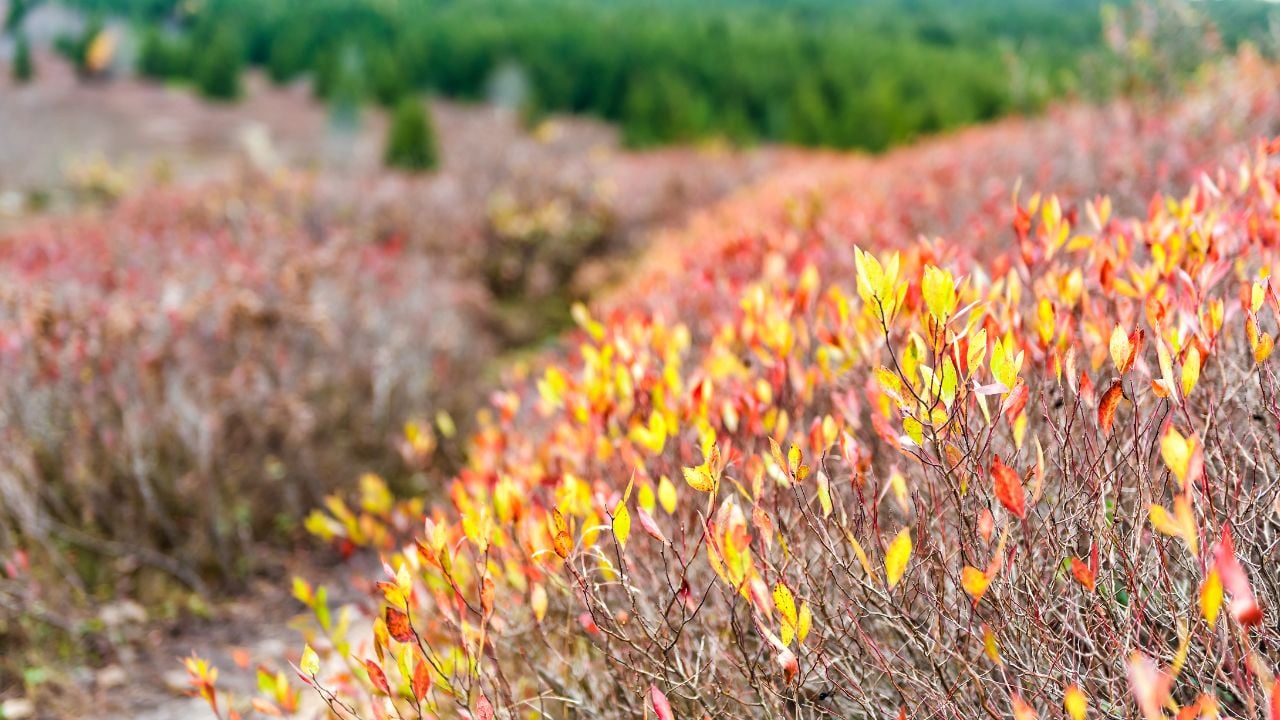
Wild blueberry fields in Down East Maine turn red and orange each fall, a UMaine Extension specialist says.
The plants behave like deciduous trees, losing their green as temperatures drop.
The red and orange are what’s left behind, and you can see them across the barrens.
The leaves drop after a killing frost.
Maine’s Barrens by County
If you want to see Maine’s wild blueberry barrens, head for Washington or Hancock County, which had about nine of every ten harvested acres in 2012.
Washington County led the state with 13,668 acres out of 18,110.
Hancock County ranked second, with 2,717 acres.
In the 2017 census, Hancock County reported 4,496 acres.
Washington County’s figure that year was withheld to avoid disclosing data for individual operations.
2. Fall Mowing
Growers prune wild blueberry plants to the ground after the August harvest, by mowing or burning.
The year after the harvest is a vegetative year, when stems, leaves and buds develop.
Plants bloom and produce blueberries in the second year, so a field typically fruits every other year.
A 2010 UMaine schedule puts mowing after the first frost and before snowfall.
Waiting for that frost lets nutrients in the leaves move down to the underground stems, a 1988 fact sheet says.
Growers prefer fall pruning because the stubble dies back to ground level over the winter.
Mowing can continue as long as the field is free of snow.
3. Spreading Straw
Some Maine wild blueberry growers spread straw across their fields in the fall after harvest, then light it in spring.
Growers typically use 40 to 90 bales an acre.
Depending on the season, growers light the dry straw with a propane lighter between the end of March and the end of April.
A straw burn is cooler and shallower.
But a straw fire can get out of control more easily than an oil burn.
Growers may need to reignite the fire multiple times.
Burning past April may lead to a decrease in yield.
Organic growers are more likely than conventional growers to burn, since burning is a critical pest management practice for them.
Psst! How much do you know about Maine’s wild blueberries? Take our quiz and see if you can ace it.
Quiz
Blueberry Barrens IQ
Answer these questions on Maine’s wild blueberry growing cycle. We bet you can’t get them all right. Prove us wrong?
According to a UMaine Extension bulletin, about how much does it cost per acre to flail mow a wild blueberry field?
4. Late-Fall Oil Burns
Between November and January, very few wild blueberry growers burn their fields with a tractor-mounted oil burner.
They do it in years with no snow cover in late fall.
A straw burn isn't possible then because straw settles over the winter.
No company currently makes the burners, so finding a used machine is the only option.
They also require a tractor of at least 7,000 to 8,000 pounds to maneuver.
Before any burn, a grower must contact the town fire warden or receive an Open Burn Permit from the Maine Forest Service.
To keep fire from reaching the wood line, growers mow a perimeter 20 to 40 feet wide close to the ground.
Staffed water tanks are required in the field while burning.
Growers are told to make sure the fire is 100% out before leaving the area.
Pruning's Payoff
Wild blueberry yields are generally highest when fields are pruned after each harvest, a 1988 fact sheet says.
Without pruning, a plant ends up with an excessive number of branches.
Branched plants also form a greater share of their fruit buds on the tips, which are more vulnerable to winter injury.
Growers typically divide their acreage equally between the two years of the cycle, so they harvest a crop every year.
Pruning History
Burning was once the only way to prune wild blueberry fields.
All fields were burn-pruned until research on flail mowing in the late 1970s, a UMaine Extension bulletin says.
Flail mowing was first adapted on a large scale in the 1980s.
Today, many fields are mowed instead of burned.
Fall Weed and Soil Work
A September 2023 UMaine Extension newsletter calls fall a good time for wild blueberry growers to keep up weed management by spot spraying and applying sulfur.
The newsletter also calls fall a good time to take a soil sample and test its pH if weeds are a problem.
Growers who skipped leaf sampling can still take samples in pruned fields.
A 2026 weed management guide lists Express, which carries a special-use bunchberry label, for fall use after harvest and up until the first killing frost.
Another can be applied in fall or winter, before the ground freezes or snow falls.
Spring Pollination
About 50,000 honeybee hives come to Maine for blueberry pollination, the Maine Monitor reported in 2023.
Pollination begins in mid-May, when the blueberries blossom, and lasts about three weeks.
Many of the hives come from Florida.
Fields harvested the previous summer don't bloom that spring, since they're in their vegetative year.
Fresh vs. Processed
Maine growers harvested 19,100 acres of wild blueberries in 2024 and produced 90.8 million pounds.
In 2023, growers harvested 23,800 acres and produced 87.6 million pounds.
The 2024 crop was bigger on fewer acres, at 4,760 pounds an acre compared with 3,680.
About 98.5% of the 2024 crop went to processing.
Fresh fruit brought $2.54 a pound that year, compared with $0.51 for processed.
That's roughly five times as much per pound for fresh.
A Warmer Climate
Maine's wild blueberry crop was traditionally harvested in early or mid-August, Inside Climate News reported in 2026.
A UMaine Extension specialist says many fruits are now ready by late July.
High heat shortens the harvest window, so growers need more labor and equipment to finish in time.
The barrens are warming faster than the rest of the state, according to 2021 research the article cites.
Occasionally, a warm autumn has caused the bushes to flower again just before winter.
The late flowering can reduce berry production the following year.
8 Things That Work Differently in the Half of Maine With No Town Government
Parts of Maine don't have a town government the way you'd expect.
The state fills in for the town, and the details can surprise you.
8 Things That Work Differently in the Half of Maine With No Town Government
8 Maine Ferry Runs Tourists Assume Go All Year
You may remember an easy Maine ferry ride from a summer trip.
Your timing could change how easy the ride is.
