
5 Colorado Water Rules That Turn a Rain Barrel Into a Violation

Until 2016, collecting rain in a barrel at your Colorado home was largely off-limits.
It’s legal now, but the law that changed that came with strings attached.
Here’s where your rain barrel can cross the line.
Note: This is general information, not legal advice. Water rules are subject to change, so confirm the current requirements with the Colorado Division of Water Resources.
1. 110-Gallon Limit
The statute lets you keep no more than two barrels, with a combined storage capacity of 110 gallons or less.
Two 55-gallon barrels use up your allowance.
Both numbers come from House Bill 16-1005, which took effect in 2016.
A one-inch rain will collect about 600 gallons from a 1,000-square-foot roof, according to the University of Arizona’s Water Wise program.
Your two barrels hold less than a fifth of that.
Barrels overflow fast.
The cap covers storage, though, so you can fill and refill two barrels all year.
A third barrel, or one 200-gallon tank, falls outside the exception.
The Colorado Division of Water Resources says rainwater collection on residential properties is allowed under certain conditions.
The two-barrel cap is one of them, so a third barrel puts you outside what the state allows.
What Counts as a Rain Barrel
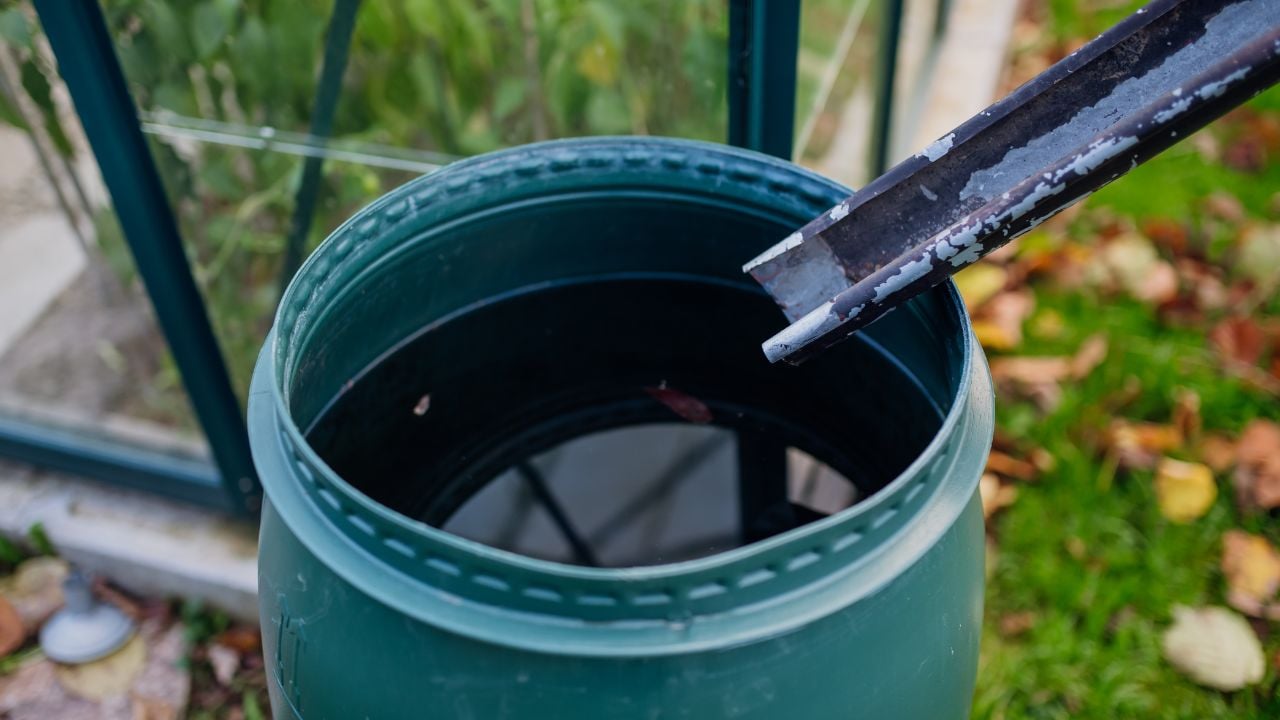
The statute defines a rain barrel as a storage container with a sealable lid.
The definition also requires the container to sit aboveground, outside a residential home.
2. Rooftop Water Only
Could a barrel catch the runoff from your driveway or patio?
Not under this exception.
Colorado State University’s 2016 explainer says rain barrels can only capture rainwater from rooftop downspouts.
The statute also names which roof counts. It’s the roof of a building used primarily as a residence.
A barrel fed by a driveway drain or a slope in your yard is collecting water the exception never covered.
3. Four-Unit Building Cap
Under that roof, the rain barrel exception covers a single-family home or a multi-family building with four units or fewer.
A fourplex qualifies, but a five-unit apartment building doesn’t.
If you own a townhome, the law treats your unit as a single-family residence.
The statute defines that term to include an individual residence in a row of homes joined by common sidewalls.
Renters, take note.
If your complex has five or more units, a barrel at your building’s downspout sits outside what the statute allows.
4. Indoor-Use Ban
Rain barrel water stays outdoors.
The statute bars you from using it for drinking water or indoor household purposes.
Piping barrel water inside for laundry or the kitchen sink breaks that rule.
Colorado State University says untreated rainwater collected from roofs isn’t safe to drink.
Outdoors, the statute allows irrigation of your lawn and garden.
Psst! How much do you know about rain barrel rules? Flip the cards and see if you can ace it.
5. Same-Property Use
Once your rain barrel water leaves the residential property where the rain fell, it’s outside the exception.
That rules out hauling it to a neighbor’s yard, a community garden, or a second home.
The division says barrel water goes to outdoor uses on the property where it was collected.
Your neighbor’s tomatoes don’t qualify.
Exempt-Well Permits
A rain barrel’s 110-gallon limit changes if your home runs on an exempt or small-capacity well permit.
You need a rooftop precipitation collection permit before you start collecting.
Senate Bill 09-080 opened that pathway to well owners in 2009.
With that permit, there’s no limit on how much water you collect, as long as it comes off the roof of your residence.
Your well permit still applies.
A December 2023 division fact sheet says you can use the collected water only for the purposes that permit allows.
If that permit limits you to indoor household use, you can’t water your garden with the collected rooftop water.
That well-permit pathway is also ruled out for homes served by a water system that supplies more than three single-family dwellings.
Curtailment Orders
Section 37-96.5-103(3) of the statute lets the state engineer curtail rain barrel use under a separate water administration statute.
That means a division engineer can order a diversion stopped when it causes material injury to a senior water right.
A senior water right is the older claim on a stream.
The first person to put a stream’s water to use gets the first right to it.
The division says that right must be satisfied before any other water rights can be fulfilled.
Say a rancher downstream holds an older right to a creek.
If barrels and other diversions upstream cut into his supply enough to cause material injury, an engineer can order them stopped.
Your barrel gets no exemption.
Enforcement Penalties
The general water enforcement statute, not the rain barrel statute, sets civil penalties of up to $500 a day.
Those penalties apply when you divert water against a valid order of the state engineer or a division engineer.
Each day counts separately.
Graywater Opt-In
What about the water from your shower or washing machine?
That’s graywater, the water collected after uses such as showers and laundry, and rain barrel rules don’t cover it.
A 2013 law made graywater reuse an opt-in program for local governments, not a statewide one, according to the Colorado Department of Public Health and Environment.
Your local government decides.
Regulation 86 excludes toilets, urinals, kitchen sinks and dishwashers as graywater sources.
If you want to reuse shower water on your garden, the use still has to fit the state’s water rights system, including well permit conditions and water supplier restrictions.
Where HOA Rules Still Apply
A rain barrel that meets every state limit can still break your homeowners association (HOA) rules.
Colorado law generally bars an HOA from prohibiting a rain barrel, but it allows reasonable aesthetic requirements for a barrel’s placement and appearance.
That protection excludes leased property, common elements, property your association maintains, and units attached to others unless their owners agree.
Check your association first.
6 Colorado Utility Charges That Keep Rising Without a Rate Case

In August 2026, Colorado regulators approved a Xcel Energy increase of about $5 a month for a typical residential bill, after cutting the utility’s request by more than half.
Some other charges on your bill can rise without a fight like that.
6 Colorado Utility Charges That Keep Rising Without a Rate Case
9 Things That Shut Down in a Colorado Mountain Town Between Seasons

Breckenridge’s Epic Discovery summer operations were scheduled to end September 7, 2026, according to the town’s tourism site.
Some of the other closures may surprise you.
9 Things That Shut Down in a Colorado Mountain Town Between Seasons
