
5 Foods Arkansans Won’t Let a Community Gathering Start Without

Some Arkansas gatherings are built around a single dish.
A supper or a festival can hinge on whether the right food is on the table.
Here are the foods Arkansans expect when the community turns out, and the stories behind them.
1. Barbecued Raccoon
The Gillett Coon Supper serves barbecued raccoon at an annual January gathering that the Gillett Farmer’s and Businessmen’s Club has sponsored since 1947.
It began with hunters sharing their raccoon with friends and neighbors.
Then it grew into a fundraiser for the high school football team.
Nearly 1,200 people each year gather in the high school gym for an evening meal, in a town that had 819 residents in 2000.
The supper has also become a rite of passage for people seeking election to political office.
In December 2025, Talk Business & Politics called the supper a required stop on the Arkansas political circuit, ahead of its 82nd edition.
At the January 1986 supper, diners ate more than 2,000 pounds of barbecued raccoon.
The 1986 menu also included fourteen hams, for those who don’t eat raccoon.
2. Pie
In April 2026, the television station KATV reported that bakers at the Arkansas Pie Festival in Cherokee Village submit two pies, one for judging and one for the auction.
The auction money goes back into science, technology, engineering, arts and math (STEAM) education in the area.
In its April 2026 preview, Talk Business & Politics said the festival draws hundreds of people from around the state.
A charity pie auction would also be held on Saturday, April 25.
Courtship and baking went together in rural areas in a ritual known as pie auctions.
Young women were expected to have mastered cooking skills and to compete for top honors, whether at the county fair or at a local fundraiser.
Beaus were expected to bid whatever it took to win the pie or cake.
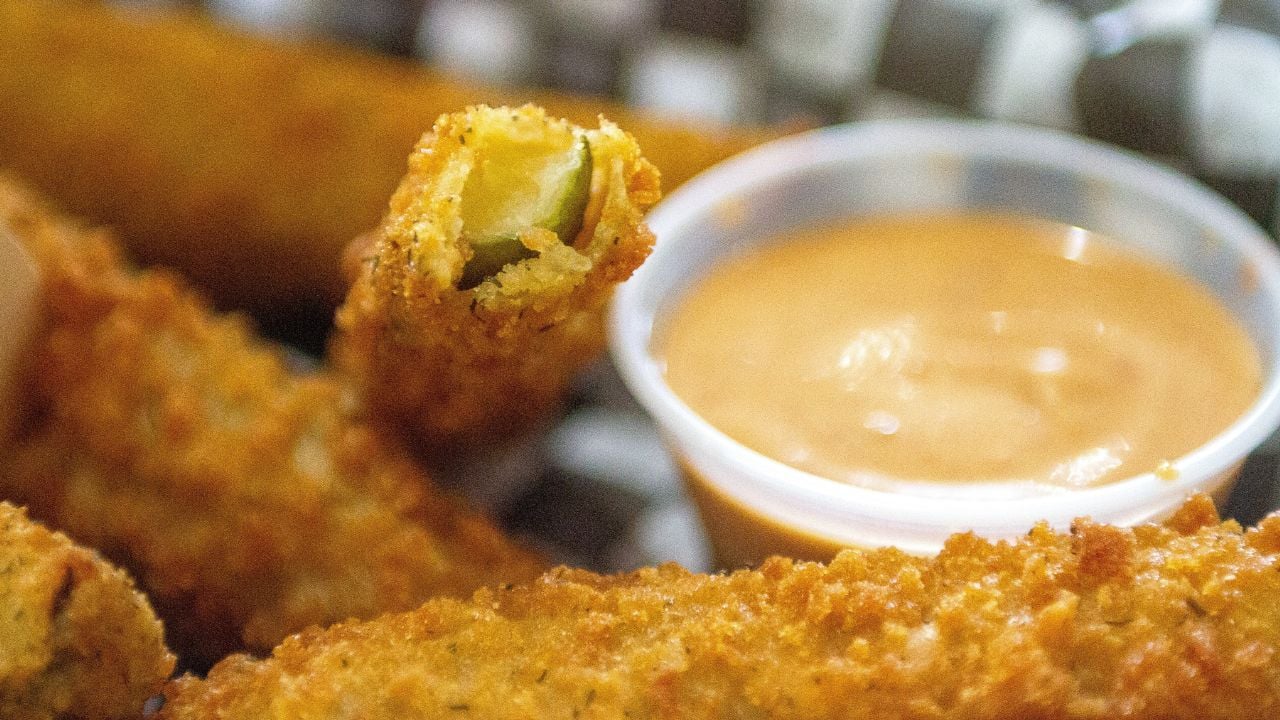
3. Fried Dill Pickles
The Encyclopedia of Arkansas describes Atkins as the home of the famous fried dill pickle.
Picklefest was first observed in 1992 and is held annually on the third weekend in May.
Fatman’s Original Fried Dill Pickles are a crowd pleaser at the annual two-day Picklefest in downtown Atkins.
The Austin family sells an estimated 2,500 orders during the festival.
4. Watermelon
Watermelon is the food behind the Hope Watermelon Festival, a gathering the Encyclopedia of Arkansas says began in 1926.
The competition for growing big melons was started by John S. Gibson, who began offering modest prizes for the largest vegetables and watermelons in 1916.
A 136-pound melon harvested on August 12, 1925, generated the excitement that led to the first festival the following year.
The first five festivals drew large crowds, and the 1928 crowd numbered 30,000.
The first series of festivals ended, and in addition to the Depression, handling the huge crowd was too much for the small town.
The festival has been ongoing, though not continuously, since 1977.
The Hope-Hempstead County Chamber of Commerce listed the 2026 festival for August 6-8 at Hope Fair Park, with free admission to the grounds.
Activities listed in the encyclopedia include watermelon-eating and seed-spitting contests, fiddling, arm wrestling contests and vendors.
Seeds fly.
5. Tomatoes
Tomatoes are the theme of the All-Tomato Luncheon, a community gathering held during Warren’s Pink Tomato Festival.
The Bradley County Extension Homemakers Club served its 68th luncheon on June 14, 2025, at First Methodist Church in Warren.
Nearly 200 guests came.
The menu included chicken salad with sliced tomatoes, green bean almondine with green tomatoes, carrots marinated in tomato juice and tomato basil crackers.
The Heavenly Tomato Cake is a chocolate cake with tomato juice in the cake and the icing.
The recipe belonged to Jean Frisby, a former Bradley County extension agent who organized the first tomato luncheon in 1957.
A state senator and a state representative pooled their money to buy the cake for $1,500.
A 20-pound box of what the Division of Agriculture’s release calls Bradley County’s finest also sold at auction, for $3,100.
Dinner on the Grounds
Sundays following church services were noted for dinner on the grounds, the Encyclopedia of Arkansas says.
It was commonly said that Methodist women would be denied access to heaven unless they brought along a covered dish.
In farm country and small towns, the main meal was called dinner and came at noon.
In conservative Protestant families, the Sunday noon meal was served cold until well into the twentieth century.
Fish also figured in Lenten food preparation, and in time the Knights of Columbus, a Catholic men’s group, served fish dinners that were invariably fried.
After the 1940s, when public school cafeterias became the norm, many Protestant children discovered that Friday was fish day.
Grape, Spinach and Gumbo Festivals
Virtually every county had some kind of festival with food as an important function, the Encyclopedia of Arkansas says.
Its examples include the Greek Food Festival in Little Rock, the Altus Grape Fest in Franklin County, a spinach festival in Alma and a gumbo festival in West Memphis.
Competitions for barbecue and chili were common.
Tomatoes, purple hull peas, peaches and crawfish are also at the center of various local events.
Psst! How much do you know about food and festivals? Take our quiz and see if you can ace it.
Quiz
Food and Festival IQ
Answer these questions on food and festivals. We bet you can’t get them all right. Prove us wrong?
At the Gillett Coon Supper, which group is allowed to make speeches?
Campaign Barbecues
Barbecue arrived in the Arkansas Territory as both a cooking technique and a way to gather, according to the Encyclopedia of Arkansas.
Settlers traveling west from the eastern seaboard and the Appalachian Mountains brought barbecue with them.
On July 4, 1821, two of the first recorded barbecues took place in what would become Arkansas.
At the one in Phillips County, a 1908 history of Arkansas says, several beeves were roasted whole and served in barbecue style.
Politicians noticed.
They began to see those community events as ideal platforms for electioneering.
Electioneering barbecues often drew hundreds of people from forty to fifty miles in every direction.
In 1840, the Tippecanoe Club of Little Rock adopted a resolution to give a free barbecue to the people of Pulaski County.
The resolution also welcomed as many people from the adjoining counties as could conveniently attend.
In 1847, the citizens of Crawford and Washington counties prepared an extensive barbecue for a volunteer company of seventy men.
Campaign barbecues remained a fundamental feature of political life in the state well into the twentieth century.
8 Restaurant Chains Arkansans Defend Harder Than They Should
Some Arkansas restaurant chains have fans who guard them fiercely.
These are the chains Arkansans defend harder than they should.
8 Restaurant Chains Arkansans Defend Harder Than They Should
7 Arkansas Sayings That Leave Out-of-Towners Completely Lost

Some Arkansas sayings stump out-of-towners before the first sentence ends.
These are the sayings that leave visitors completely lost.
7 Arkansas Sayings That Leave Out-of-Towners Completely Lost
