
5 Mistakes Kansans Make When Taking Pets on a Road Trip

A parked car’s interior can pass 110 degrees within an hour on a 70-degree day, and cracking the windows doesn’t slow it down, according to the American Veterinary Medical Association.
A Kansas summer afternoon starts well above 70.
These are the mistakes Kansans make when taking pets on a road trip.
1. Blowing Past the Two-Hour Mark
Interstate 70 runs 424 miles across Kansas, and when the state finished the highway in 1970, it was the longest continuous stretch of interstate any single state had built.
That’s a lot of road between stops.
The AVMA recommends a bathroom and water break every two hours for a dog.
Skip that mark on a long haul across western Kansas, and a dog can go through much of a tank of gas without stretching its legs or getting a drink.
That break is meant for exercise time, not just a bathroom minute.
Nobody notices the miles pass.
2. Leaving the Car for One Quick Stop
A quick gas station stop in Kansas is exactly when a dog ends up left in the back seat with the windows cracked.
It never takes long to turn dangerous.
The AVMA measured that 110 degrees on a 70-degree day, which is mild by Kansas standards.
Wichita’s numbers back that up: The National Weather Service puts the city’s normal high near 91 degrees at the peak of summer.
A car that starts hot only gets worse from there.
Shade doesn’t save it either.
The AVMA’s advice on this one is blunt: Never leave a pet alone in a parked car, no matter the outdoor temperature or how quick the errand seems.
How Fast a Parked Kansas Car Heats Up
A parked car in Kansas doesn’t need triple digits outside to turn dangerous inside.
The AVMA breaks the rise into stages.
The interior runs about 19 degrees hotter in the first 10 minutes, 29 degrees hotter by the 20-minute mark, and 34 degrees hotter by the half hour.
None of that slows down with a window cracked or the car parked in shade.
An hour in, the interior runs about 43 degrees hotter, and the gap tops 50 degrees by the two- to four-hour mark.
The same math applies whether a dog is inside for five minutes or fifty.
3. Letting a Head Hang out the Window
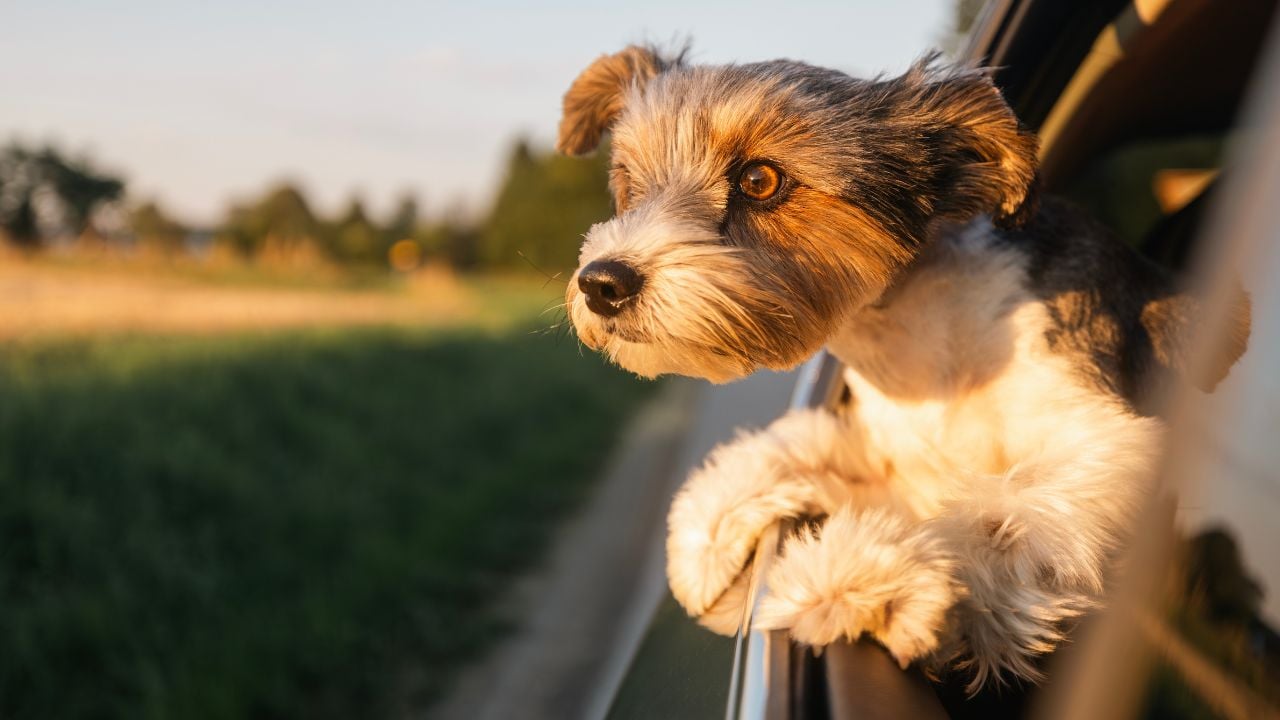
Kansas’s rural interstates and its Turnpike carry a 75 mph speed limit, and that’s exactly the wrong speed for a dog’s head to be hanging out a window.
Ears flapping in the wind looks like the best part of the trip.
The AVMA warns against letting a dog extend its head outside a moving vehicle, since debris, gravel, and bugs travel at highway speed too.
At 75 mph, that debris hits hard enough to matter, especially behind a gravel truck or a mower cutting the shoulder on a Kansas backroad.
The AVMA also flags a second risk beyond debris: A sudden stop can throw a dog partway out that open window.
A cracked window is plenty.
4. Riding Loose in the Truck Bed
Pickup trucks are a common way to get around rural Kansas, and many dogs still ride loose in the bed.
The AVMA notes it’s outright illegal in some states, though not every state treats it that way.
That’s a hard habit to break.
The AVMA calls for a secured, properly sized kennel in a truck bed instead of a dog riding loose.
A sudden stop or a pothole can throw a dog clear of the truck.
A leash tied to the bed rail isn’t a fix either.
A dog thrown over the side can end up dragged instead of thrown free, or caught and choked by a tether that snags on the way over.
A kennel changes that math.
Psst! How much do you know about the history of hitting the road with a pet? Take our quiz and see how many you can get right.
Quiz
Road Trip History IQ
Answer these questions on pet and road trip history. We bet you can’t get them all right. Prove us wrong?
What breed was Bud, the dog who joined the first cross-country road trip across America in 1903?
5. Skipping the Pre-Trip Vet Visit
Kansas holds the geographic center of the Lower 48, a spot near Lebanon the U.S. Geological Survey pinpointed, which means a road trip out of the state can start within a couple of hours of home.
That crosses a state line fast.
The AVMA recommends a travel checkup, a current rabies vaccination, and a Certificate of Veterinary Inspection signed by an accredited veterinarian.
That paperwork needs a date within 30 days of a trip that crosses into another state.
Skip that step, and a routine stop at a boarding kennel or a state checkpoint can turn into a scramble for paperwork nobody packed.
Paperwork travels light.
The Nation's First Interstate Stretch
Kansas opened the country's first section of interstate highway on November 14, 1956, an eight-mile stretch of US-40 just west of Topeka, according to the Kansas Historical Society.
Kansas got there first.
That same stretch, built between the Valencia and Maple Hill roads, was also the first concrete highway finished anywhere in the country under the new Federal-Aid Highway Act.
The Kansas Turnpike had opened a month earlier, in October 1956, and I-70's later route incorporated part of that turnpike between Kansas City and Topeka.
Drivers crossing Topeka on I-70 today are still riding close to that same 1956 alignment.
Every mile marker on a modern Kansas road trip sits on a route the state was already building before many states had an interstate system to plug into.
10 Things That Only Make Sense to People Who Grew Up in Kansas

Four Kansas counties run their clocks an hour behind the rest of the state, and every kid who grew up there just accepts it.
A Kansas childhood packs in habits and know-how that stop making sense the moment someone crosses the state line.
10 Things That Only Make Sense to People Who Grew Up in Kansas
8 Hy-Vee Etiquette Rules Kansas Shoppers Wish Everyone Followed

A Lenexa shopper lets go of her cart to wave at a familiar face, and it rolls three spaces before anyone notices.
Small moments like that add up to a list of unwritten etiquette Kansas Hy-Vee regulars wish every shopper knew.
8 Hy-Vee Etiquette Rules Kansas Shoppers Wish Everyone Followed
