

5 Roadside Memorial Rules Kentucky Families Find Out About Too Late

Kentucky’s highway encroachment law lets the state fine anyone who leaves an unauthorized structure in a road’s right-of-way up to $2,000.
A homemade cross planted in the grass past the shoulder counts, and Kentucky runs no official program to register a memorial there.
These are the roadside memorial rules Kentucky families find out about too late.
Note: This is general information, not legal advice. Right-of-way rules, fines, and enforcement practices are subject to change.
1. A Permit for Every Marker
Kentucky law treats a cross or a small memorial garden in a state road’s right-of-way the same way it treats an illegal fence or driveway.
It’s an encroachment, and encroachments need a permit.
Almost nobody applies for one before setting up a memorial.
Grief doesn’t leave room for paperwork, and the law doesn’t carve out an exception for it.
It’s still the law.
Skip the permit, and a family has technically broken the same statute that covers a fence built without a permit.
The Fine Schedule in Kentucky
Kentucky’s encroachment law doesn’t charge one flat fee.
A first violation runs $500.
The fine rises to $1,000 on a second violation within three years.
A third violation reaches $2,000.
The state can also bill a family for the cost of removing the memorial, separate from any fine.
2. No Guarantee Against Removal
Kentucky sets no official window for how long a roadside memorial can stay up because there’s no program to set one in the first place.
Other states draw a line and stick to it.
Florida keeps a marker up for about a year before it comes down, and California stretches closer to seven.
The state offers neither guarantee.
A memorial could stand for a decade untouched, or it could come down next week.
The same routine maintenance schedule creates another way a memorial can disappear.
Kentucky Transportation Cabinet crews already clear one category of unauthorized object from the right-of-way on a regular basis: Political and advertising signs.
Those signs threaten drivers and the mowing crews themselves, so crews remove them.
The Cabinet’s mowing bulletins spell out that reasoning, but they’re written about signs, not memorials.
Nothing in that policy exempts a memorial from routine roadside maintenance.
No state crew has been documented removing a cross or a wreath under that policy, but nothing in it protects a memorial from the mower either.
3. Stopping to Tend a Memorial
State law bars stopping, standing, or parking on the roadway or the shoulder of a highway outside a short list of exceptions.
Pulling over to swap out flowers or straighten a leaning cross isn’t one of them.
Kentucky Revised Statutes 189.450 names disabled vehicles, official traffic stops, and a handful of other narrow cases.
Nothing else qualifies.
The rule tightens further on any controlled-access highway.
Stopping on an interstate shoulder to visit a memorial isn’t a gray area.
It’s parking where the law names the exact spot as off-limits.
Psst! How much do you know about Kentucky’s roadside history? Take our quiz and see how many you can get right.
4. No Protection If a Memorial Disappears
The state does criminalize damaging a public monument, a charge that carries a Class A misdemeanor.
That word “public” is doing a lot of work.
A memorial a family builds without a permit never picked up any official standing to begin with.
Whether it counts as the kind of monument that statute protects is a question nobody in Kentucky has clearly answered.
In practice, that uncertainty leaves an unofficial memorial with no protection at all.
A family whose memorial disappears has no clear legal recourse, not against a stranger who takes it and not against a work crew that clears it.
A Lexington family found out exactly what that looks like.
Deborah Allen’s handmade cross for her son Zachary, killed in a crash near Mason Headley and Beacon Hill roads, disappeared from the crash site about two months later.
She reached out to the city and to neighbors near the intersection.
Nobody had an answer.
5. Private Land and County Roads
Families often assume moving a memorial a few feet farther from the pavement solves the problem, and sometimes it does nothing of the sort.
Land beside a rural road is frequently private property, not extra right-of-way.
That patch belongs to a landowner, and planting a memorial there without asking is trespassing, however good the reason.
Permission still matters.
The road itself can shift the rules too.
A large share of Kentucky’s rural miles are county roads, not state highways, so the state’s encroachment statute never applies there at all.
Whatever rule governs that stretch belongs to the county fiscal court, and it’s rarely written down anywhere a family can find before they need it.
Why Enforcement Rarely Matches the Law
Kentucky’s rules on paper look stricter than what happens along many of its roads.
Officials show deference to grieving families even where a memorial is technically against the rules.
Crews usually leave a marker alone unless a complaint comes in or it blocks a sightline.
Amanda Reid, a University of North Carolina journalism and law professor, documented that gap in a paper titled “Private Memorials on Public Space.”
Her paper puts it bluntly: “in probably no other area of public life does practice diverge so dramatically from official policy.”
It won’t always hold.
A new district engineer, a road-widening project, or one neighbor’s complaint is usually what flips a Kentucky memorial from overlooked to enforced.
When it does, the same $500 first-violation fine applies, no matter how many years the memorial had already stood.
9 Kentucky Dishes That Make Out-of-Staters Put Their Fork Down

Cadiz, Kentucky, has held a festival honoring one food since 1977, and it isn’t barbecue or bourbon.
Out-of-staters bite in expecting a mild breakfast meat and get a wall of salt instead.
9 Kentucky Dishes That Make Out-of-Staters Put Their Fork Down
9 Things That Change the Second You Cross From Ohio Into Kentucky
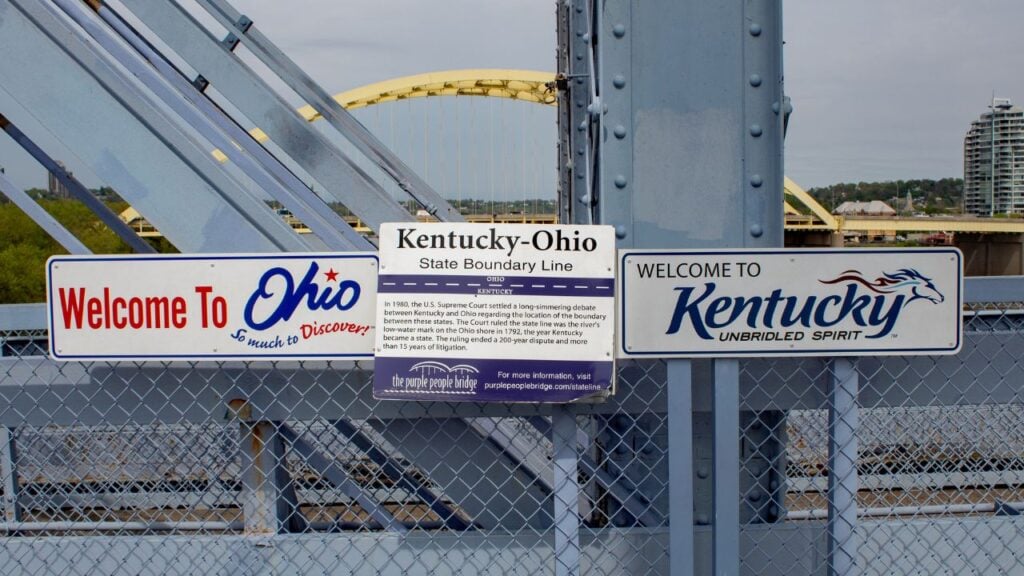
The Roebling Suspension Bridge carries drivers from Cincinnati straight into Covington, Kentucky, with nothing about the crossing looking unusual.
The tax on the receipt says otherwise, and so does the price at the pump.
9 Things That Change the Second You Cross From Ohio Into Kentucky
