
5 South Dakota Roadside Stops That Are Stranger Than the Billboards Suggest

Somewhere near Exit 110 on Interstate 90, a driver crossing South Dakota passes the fourth hand-painted Wall Drug sign in five miles.
The billboards are the tame part.
These are the South Dakota roadside stops that are stranger than the billboards suggest.
1. Corn Palace
The Corn Palace looks like exactly what the roadside signs promise: A domed building in Mitchell covered floor to roofline in corn.
The corn claim on the billboard checks out.
It says nothing about the wrestling matches, the graduation ceremonies, or the touring acts.
Mitchell’s arena has hosted basketball games, dances, banquets, rodeos, and performers from John Philip Sousa to Willie Nelson, all inside the same corn-covered walls.
The town spends about $130,000 a year keeping a 1921 building looking finished, and around half a million people still show up to see it.
The murals themselves don’t last.
Every June, workers strip the Corn Palace’s exterior back to bare board.
They hand-press on well over 275,000 ears of native corn, plus wheat, rye, and sour dock, restarting the whole design from nothing.
Nobody paints it.
The color comes from eleven corn varieties that grow that way on their own.
Why the Corn Palace Looks New Every Summer
Workers don’t touch up the Corn Palace’s old mural.
Muralists trace each new design onto black roofing paper with a projector first, then press the corn on panel by panel, a method locals call corn-by-number.
Interior murals last 15 to 20 years between replacements.
The exterior is the only part that comes down and goes back up from scratch each summer, which is why the Corn Palace never looks like last year’s building.
2. Petrified Wood Park
Petrified Wood Park doesn’t look like much on the highway sign, just a name and an arrow.
Lemmon’s actual park takes up a full city block, built almost entirely out of petrified wood.
An amateur geologist named Ole Quammen built it in the early 1930s, using the project to give local families paying work during the Depression.
Quammen and his crews gathered more than 3,200 tons of petrified wood and 100 tons of petrified grass from within 25 miles of town.
Not from a quarry.
They stacked some of it into towers as tall as 32 feet.
Others went into an octagonal building called the Castle, built from more than 300 tons of petrified material, including dinosaur and mammoth bones.
A museum next door uses petrified logs for its walls and petrified grass for its floor.
The town of Lemmon has owned and run the park since 1954.
It’s also listed on the National Register of Historic Places.
3. Porter Sculpture Park
Porter Sculpture Park announces itself off I-90 near Montrose with one thing: A 60-foot, 25-ton bull’s head rising over the prairie.
That’s the postcard shot.
It’s also the one sculpture here that doesn’t unsettle visitors.
Visitors pay a $10 admission and sign the guestbook before setting out.
A self-guided trail then leads past more than 60 sculptures that reviewers and local press have called creepy and bizarre, not cute.
Second in size is a 40-foot, 40-ton horse, a full standing figure rather than a head like the bull’s.
The other 59 sculptures don’t get the same friendly billboard treatment as the bull.
Rancher-turned-welder Wayne Porter built the whole collection himself, starting with a piece he made at age 10 in his father’s blacksmith shop in St. Lawrence, South Dakota.
He opened the park to the public in 2000, and it still runs its regular season from mid-May to mid-October.
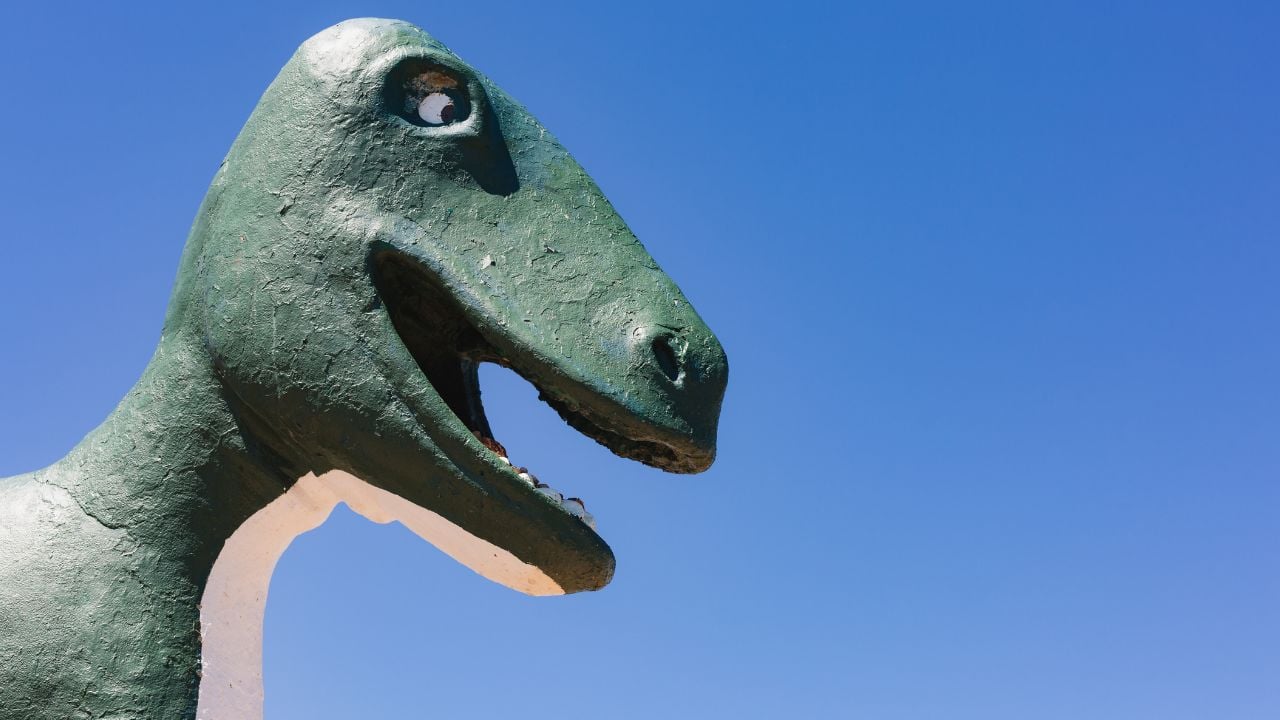
4. Dinosaur Park
Dinosaur Park sits on a free hilltop above Rapid City with a view best at sunset.
Its seven concrete dinosaurs hide a stranger story than that postcard view lets on.
A lawyer and sculptor named Emmet Sullivan designed the dinosaurs in 1936.
A Depression-era Works Progress Administration (WPA) project put local men to work and gave Rapid City a tourist draw.
Each one is built the same way: A two-inch iron pipe frame wrapped in wire mesh, topped with a concrete shell four to five inches thick.
The Apatosaurus alone runs 80 feet long and 28 feet high.
Sullivan and his crew finished the original five dinosaurs by 1938.
A Dimetrodon and a Protoceratops joined the park in 1958, two decades after the 1937 dedication.
Dinosaur science has moved on since then.
The statues haven’t.
They still wear a green-and-white paint scheme from a 1950s touch-up, and their shapes reflect what paleontologists believed generations ago, not what they know today.
Psst! How much do you know about South Dakota beyond its roadside stops? Take our quiz and see how many you can get right.
Quiz
South Dakota IQ
Answer these questions on South Dakota records and geography. We bet you can’t get them all right. Prove us wrong?
In what single year did South Dakota set both its hottest temperature on record (120°F) and its coldest (-58°F)?
5. Wall Drug
Wall Drug is the reason for the sign near Exit 110, and dozens more like it across South Dakota.
Ted and Dorothy Hustead opened the pharmacy in December 1931.
It nearly failed until 1936, when Dorothy borrowed the idea from Burma-Shave and painted a message on boards along the highway: "Free ice water."
Travelers pulled off in droves, and the signs kept multiplying.
One eventually went up in the London Underground, pointing travelers toward Wall, South Dakota, 5,160 miles away.
None of those signs mention what's waiting at the end of the exit ramp.
Wall Drug has grown into a storefront complex spanning more than 50,000 square feet.
There's a giant jackalope for photos, an animatronic Tyrannosaurus rex that roars and shakes its head on a timer, and a shooting gallery.
There's also a chapel and a Western art gallery restaurant that seats 500 people.
The ice water is still free.
The coffee's still a nickel.
Ted and Dorothy's family still runs the store.
It now pulls in about 2 million visitors a year, with up to 20,000 people passing through on a busy summer day.
8 Austin Freecycling Options That Don't Require Climbing Into a Dumpster
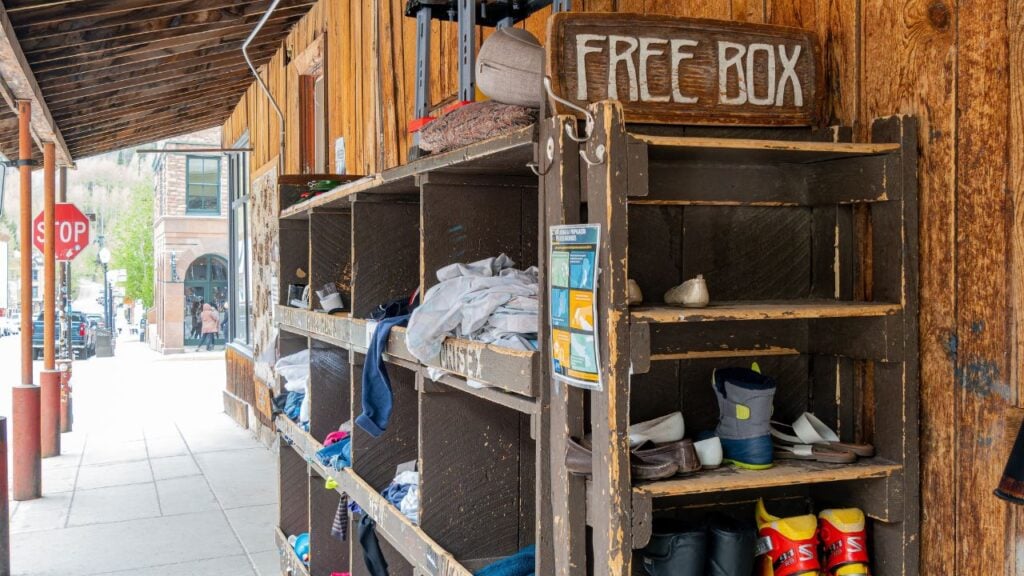
Austin set a goal back in 2009 to divert 90 percent of its trash from landfills and incinerators.
Giving things away instead of tossing them does a good share of that work, and the city has more freecycling options than many people ever check.
8 Austin Freecycling Options That Don't Require Climbing Into a Dumpster
