
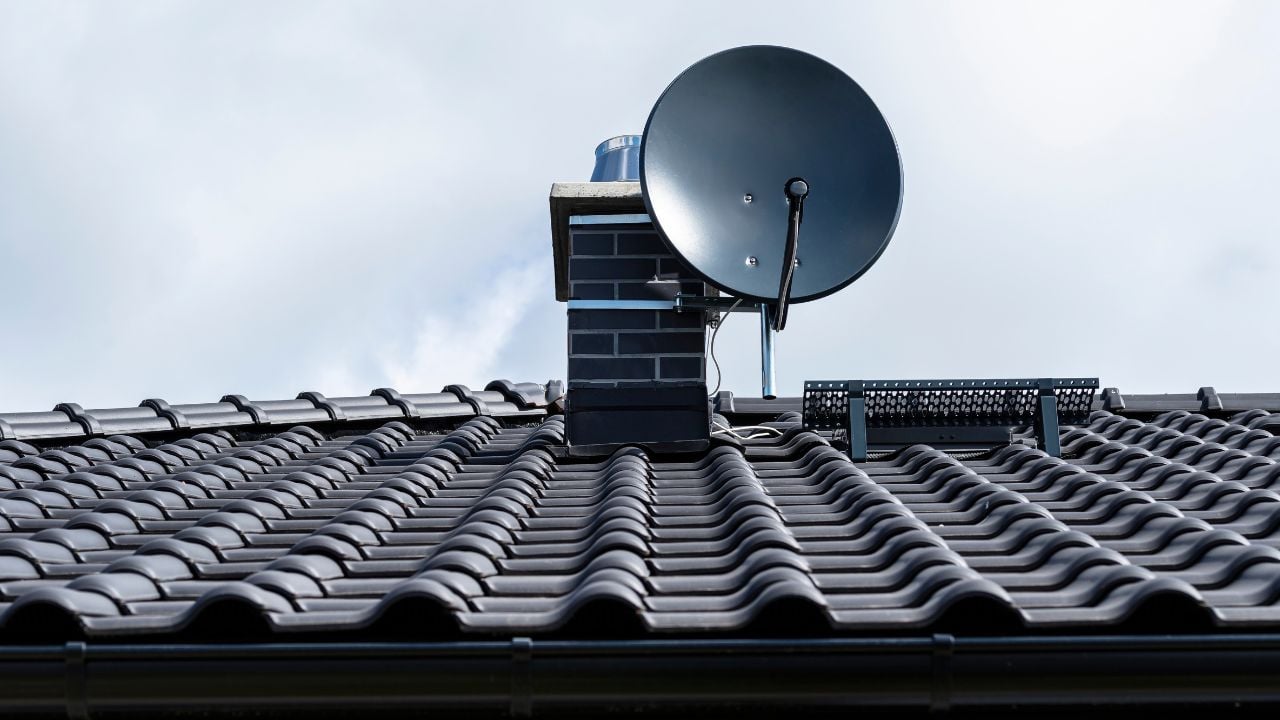
5 Things a Georgia HOA Can’t Stop You From Doing in Your Yard

Starting Jan. 1, a Georgia homeowners association that hasn’t registered with the Secretary of State can’t collect fines from owners.
That’s a brand-new limit.
But older limits on HOA power already reach into your yard, and HOAs can’t write covenants around them.
These are the things a Georgia HOA can’t stop you from doing in your yard.
Note: This is general information, not legal advice. Association rules vary by community and are subject to change, so check your community’s governing documents.
1. Satellite Dishes
A Georgia HOA can’t ban the satellite dish on your lot because a Federal Communications Commission (FCC) rule overrides the covenants.
The rule protects dishes one meter or less across, which works out to about 39 inches.
That’s a big dish.
The same language covers a dish that sends and receives internet signals by satellite, so a satellite internet setup qualifies too.
Under the FCC rule, an HOA restriction can’t unreasonably delay your installation or unreasonably raise its cost.
It also can’t keep you from receiving an acceptable signal.
So a rule that pushes your dish to a shady corner of the backyard, where it can’t see the sky, doesn’t hold up.
Your HOA does keep one opening.
It can enforce a restriction that serves a clearly defined safety goal, as long as that restriction applies equally to other fixtures of similar size and weight.
2. Over-the-Air TV Antennas
Georgia HOAs answer to that same FCC rule when a homeowner puts up an antenna for free broadcast TV.
Broadcast TV antennas have one extra advantage, though.
The one-meter cap applies to satellite dishes and certain wireless antennas, while the rule’s line for broadcast TV antennas carries no size limit.
Bigger antennas count too.
The rule also protects the mast that holds a covered antenna up.
Your HOA can still ask for a safety review, though, on a mast that rises higher than about 12 feet above your roofline.
That helps anyone in Macon or Marietta who wants to drop cable and still catch the local news.
The protection stops at the property line you control, however.
According to the FCC, an association can still restrict antennas in the common areas it controls.
If your HOA fights an antenna on your lot, you can ask the FCC to settle it with a petition for declaratory ruling, or take the dispute to court.
3. Grandfathered Yard Uses
An HOA can’t enforce a newly added covenant restriction against your lot unless you agreed to it in writing.
That protection covers planned subdivisions of 15 or more lots.
That Georgia Code section covers any change that imposes “a greater restriction on the use or development of the land.”
Picture it in your backyard.
Say the covenants allowed a storage shed when you bought your house, and a later amendment bans sheds.
If you never signed off on that amendment, the statute bars enforcing it against your lot.
The Georgia Court of Appeals applied that rule in a 2013 case against the Clary Lakes Homeowners Association.
Clary Lakes had amended its declaration to require that garages stay clear for parking instead of storage.
The homeowners who fought it had bought years before that amendment and never consented to it in writing, and the court held the new restriction couldn’t be enforced against them.
That consent rule comes with one big exception.
Which Georgia HOAs Skip the Consent Rule
Georgia’s written-consent rule for new covenant restrictions doesn’t reach every HOA.
The Georgia Property Owners’ Association Act switches it off for covenants in any declaration created under that act or submitted to it.
In those communities, an amendment generally needs the agreement of owners holding two-thirds of the association’s votes.
One owner’s objection can’t block it.
Your recorded declaration shows whether your community falls under that act.
4. American Flag Displays
Federal law keeps a Georgia HOA from banning the U.S. flag on your property, through the Freedom to Display the American Flag Act of 2005.
The federal law, signed in July 2006, bars condo, co-op and homeowners associations from adopting or enforcing any policy that keeps a member from displaying the flag.
It covers property the member owns or has exclusive use of.
Associations also can’t enter into any agreement that would restrict a flag display.
The covenants can’t override it.
That holds for a porch bracket in Savannah and a front-yard display in Alpharetta alike.
Your HOA isn’t left with zero say, though.
The act allows reasonable limits on the time, place or manner of a display when an association needs them to protect a substantial interest.
Your display also has to follow the federal flag code in Title 4 of the U.S. Code.
5. Wheelchair Ramps
Under the federal Fair Housing Act, a Georgia HOA can’t stop a resident with a disability from making reasonable modifications to their home.
The Department of Housing and Urban Development (HUD) and the Justice Department issued joint guidance in 2008 that applies the rule to homeowners associations.
That guidance uses a ramp at a home’s entrance as one of its examples.
A ramp built for a wheelchair generally needs about a foot of length for every inch it rises.
Clearing a raised entrance can mean a run that stretches well out across your yard.
You pay for it.
The guidance puts the cost of the work on the person with the disability, not on the association.
Your HOA still gets a say in how the ramp goes in.
Under the HUD guidance, a housing provider can require you to get approval first, pull any needed building permits and have the work done in a workmanlike manner.
Once a request meets those conditions, the guidance says the provider can’t deny it.
Where the Protection Runs Out
Georgia HOAs keep control over several yard projects that homeowners might assume the law protects.
Solar panels are one.
A 2025 bill, House Bill 389, would have barred Georgia associations from blocking solar energy devices.
Lawmakers never passed it.
Georgia’s Solar Easement Act of 1978 does something narrower, letting property owners create written easements that protect a solar device’s access to sunlight.
Signs get no special shield, either.
In a 2000 ruling, the Georgia Court of Appeals upheld an injunction against an unapproved sign a homeowner posted criticizing his builder.
The court held that the homeowner had agreed by contract to follow the neighborhood’s covenants.
The FCC antenna rule has gaps too, since it doesn’t cover AM or FM radio antennas, amateur radio antennas or citizens band (CB) radio antennas.
Psst! How well does your HOA follow Georgia’s rules? Run through this checklist and see where it stands.
What Changes on Jan. 1
Georgia HOAs face new state oversight on Jan. 1, 2027, when the Secretary of State’s office takes charge of the Georgia Property Owners’ Bill of Rights Act.
That law, Senate Bill 406, requires owners’ associations to register with that office every year.
Skipping it costs them.
An unregistered association can’t assess or collect fines or fees against owners, including a fine for a yard violation.
The law also gives owners a new place to push back.
An owner can file a written complaint with the Secretary of State within 180 days of the association’s alleged action or inaction.
Filing that complaint automatically stops the association from collecting any fines or fees tied to it.
The stay lasts until a hearing officer issues conclusions, and the officer can stretch it another 15 days.
7 Rules That Decide What Georgians Can Do About a Neighbor’s Camera Pointed at Their Yard
If someone points a camera at the wrong patch of a neighbor’s backyard in Georgia, the charge can be a felony carrying up to five years in prison.
Many homeowners on both sides of the lens have no idea where Georgia draws that line.
7 Rules That Decide What Georgians Can Do About a Neighbor’s Camera Pointed at Their Yard
5 Publix Differences Georgians Notice That Florida Shoppers Never Deal With

Publix stores in Valdosta and Tallahassee sit about 85 miles apart by road, yet they don’t run on the same rules.
Georgia law changes what happens at the register in ways Florida shoppers never see.
5 Publix Differences Georgians Notice That Florida Shoppers Never Deal With
