
5 Things Tennesseans Learned in School About Tennessee History That Historians Have Since Corrected

Davy Crockett wasn’t born on a mountaintop. He was born along the Nolichucky River in Greene County.
Tennesseans learned stories like that in school, and historians have set some of them straight.
Here’s what kids learned in school about Tennessee history that historians have since corrected.
1. Scopes Trial Verdict
The Scopes trial in Dayton ended with a guilty verdict that took the jury less than ten minutes to return.
The day before, defense lawyer Clarence Darrow had called prosecutor William Jennings Bryan to the stand as an expert witness on the Bible.
If you picture Scopes being acquitted at trial, you’ve got the verdict wrong.
Judge John T. Raulston fined him $100, the minimum.
To find the ruling that ended the case, you have to look past the trial.
In January 1927, the Tennessee Supreme Court threw out the conviction because of how the fine was set.
The state constitution required a jury to set any fine over $50, but the judge set the fine.
The court also strongly recommended that the state not retry the case.
The court left the Butler Act standing.
It stood until 1967.
Mississippi and Arkansas passed antievolution laws in the years that followed.
2. Crockett’s Mountaintop
Davy Crockett wasn’t born on a mountaintop.
He was born in Greene County, along the Nolichucky River.
The lyrics of “The Ballad of Davy Crockett” may have convinced generations of a mountaintop birth.
The song was the theme of a five-episode Disney series that began in December 1954.
Author Bob Thompson says the birthplace is a river valley where you can’t see any mountains.
Your mental picture of Crockett’s coonskin cap needs a correction too.
Biographers maintain that Crockett rarely wore a coonskin cap anywhere.
He only started donning one late in life, after the public had come to expect it.
Actor Fess Parker wore one in a series of five Disneyland episodes.
A craze followed.
That mania wasn’t limited to the United States.
The craze pushed up the price of raccoon pelts.
The caps sold to boys were usually faux fur with a raccoon tail attached.
3. Boone and Cumberland Gap
At Cumberland Gap, you can stand in three states at once.
The gap was a trail for thousands of years before Daniel Boone ever saw it.
Bison cut a path through the gap on their way north to salt licks.
Cherokee, Shawnee and Creek people used the route for hunting, trade and settlement.
In 1750, the Virginia Loyal Land Company sent Thomas Walker to find a pass into western Virginia, now Kentucky.
Walker was the first European to document a trip through the gap.
He named the mountain for Prince William, the Duke of Cumberland.
Boone came nineteen years later.
He heard about the gap from a friend and traveled through it on a hunting expedition.
Boone wasn’t the first to find it.
In 1775, land speculator Richard Henderson paid Boone to blaze a trail through the gap for settlement.
You’ll hear that path called the Wilderness Road, and it let roughly 200,000 to 300,000 colonists travel west.
The National Park Service says George Caleb Bingham’s painting of Boone escorting settlers through the gap takes artistic license.
It calls the scene a mythical image of manifest destiny.
4. Fort Nashborough
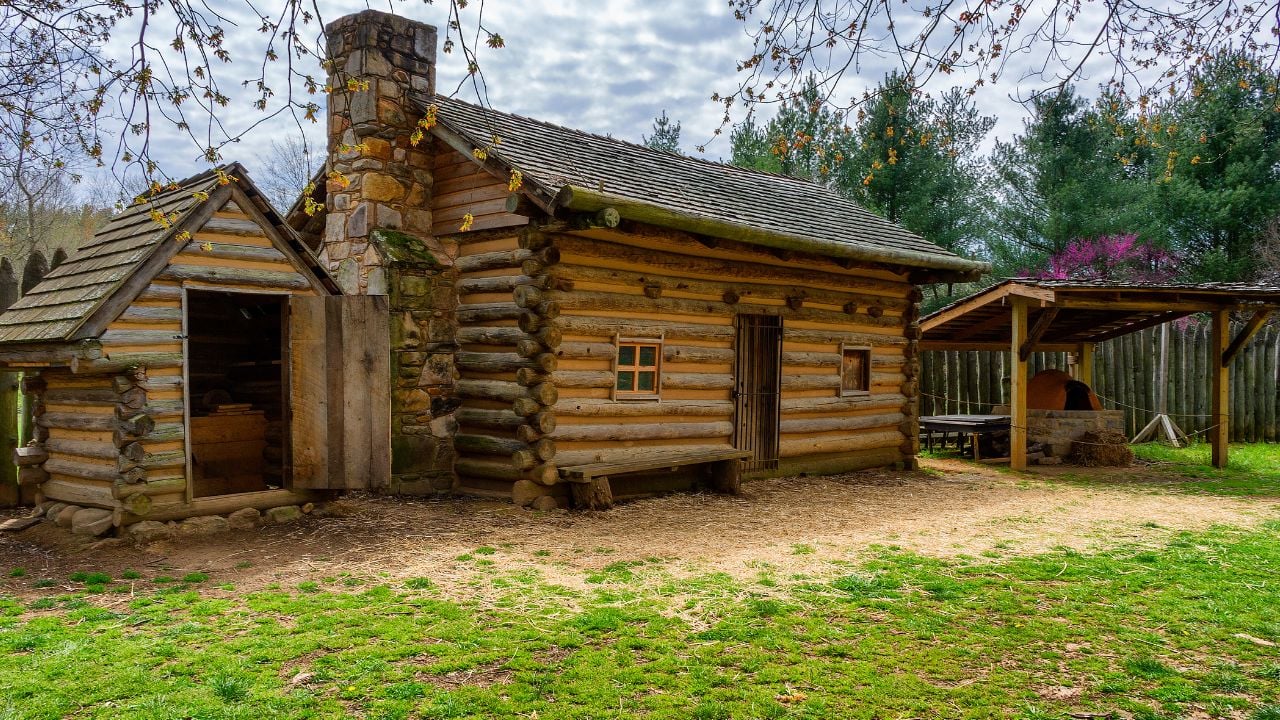
If you’ve seen Fort Nashborough on Nashville’s riverfront, you’ve seen a replica, not the original.
The Tennessee Encyclopedia dates the current version to a 1930 reconstruction and a 1962 rebuild.
The 1962 version is smaller than the initial two-acre enclosure.
The Cultural Landscape Foundation dates a replica to the 1930s and calls today’s open-air fort the third replica.
It also describes an early sketch of the fort as a rectangle 247 by 123 feet, which is under an acre.
The sizes don’t match.
Local donations and the Daughters of the American Revolution paid for that 1930s replica.
The name Fort Nashborough appears in history books, but researcher Paul Clements found that pioneers apparently never used it.
Early residents called the place the fort, the bluff, French Lick Station or Bluff Station.
The fort went up in 1779 on a bluff above the Cumberland River.
Settlers built a two-story structure from nearby timber and surrounded it with log cabins.
The settlement itself did carry the name Nashborough, for General Francis Nash of North Carolina.
The name changed to Nashville in 1784.
Psst! How much do you know about Tennessee’s state symbols? Take our quiz and see if you can ace it.
Quiz
Tennessee Symbols IQ
Answer these questions on Tennessee history and state symbols. We bet you can’t get them all right. Prove us wrong?
Which fruit did Tennessee name its official state fruit in 2003?
5. Trail of Tears Routes
Many people picture the Cherokee Trail of Tears as one unbroken journey, and you might have learned it that way.
Several groups left by water.
In May 1838, 7,000 U.S. soldiers under General Winfield Scott began rounding up Cherokee families.
Most Cherokee families spent the summer in collection camps.
The first plan for the forced removal was a water route down the Tennessee River to the Mississippi.
A drought had lowered the river levels.
That summer, three groups left by water from present-day Chattanooga.
The first two crowded more than 1,300 Cherokee onto flatboats pulled by steamboats.
The third crossed the Tennessee River by ferry and traveled overland to Waterloo, Alabama, before boarding boats.
Most Cherokee traveled overland.
The first overland group left on August 28, 1838.
The Tennessee Encyclopedia says the Trail included three routes.
One crossed Tennessee to Memphis, then followed the Arkansas River to Cherokee land.
A second started at Fort Payne, Alabama, and ran through West Tennessee to Missouri, then down through Arkansas to Oklahoma.
The third went through Nashville to Kentucky, Illinois and Missouri.
Estimates say more than 4,000 of the roughly 14,000 Cherokee on the march died before reaching their destination.
7 Things Tennessee Drivers Can Get Ticketed for That Feel Completely Legal

Some driving habits feel completely harmless.
But a few of them can earn you a ticket in Tennessee.
7 Things Tennessee Drivers Can Get Ticketed for That Feel Completely Legal
7 Tennessee Discounts and Tax Breaks for Residents Over 65 That Go Unclaimed Every Year

Everything seems pricier these days.
Here's where Tennessee seniors may be leaving money on the table.
7 Tennessee Discounts and Tax Breaks for Residents Over 65 That Go Unclaimed Every Year
