
5 Things That Change in Florida the Week School Starts Back

One Monday morning, Florida still feels like summer.
The next, the first school bell rings, and everyday life shifts faster than a parent running late for drop-off.
These are five things that change across Florida when school starts back.
Note: Fines, deadlines, and prices are subject to change, so confirm current details with your county school district or local police department.
1. School Zone Cameras Blink Back On
School zone speed cameras click back on the same week students do.
In Sarasota and Charlotte counties, the cameras start watching again the moment classes resume, and they don’t just cover the ten minutes around drop-off.
Manatee County dropped its own countywide camera program, but the City of Bradenton and Holmes Beach still run theirs.
Florida law lets them ticket you any time from 30 minutes before the first bell through 30 minutes after the last bell, the entire school day included.
Speed more than 10 mph over the posted school zone speed limit, and you’ll get a $100 civil citation in the mail within a month.
Here’s where that money goes: $60 stays with the city or county for administration and safety, $20 goes to the state’s general fund, $12 funds school security, $5 pays for the school crossing guard program, and $3 trains law enforcement.
Nobody waves you down.
A camera catches you instead.
2. Bus Stop-Arm Cameras Start Snapping Photos
Duval County put cameras on more than 900 school buses this year, aimed at drivers who blow past a stopped bus with its arm out.
The state logged more than 8,000 stop-arm violations in 2025.
It’s probably a lot higher.
The state bills the vehicle’s registered owner $225 automatically, without requiring an officer to witness the violation in person.
Footage still goes through a law enforcement review before any citation goes out.
Roughly 30,000 Duval County students ride a bus to school every morning.
That’s not a small problem.
Other Florida counties are watching Duval’s numbers before deciding whether to add cameras of their own.
Psst! How much do you know about Florida’s school history? Take our quiz and see how many you can get right.
Quiz
Florida School History IQ
Answer nine questions on Florida school firsts and old rules. We bet you can’t get them all right. Prove us wrong?
Florida’s oldest public high school opened in 1831, fourteen years before statehood. In which city?
3. Morning Commute Slows Down
Florida's roads pick up a whole new rhythm the week school starts.
AAA tells drivers to budget an extra half hour for the morning commute, since so many parents are back to driving kids themselves for the first few days.
AAA's own survey found 57% of Florida drivers regularly pass through a school zone, and 55% pass a school bus stop on their normal route.
More than a third admitted to speeding in an active school zone, and about one in five said they've driven around a stopped bus with its red lights flashing.
That's not a rare mistake.
Somebody's going to get caught doing it this fall.
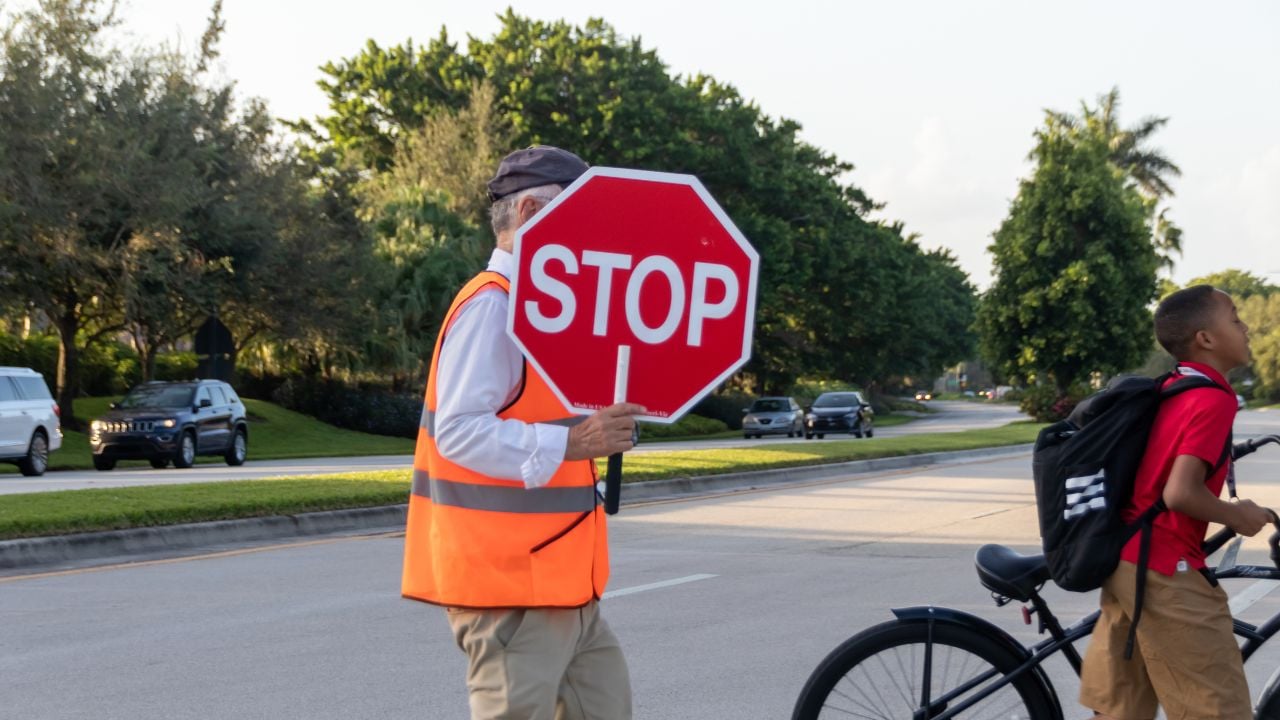
4. Crossing Guards Are Present (But Harder to Find)
Hillsborough County heads into this school year short more than 20 crossing guards.
The Sheriff's Office covers more than 350 crossing locations countywide, and every empty post means a corner with nobody there to stop traffic for a kid crossing alone.
Pay starts around $21 an hour now, well above what the job paid a few years back.
They're still short.
The Sheriff's Office is recruiting anyone from age 19 to 95, and the schedule only asks for an hour or so at drop-off and pickup.
A retiree working two mornings a week fills the same gap a full-time hire would.
The same ads are running in county after county, just with less attention.
5. Tax-Free Window Doesn't Close
Most shoppers assume Florida's back-to-school tax break ends once the backpacks are already on the bus.
It doesn't.
The 2026 sales tax holiday runs from July 20 through August 20, so it stays open more than a week after most Florida districts are already back in session.
That's ten extra days of shopping.
Clothing under $100, school supplies under $50, and learning aids under $30 all ring up tax-free, and so do computers and accessories priced at $1,500 or less.
State lawmakers made the holiday a permanent fixture in Florida law instead of something they renew every year, so the dates should look familiar again next summer.
Buy that laptop the week after the first bell, and it skips the tax exactly like it would have back in July.
The Later Start That Never Came
Florida almost forced every middle and high school to push its first bell back this fall.
A 2023 law set a hard deadline: Middle schools start class no earlier than 8 a.m., high schools no earlier than 8:30 a.m., starting with the 2026-2027 school year.
That deadline is this year.
Districts spent two years redrawing bus routes and staff schedules to hit it, then Gov. Ron DeSantis signed a repeal in May 2025, and the requirement disappeared before a single school had to follow it.
Lawmakers blamed bus driver shortages and the cost of running a second set of routes on a later clock.
So bells across Florida ring at the same times they always have, mandate or no mandate.
Districts remain free to move to a later start time on their own, and a few still might, but nothing in Florida law requires it anymore.
Free Lunch Comes With a Price Tag
Every student in Miami-Dade County lost automatic free lunch this year.
The district had qualified for years under a federal program called the Community Eligibility Provision, which pays for every meal at a school once enough students are automatically certified as low income through the Supplemental Nutrition Assistance Program (SNAP), Medicaid, or foster care.
Miami-Dade's rate dropped from 64% four years ago to 45.1% this year, below the federal eligibility threshold of 62.5%.
Enough to lose the program.
Lunch now runs $4.20 for most students, and breakfast is free at elementary schools but costs $2.50 at middle and high schools, unless a family qualifies for reduced or free pricing on its own.
Palm Beach County lost the same coverage at dozens of schools, where lunch can run $3.75 a day.
9 Underrated Florida Day Trips Locals Take All Summer

A real Florida day trip rarely needs a velvet rope or a mouse-ear logo.
It needs a two-lane road, a spring, or a roadside spot nobody bothered to put on a billboard, and locals have been finding them for years.
9 Underrated Florida Day Trips Locals Take All Summer
12 Things Florida Kids Did in Summer Before the Internet

Florida summer nostalgia always sounds picture-perfect, all lazy afternoons and heat that somehow wasn't so bad.
The real version came with sandspurs underfoot and love bugs smeared across every windshield by July, and grown-up Floridians still call it the best summer of their lives.
