
6 Foods New Yorkers Grew Up With That Have All But Disappeared

Ask a longtime New Yorker what they miss eating as a kid, and the answers come fast.
A cake, a sandwich, a dish that cost a nickel, each sold at an address that’s gone now.
These are the foods New Yorkers grew up with that have all but disappeared.
1. Nickel in the Slot
Macaroni and cheese cost a nickel at New York City’s Automat, baked into individual dishes and kept warm behind a wall of small glass doors, alongside Boston baked beans and coconut-custard pie.
Horn & Hardart ran the show behind every door in the city.
A nickel in the slot, a turn of the chrome knob, and the little door swung open on that same macaroni and cheese.
At its early-1950s peak, the chain fed roughly 400,000 people a day across its cafeterias.
Executive vice president Michael Sherman later told Time magazine that newly successful New Yorkers had simply stopped coming, calling only to ask why the Automat was closing.
The last Automat, on 42nd Street near Grand Central, closed for good in April 1991.
No comeback.
2. Cake Nobody Could Copy
New York City lost Ebinger’s Blackout Cake when the Brooklyn bakery chain went bankrupt in 1972, closing more than fifty stores across Brooklyn and Queens.
German bakers had opened Ebinger’s decades earlier, and the cake earned its name during World War II, when Brooklyn residents ran blackout drills to keep ships leaving the Brooklyn Navy Yard hidden after dark.
The cake layered dark chocolate sponge, a chocolate pudding filling, and chocolate cake crumbs on top.
It’s simple enough to describe.
Nobody’s matched it since.
The original recipe vanished along with the company, and food writer Molly O’Neill once tested fifteen competing versions at four separate bake-offs trying to settle which version was right.
None of them satisfied everybody.
Ebinger’s Missing Recipe
A retired baker from New York City’s Ebinger’s once told cookbook author Lyn Stallworth that the secret ingredient in the Blackout Cake was a chocolate sauce, possibly Hershey’s, though he never handed over exact amounts.
Every version sold or baked today, from bakery counters to cookbooks, is somebody’s best guess.
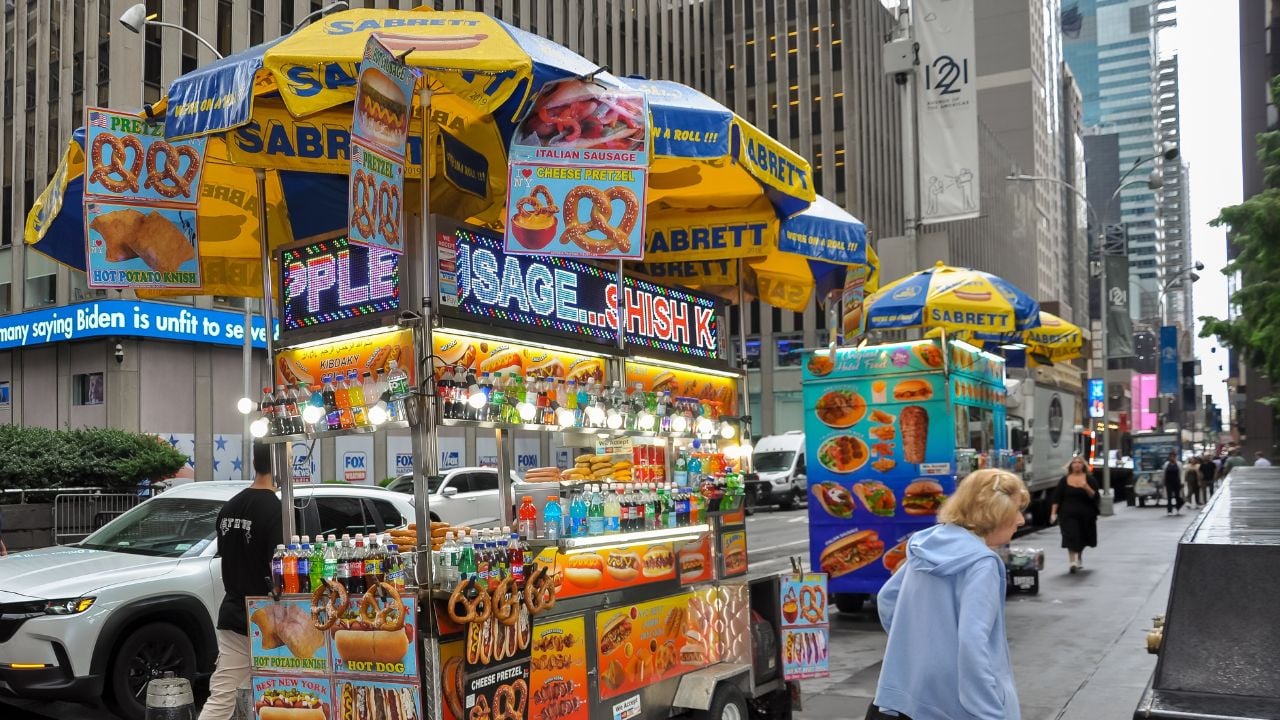
3. Hot Dogs on Every Corner
A bright orange drink was the only thing New York City’s Nedick’s stands sold when they opened in 1913.
Hot dogs joined the menu in 1930, dressed with a mustard relish nobody else served.
The orange-and-white stands thinned out through the 1970s.
The chain shut down for good during the 1980s, after criticism over the quality at its Central Park Zoo concession.
Gone.
A 2003 revival by the Riese Organization opened three New York City locations.
All three closed again within a few years.
Nobody built a new stand.
A hot dog and a swig of orange drink used to be a New York City breakfast that now only shows up in somebody’s old photograph.
Psst! How much do you know about New York’s food history? Take our quiz and see if you can ace it.
Quiz
New York Food IQ
Answer these questions on New York’s food history and lost eats. We bet you can’t get them all right. Prove us wrong?
A Maine lawmaker once tried to outlaw putting what in clam chowder, the way New York does it?
4. Sundaes With White Gloves
Schrafft's required white gloves for its hot fudge sundaes, serving lunch crowds at more than fifty locations across New York City.
Women's clubs and shoppers treated a Schrafft's booth like a standing reservation.
Lunch crowds also ordered creamed chicken on toast and lobster Newburg, dressed-up comfort food that fit the ladies-who-lunch crowd.
The dining rooms kept going through the 1970s.
The last locations closed by 1984.
White gloves went out.
Schrafft's own ice cream stayed on some supermarket shelves for a while after the restaurants shut, so New Yorkers could still buy a pint even after the sundae counter was gone.
5. Dime a Sandwich
A nutted cream cheese sandwich on date-nut bread cost a dime at New York City's Chock full o'Nuts lunch counters in 1940.
The chain grew to dozens of locations within a few decades.
William Black opened the first shop on Broadway in 1926, selling roasted nuts before he added the sandwich to the menu.
The company picked coffee instead.
Sara Lee bought the company in 1999.
Massimo Zanetti took over the coffee brand in 2005, keeping the name on grocery shelves years after the lunch counters were gone.
The lunch counters themselves closed through the 1970s and 1980s.
Only a small number of Brooklyn locations still serve the sandwich today.
6. Nickel Under Pink Cardboard
New York City's Charlotte Russe sold for a nickel: A sponge cake base held a tower of whipped cream and a maraschino cherry, wrapped in a pink polka-dot cardboard cup.
Candy stores and bakeries sold them every fall and winter.
Kids pushed the cardboard bottom up bit by bit to keep the cake coming as they licked away the cream.
No spoon needed.
Many of the shops that sold Charlotte Russe shut down over the decades, and the treat now survives at only a scattering of old-school bakeries, including Holtermann's on Staten Island.
Why They Vanished Together
Big manufacturers hit New York City's bakeries first.
Ebinger's went bankrupt partly because rivals like Entenmann's could turn out packaged cakes for supermarket shelves at a fraction of the cost of running fifty Brooklyn storefronts.
The other reason is coffee.
Chock full o'Nuts found it more profitable to sell bottled coffee on a grocery shelf than to staff a lunch counter, so the counters closed while the coffee brand kept going.
New York's first Automat opened in 1912.
The chain lasted nearly eighty years before Horn & Hardart closed its final location.
A Philadelphia family later bought the Horn & Hardart name out of bankruptcy, and it sells only coffee online today, with no automat and no mac and cheese anywhere in the deal.
10 Words New Yorkers Use That Confuse Everyone Else

Many people assume New York has one accent and one set of words for everything.
It has at least four, and they change at county lines.
10 Words New Yorkers Use That Confuse Everyone Else
4 Things That Cost More in New York City Than Anywhere Else in the Country
Think a cramped New York City apartment is the worst kind of sticker shock?
New York City finds new ways to out-charge the rest of the country, and rent isn't even the biggest surprise.
4 Things That Cost More in New York City Than Anywhere Else in the Country
