
6 Things New Yorkers Can’t Legally Put Out With Their Household Trash

It’s the Sunday after Thanksgiving, the guests have gone home and you’re hauling the last bags out to the curb.
You’ve earned a rest.
But it’s worth asking whether everything in your tied-off bag is legal to leave for the garbage truck.
These are the things New Yorkers can’t legally put out with their household trash.
Note: This is general information, not legal advice. Disposal rules and penalties are subject to change.
1. Old Electronics
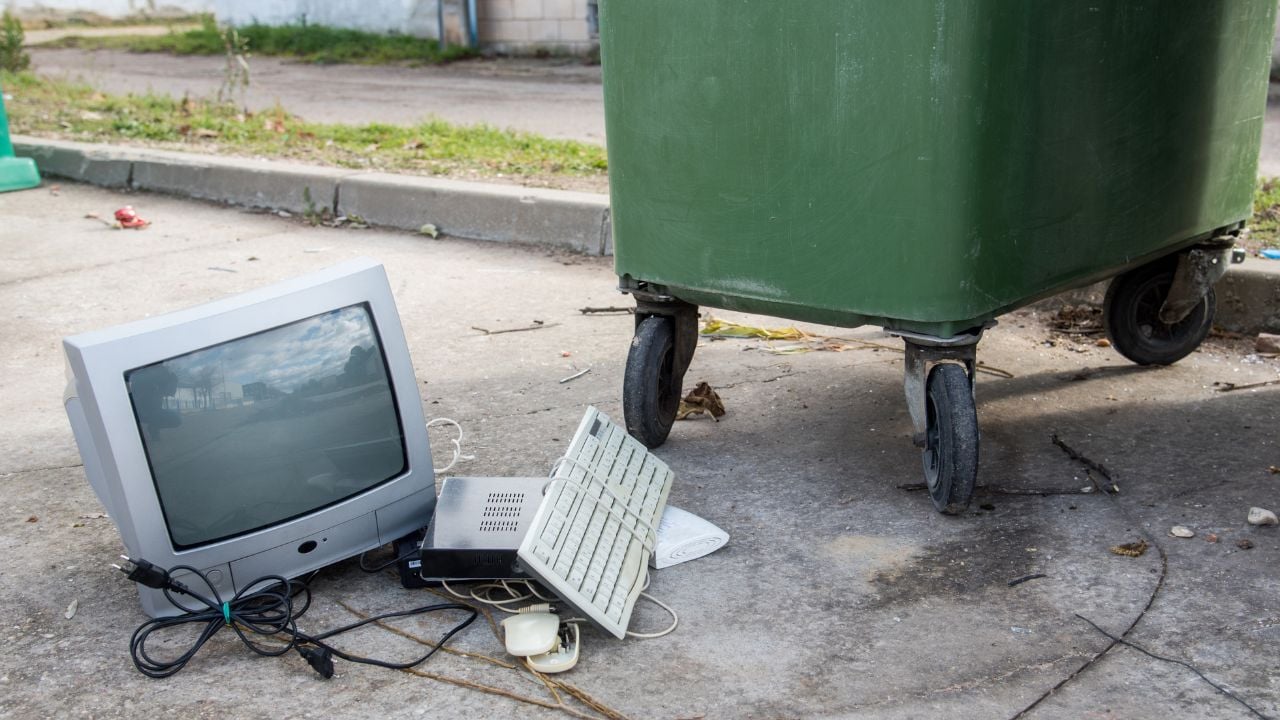
Many old electronics can’t go out with your household trash or at the curb in New York.
That could be the dead laptop in your closet or the tablet with the cracked screen.
The state’s Electronic Equipment Recycling and Reuse Act has banned covered electronics from the trash since January 1, 2015.
The Act also covers printers, monitors, game consoles and any television bigger than four inches diagonally.
Your VCR is covered too.
The good news is that state law requires manufacturers to provide free and convenient recycling to most consumers.
The catch is that manufacturers don’t have to run a drop-off in every community, so check the state’s county list of registered collection sites.
In New York City, the Department of Sanitation (DSNY) calls it illegal to dispose of certain electronic devices with trash or recycling.
Its list names cable boxes and cell phones, so check your junk drawer.
2. Rechargeable Batteries
New York’s rechargeable battery law makes it illegal for you to throw covered rechargeable batteries in the trash.
Covered types run from lithium ion and nickel metal hydride to e-bike and e-scooter batteries.
Dead batteries count too.
New York City’s rule reaches your recycling bin too, and the city calls lithium-ion batteries dangerous as well as illegal.
Lawmakers amended the law in 2025, after it had been on the books since 2010.
What New York’s Battery Law Doesn’t Cover
The state Department of Environmental Conservation says New York’s rechargeable battery law doesn’t cover single-use alkaline batteries.
It also doesn’t cover packs that weigh 50 pounds or more, or the memory backup batteries built into devices.
Vehicle batteries fall under a different state law.
3. Car Batteries
A dead car battery can’t go out with your household trash in New York, and the state can fine you up to $50 for each violation.
The state’s Lead-acid Battery Recycling Law has made that illegal since January 1, 1991.
Disposing of the battery is the easy part, since retailers that sell lead-acid batteries have to take your old battery back.
That’s up to two batteries a month per person, whether or not you buy a new battery.
The drop-off costs nothing.
If you buy a new battery with no trade-in, a retailer can charge a $5 return incentive, refunded when you return a dead battery within 30 days.
9 New York Laws Newcomers Break Without Realizing
Moving to New York doesn’t erase the driving and shopping habits you brought from your old state.
Some of those habits can land you in trouble.
9 New York Laws Newcomers Break Without Realizing
4. Mercury Thermostats
If you toss a mercury thermostat in your trash, you’re breaking a New York ban that dates to 2005.
Older thermostats, fever thermometers, oven thermometers and meat thermometers may contain mercury.
Look in your medicine cabinet.
A silver bulb usually means mercury, unless the thermometer is marked mercury-free.
In New York City, it’s illegal to discard liquid mercury, thermostats or thermometers that contain mercury into the trash or recycling.
Liquid mercury shouldn’t go down your drain or toilet either.
Dropping a thermostat off won’t cost you anything, since the Mercury Thermostat Collection Act of 2013 requires manufacturers to run collection programs at no cost to you.
The Thermostat Recycling Corporation runs those programs in New York.
Psst! How much do you know about New York’s recycling rules? Take our quiz and see if you can ace it.
Quiz
New York Recycling IQ
Answer nine questions on New York’s bottle returns, bag rules and recycling law. We bet you can’t get them all right. Prove us wrong?
Which of these plastic bags is still allowed under New York’s plastic bag ban?
5. Used Motor Oil
Used motor oil doesn't belong in a New York City trash bag, a recycling bin or a sewer, and DSNY calls dumping it illegal.
If you change oil at home, you're left with a full drain pan.
Now what?
New York State law requires many businesses that sell new motor oil to accept used oil from residents free of charge.
Service stations that change oil must take up to five gallons per day, per person, at no charge.
The used oil in your drain pan belongs at a service station that changes oil or a retailer that sells it, not at the curb.
6. Food Scraps and Yard Waste
Food scraps and yard waste can't go in your trash in New York City, where separating them became mandatory citywide on April 1, 2025.
Every resident has to separate leaf and yard waste, food waste and food-soiled paper, whether you rent or own.
DSNY says the fine falls on property owners.
If you rent, the sorting is still yours.
In buildings with one to eight units, the fine is $25 for a first offense, $50 for a second and $100 for a third and every one after.
Buildings with nine or more units pay $100, $200 and $300.
Set your food scraps and yard waste out in a labeled bin with a secure lid, or in a brown compost bin from the city.
Paint and Light Bulbs You Can Toss
Paint and light bulbs sound like they'd be banned from your trash.
In New York City, though, DSNY says small amounts of paint and compact fluorescent (CFL) bulbs can go out with your regular pickup.
You can let a small amount of leftover paint dry, or mix it with kitty litter or newspaper, then put it in the trash.
Unused paint belongs at a PaintCare retailer take-back or a city Special Waste Site instead.
What about bulbs?
CFLs contain minimal amounts of mercury, but the city lets you put them in your trash if you double bag them to avoid injury when they're handled.
Fluorescent tubes under four feet go to a Special Waste Site, and longer tubes go in the garbage.
Businesses play by different rules, since state regulations make them handle used fluorescent lamps as hazardous or universal waste.
9 Things New York Landlords Can't Do, No Matter What Your Lease Says
A New York landlord can ask for no more than one month's rent as a security deposit.
That's one of several rules worth checking before you sign a lease.
9 Things New York Landlords Can't Do, No Matter What Your Lease Says
