
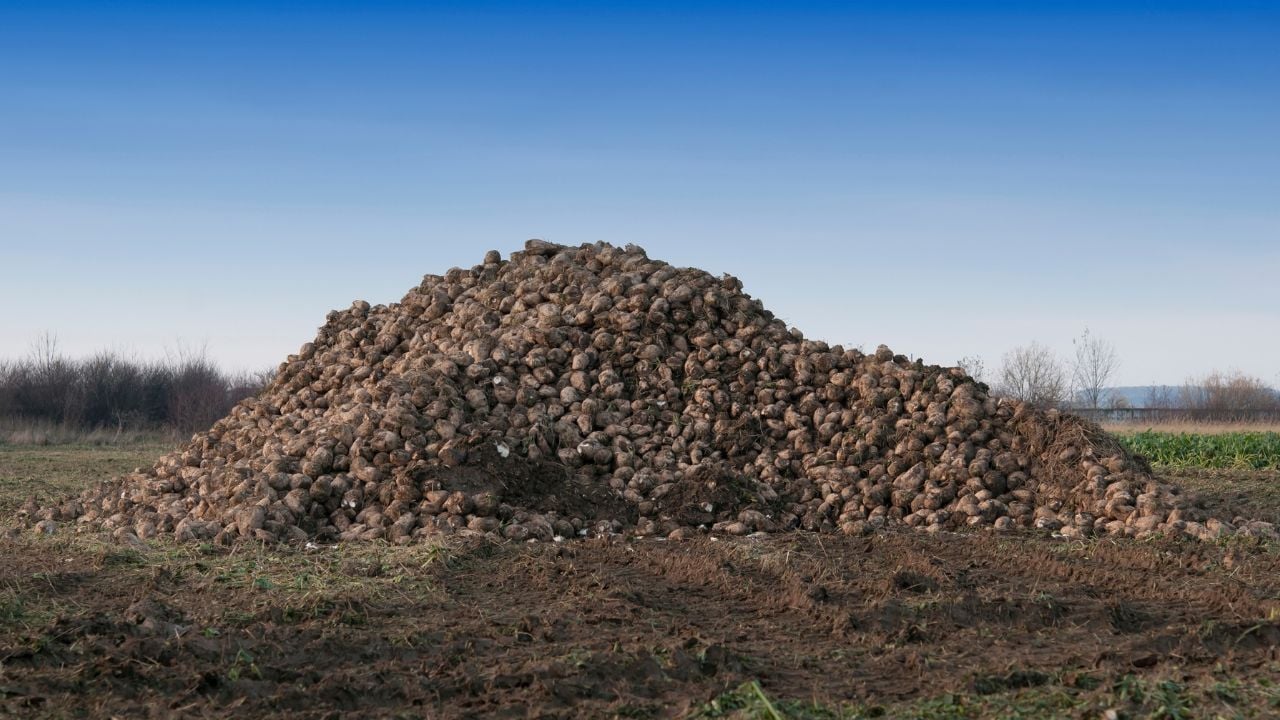
6 Things North Dakota Farmers Do Once Sugar Beet Harvest Wraps Up

Drive past a North Dakota field after the last beets come out, and it can look like the work is done.
Growers know better.
Here’s what many of them turn to next.
1. Crediting the Leftover Nitrogen
Farmers don’t dig a beet field and walk away once the harvester clears out.
Modern defoliators mulch the tops right back onto the ground as they strip them off each beet.
Growers once raked that kind of residue into windrows for cattle instead.
You won’t see cattle turned loose on beet ground anymore.
Nitrogen banked for next year.
That residue still carries nitrogen the beets didn’t use up.
North Dakota State University (NDSU) and University of Minnesota guidance lets growers claim it as a credit against next year’s nitrogen rate.
Fields where the tops came off green earn the bigger cut, 60 to 80 pounds an acre.
Tops that had already faded to yellow-green are worth less credit, 20 to 30 pounds.
Skip that credit, and you’re paying twice for nitrogen the field already has.
2. Prepping the Ground for Next Year
North Dakota and Minnesota farmers grow that 60% together.
The other 40% comes from beet and cane fields in other parts of the country.
Their fields, concentrated in the Red River Valley the two states share, start tillage the moment a field’s harvester clears out.
The standard practice is a fall chisel plow paired with a nitrogen application.
Farmers do that work right after the beets come out, while the ground is still workable before freeze-up.
No wasted days.
Wait too long, and you’re chiseling frozen ground.
You’ve got a short window between harvest and freeze-up to get it done.
3. Collecting the Co-op’s First Payment
The cooperative doesn’t pay growers by the ton when they deliver beets at harvest.
The cooperative sends an initial payment that fall, based on the estimated value of the sugar those beets will yield.
Money now, more later.
More installments follow over the next several months, once the final numbers are in.
That wait includes deductions, too.
Hauling and dirt-handling costs run up to $1.50 a ton, and the co-op subtracts those from your check before it’s final.
You can expect deductions on every check, not just the last one.
You’d think a bigger harvest means a bigger check every time, but it’s not quite that simple.
What a Beet Check Pays For
American Crystal Sugar doesn’t calculate a grower’s check off the number of tons delivered.
The payment is based on the hundredweight of sugar those beets yield once they’re processed, not the raw weight of the beets themselves.
Two growers hauling identical tonnage to the same receiving station can walk away with different-sized checks if one field’s beets simply tested higher in sugar content than the other’s.
4. Voting at the Annual Meeting
American Crystal Sugar’s grower-shareholders elect their board once the harvest season winds down.
The cooperative held its annual meeting in early December after the 2025 harvest, with board elections and a new chairman named the same week.
You don’t get a vote at this meeting unless you’re a shareholder, and the farmers who grow the beets also own the company.
New leadership, weeks after harvest.
You can look up every name on that new board and find a working farm behind it.
Growers who serve on that board are still farmers themselves, elected by neighbors who spent the same October digging beets out of the ground.
5. Putting the Harvest Equipment Away
Farmers retire their beet equipment for the winter the moment the season ends.
Defoliators and harvesters only run for a few weeks each fall, so they sit idle for the rest of the year.
That’s why draining fuel lines and adding a stabilizer matters, so the machine starts again next October.
Farmers pull the batteries and store them somewhere warm and dry, and clean the terminals before they go back in next spring.
Check your fuel lines for cracks, too, since cold makes rubber components brittle.
Ready by spring.
Beet carts and pilers get the same routine, then head under a shed roof for the winter.
You won’t need any of it again until next October.
Psst! How much do you know about North Dakota’s sugar beet industry? Take our quiz and see how many you can get right.
Quiz
ND Sugar Beet IQ
Answer these questions on North Dakota’s sugar beet industry. We bet you can’t get them all right. Prove us wrong?
How do North Dakota sugar beet co-ops keep thousands of tons of harvested beets from rotting in storage piles all winter?
6. Contracting Next Year's Acres
Farmers sign a new beet contract with the cooperative for next year, not just once and done.
American Crystal Sugar's grower agreement makes it official.
The acres a shareholder plants to beets get set by a new annual contract between grower and company, not one that just rolls over.
Same field, different crop.
Sugar beet fields don't grow sugar beets again the very next year.
The standard rotation cycle in the Red River Valley brings beets back to the same field once every four years.
On American Crystal Sugar's end of the valley, that usually means corn, soybeans and wheat filling the gap before beets come back around.
The company can set rotation rules, and growers agree to follow them as part of that same contract.
You won't find this year's beet ground back on next year's contract.
Your field cycles through that same four-year rotation, whether it's this parcel or the next one.
The field that just gave up its beets for the year won't grow another crop of them for four years, long enough for a presidential election to come and go.
6 Things North Dakotans Do Every County Fair That Visitors Find Charming

More than half of North Dakota's 53 counties still put on a county fair every summer, and the fairgrounds run on habits a first-time visitor never sees coming.
The rides and the fried food draw the crowds, but the show is in the barns and the grandstand.
6 Things North Dakotans Do Every County Fair That Visitors Find Charming
8 North Dakota Sayings That Leave Out-of-Towners Completely Lost

By 1910, North Dakota counted nearly 46,000 Norwegian-born residents alongside roughly 52,000 German speakers, and neither language ever fully won out.
What came out the other side is a vocabulary that sounds like plain English, right up until somebody uses it on a stranger.
8 North Dakota Sayings That Leave Out-of-Towners Completely Lost
