
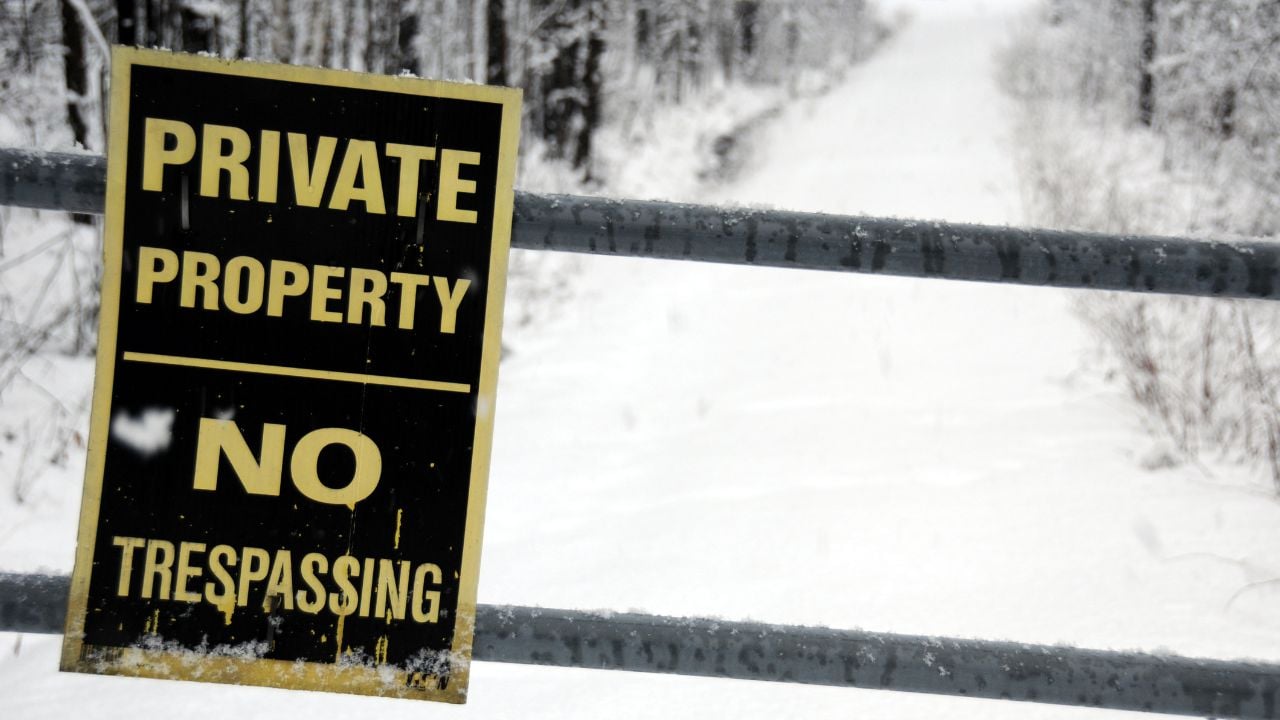
6 Things Vermont Law Says About Snowmobiles Crossing Private Land

Trail season opens Dec. 16, and some trails cross private fields.
Here’s what Vermont law says about riding across private land, for riders and landowners alike.
Note: This is general information, not legal advice. Snowmobile rules and fees are subject to change, so confirm current registration requirements with the Vermont Department of Motor Vehicles.
1. Landowner Permission
Snowmobiles are banned from privately owned land unless one of a few conditions applies.
You’re covered if you own the land or belong to the immediate family of its owner or lessee.
If you’re neither, you have to carry the owner’s consent with you.
That route requires it in writing.
Local clubs ask owners for that permission before a trail ever crosses a field.
The trail pass in the next section is how that permission travels on your sled.
A sled needs no registration or trail pass when you ride solely on private land with the owner’s written consent.
2. Trail Pass as Proof
The trail pass on your snowmobile, officially the Vermont Trails Maintenance Assessment (TMA) decal, can stand in for the owner’s written consent.
A valid one shows club-based consent.
VAST’s online store lists an early-bird full-season pass at $165 for in-state registrations and $195 for out-of-state registrations, through Dec. 15.
Online full-season pricing includes $35 in club dues and fees.
Join first, then ride.
Out-of-State Sleds and the Trail Pass
Registering a snowmobile doesn’t give you permission to cross or operate on public or private land.
A sled registered in another state or province gets a few narrow breaks from the trail pass, and the main one is short.
That sled can use the trail system, a public right-of-way open to snowmobiles or posted private land.
The trip can run up to three miles, solely to reach the closest food, fuel, lodging or repair.
If you ride in from out of state, signs at the three-mile mark from the state line tell you a trail pass is required beyond that point.
3. Posted Land
Snowmobile access to private land can also come from a sign because state law lets an owner post land as open to snowmobiles.
The owner has to post the area in a manner the state approves, giving reasonable notice that snowmobiling is permitted.
A sign can say yes.
If you spot one at the edge of a field, the posting itself is your permission.
Psst! How ready is your sled for the trail? Run through this checklist and see where you stand.
4. Diligent-Search Defense
A snowmobile rider charged with trespass has one affirmative defense, meaning a reason the ride is excused even though it happened.
You can raise it if, after a reasonably diligent search, you couldn’t find anyone in the state with authority to grant or deny permission.
The defense covers a trespass charge under the private-land rule, and nothing else on the trail.
You’d raise it in court.
5. Cost of Trespass
If you ride a snowmobile on private land without one of those routes, you owe a civil penalty of $300 for each violation.
The statute makes that penalty mandatory and bars any reduction.
If you ride an unregistered sled, you owe $135 for each violation under the same section.
Trespass costs more than double.
6. Nighttime Closures
If you own land along a snowmobile trail, you can request a ban on riding the trail system between 11 p.m. and 6 a.m.
A town can order the same ban through an ordinance, and trails under a ban have to be posted as closed during those hours.
Riding more than 500 feet from a residence is exempt, and so is grooming.
Check for a ban first.
Psst! How much do you know about winter trail rules? Take our quiz and see if you can ace it.
Quiz
Winter Trail Rules Quiz
Answer these questions on snowmobile rules and winter trail safety. We bet you can’t get them all right. Prove us wrong?
Vermont children under what age may operate a snowmobile only on land owned by their parents, family or guardian?
Closing Dates
The association's trail calendar opens the season on December 16, snow permitting, and ends it each year on April 15.
Check those dates before you load your sled.
The statute sets a rule for the closed season too.
It bans riding the Statewide Snowmobile Trail System then.
It also bars riding before the trails have been officially opened, including a closure for lack of snow or dangerous trail conditions.
Snow alone isn't enough.
The civil penalty for riding during the closed season is up to $500.
Landowner Liability
If you own land a snowmobile trail crosses, Vermont's general recreational-use law can protect you from liability, and it covers more than snowmobiles.
An owner who lets people onto land for recreation without consideration, meaning without charging for entry, isn't liable for their injuries or property damage.
A fee ends that protection.
So does willful or wanton misconduct by you as the owner.
Permission to enter the land doesn't by itself include permission to use the owner's equipment, machinery, personal property or structures.
Coverage for Landowners
Landowners who host a snowmobile trail get insurance on top of the state's recreational-use law.
The association carries general liability coverage of $3 million for each occurrence and $6 million aggregate.
Sign a contract for access or grant an easement, and you're automatically named as an additional insured.
The carrier then issues you a certificate of liability insurance naming you.
Permission has limits.
Fat bikes, ATVs, four-wheelers, hiking and cross-country skiing each need written authorization from the landowner and the club, plus sanction from the association.
Any other use of that land is treated as trespassing.
Why Vermont General Stores Keep Losing Their Owners
How many owners of Vermont's surviving country stores know who's taking over once they're done?
Not every one of them has an answer.
Why Vermont General Stores Keep Losing Their Owners
7 Things That Still Happen at Vermont Town Meetings That Out-of-Staters Can't Believe Are Real

Vermont's town meetings still run on rules that stop a first-time visitor cold.
Out-of-staters can't believe some of them are real.
7 Things That Still Happen at Vermont Town Meetings That Out-of-Staters Can't Believe Are Real
