
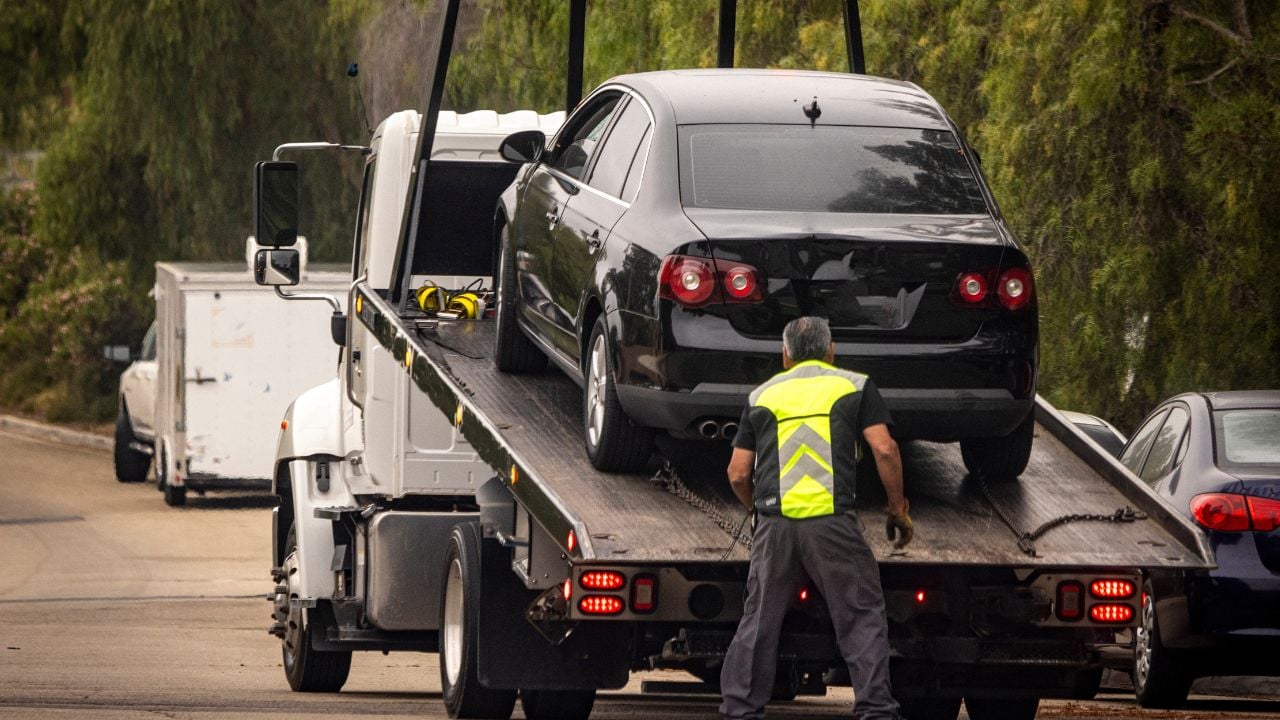
6 Things Virginia Tow Truck Drivers Wish Drivers Did After a Breakdown

Break down on a Virginia highway, and #77 on your phone can connect you with free help.
Tow truck drivers wish more stranded drivers knew that, along with what to do while they wait.
Here’s what Virginia tow truck drivers wish drivers did after a breakdown.
Note: This is general information, not legal advice. Towing and highway rules are subject to change.
1. Leaving the Travel Lanes
A breakdown in a travel lane puts your car in the path of everything behind it.
Don’t wait in the lane.
When it’s safe and no one is hurt, Virginia law says to move a disabled vehicle from the roadway to the shoulder as soon as possible.
In a 2018 report, Virginia Department of Transportation (VDOT) officials advised taking an exit if you can reach one, and moving to the far shoulder if you can’t.
The same law has you report your location to the nearest law-enforcement officer as soon as you reasonably can.
If your car sits on the shoulder as a traffic hazard, an officer can order it removed at your expense.
Under the same law, the car has to come off the shoulder without unnecessary delay.
2. Your Hazard Lights
Virginia law requires you to turn on your emergency flashing lights after a breakdown, if your car has them.
Your flashers bring the Move Over law into play for the drivers who pass you.
On highways with four or more lanes, passing drivers who can change lanes safely are supposed to move away from you.
Drivers who can’t change lanes safely are supposed to slow down.
3. Staying Inside Your Car
Many tow truck drivers would rather find you sitting in your car than standing at the edge of the road.
In a 2018 NBC4 report, VDOT officials told drivers not to get out of the car after a breakdown on an interstate.
The report’s next step was to dial #77.
If you’re tempted to wave down help, that’s what #77 is for.
Psst! How much do you know about roadside breakdowns? Take our quiz and see if you can ace it.
Quiz
Roadside Breakdown IQ
Answer these questions on Virginia’s tow truck and highway rules. We bet you can’t get them all right. Prove us wrong?
Virginia law says a tow truck driver can’t knowingly let another person do what while your car is being towed?
4. Calling #77
News reports point drivers to #77 to reach VDOT's free Safety Service Patrol; #77 is also the State Police's cell number.
A 2025 local TV report lists patrol coverage on I-95, I-64, I-81 and I-66.
Patrollers can give you a jump start, change a tire or bring fuel.
On I-81, a 2019 expansion put patrol coverage between Radford and Natural Bridge in VDOT's Salem district.
Know your mile marker or overpass and which way you're headed, a 2011 State Police tip sheet told callers.
5. Asking Who Sent the Truck
If a tow truck you didn't call pulls up behind your car, ask who sent it.
The question matters because Virginia law bars tow truck drivers and towing operators from having someone else solicit or offer towing at a disabled vehicle on a highway.
Breaking that rule is a misdemeanor.
6. Asking the Price Before Hookup
Ask the tow company what the tow will cost before the truck hooks up.
Virginia operators have to post a list of all towing, recovery and processing fees in a conspicuous place at their principal office.
The maximum fees they normally charge for basic towing and initial hookup must be readily available there on request.
The posted fees give you something to check a quote against.
What Virginia Tow Operators Must Accept
When you pay for a tow, the operator has to accept cash, insurance company checks, certified checks and money orders.
Operators also have to take at least one of two commonly used, nationally recognized credit cards.
Operators who earn under $10,000 a year from towing don't have to take credit cards, except on police-requested tows, and they still have to take personal checks.
What Passing Drivers Owe You
Virginia's Move Over law can cover you after a breakdown on a busy highway, and it became effective in 2002.
The law expanded in July 2023 to cover any vehicle pulled off the main lanes that shows flashers or other warning signs.
Before then, it covered emergency vehicles, tow trucks and VDOT workers.
The lane-change duty applies on highways with at least four lanes.
At least two of those lanes must run in the passing driver's direction.
That lane-change duty doesn't apply in highway work zones.
In 2018, VDOT officials told drivers to know the move-over rules and shift a lane away from flashing lights.
The lights on the stopped vehicle decide the penalty.
If you're passing, ignoring a stopped vehicle that shows hazard flashers, caution signs or lit flares is a traffic infraction.
Ignoring certain stopped vehicles with flashing blue or red lights, such as police, fire and rescue vehicles, is reckless driving.
Amber lights, like those on tow trucks, fall under the lower infraction penalty.
At the Tow Yard
A tow truck's work ends at the tow yard. Virginia law sets rules for how you collect your car there.
Before releasing your car, a tow operator can't require any document the law doesn't already require, other than payment of fees.
They have to let you collect your personal items without retrieving the car or paying a fee.
Expect to show proof of ownership to get those items.
If your car was towed without your consent and you pay cash, the operator can't refuse to make change up to $100.
If an officer asked for the tow, the operator can't take your car to any location outside Virginia.
Tow Operators on the Shoulder
Tow truck drivers do their jobs on highway shoulders, next to traffic.
In 2020, VDOT said two towing partners died in less than a week on Northern Virginia highways.
VDOT asked drivers to slow down and move over for amber lights.
If you see amber lights on a shoulder, you're passing someone's workplace.
A tow truck driver died on the Beltway shoulder in 2014 after being struck.
Virginia police renewed their calls for drivers to obey the Move Over law afterward.
State police said many drivers don't move over or slow down for responders stopped on the shoulder.
15 Things a Virginia Safety Inspection Checks Before Your Car Passes
A Virginia safety inspection covers far more than your brakes.
Some of what it checks might not be on your radar.
15 Things a Virginia Safety Inspection Checks Before Your Car Passes
9 Things Virginians Never Do at a Rest Stop on I-95

A rest stop on I-95 comes with a rulebook.
A few of the habits on that list may surprise you.
