
7 Dishes You’ll Find at Every Maine Church Supper

Randolph United Methodist Church used to seat about 100 people for its Saturday supper.
These days, the church draws about half that many, even though the plate still only runs $8, per the Kennebec Journal.
These are the dishes you’ll find at every Maine church supper if you’re among the attendees.
1. Bean-Hole Baked Beans
Bean-hole baked beans, a church supper staple, trace to a Penobscot cooking method that logging camps adopted a century ago.
Dig a pit, bury a kettle of beans in hot coals, and leave it there overnight.
No oven required.
Grange halls and church kitchens across the state still run the same kind of supper today.
Danville Junction Grange in Auburn could seat up to 85 people at a single bean supper before the pandemic thinned the crowd, according to the Sun Journal.
Volunteers there work well into their nineties, the paper found, still rolling dough and running the kitchen.
Waterford Grange, in the same reporting, restarted a bean supper after a pause.
2. Steamed Brown Bread
Steamed brown bread rides next to the beans at almost every bean supper, baked dark with molasses and dotted with raisins.
B&M got its start in Portland in 1867, canning brown bread there for generations before the plant left the state in 2021.
The pairing on the supper table didn’t leave with it.
Nobody skips the bread.
Coleslaw and a slice of pie usually round out the same plate.
3. Red Snapper Hot Dogs
Red snapper hot dogs sit next to the bean pot at the same suppers, easy to spot by the dye that turns the natural casing bright red.
Bangor’s W.A. Bean & Sons says it’s made them since 1918.
Bite into the natural casing, and it snaps, which is where the name comes from.
That’s the whole point.
Outside Maine and a few pockets of southern New England, the red dog is hard to find.
A 2023 bean supper run by Town Hill’s Village Improvement Society near Bar Harbor served them stacked right next to the beans, the coleslaw, and the pie.
4. Whoopie Pies
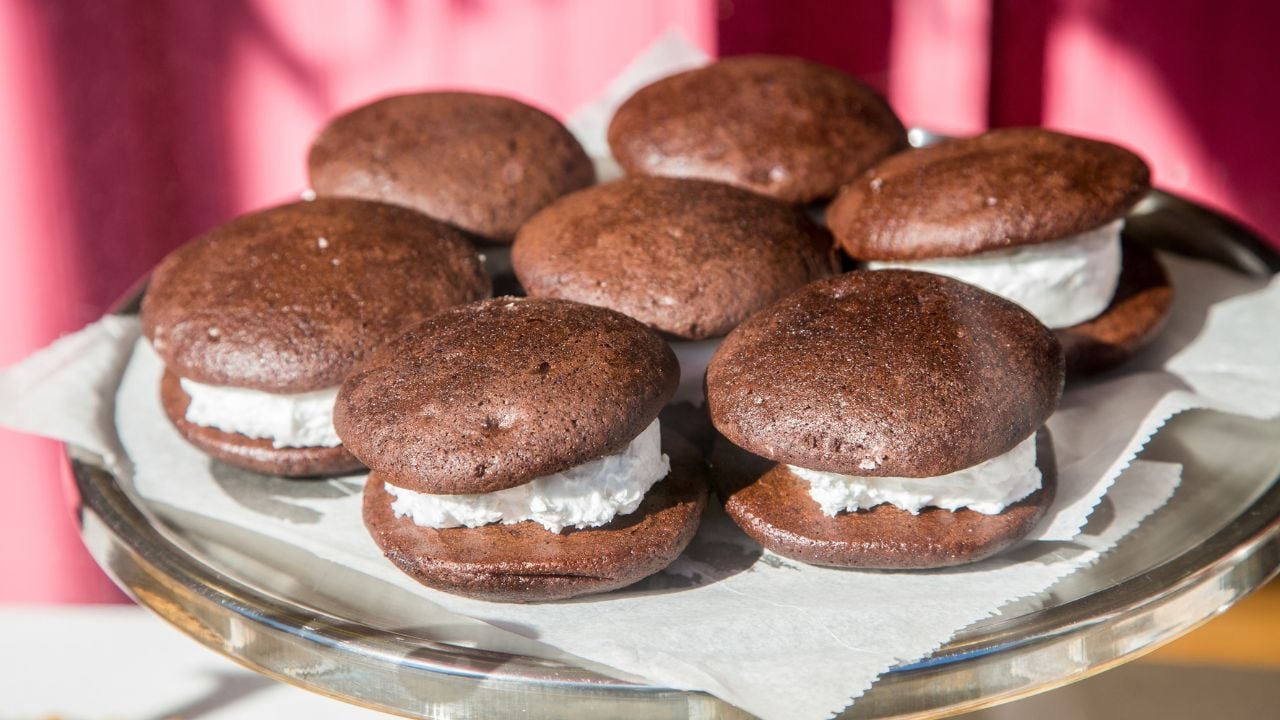
Whoopie pies fill the dessert end of the supper table, two chocolate cakes squeezed around a filling thick enough to hold its shape.
Maine’s Legislature made it official in 2011, naming the whoopie pie the state’s treat by law.
Pennsylvania Dutch country still disputes that.
The Legislature hasn’t budged.
Some accounts put the recipe in Maine kitchens as far back as 1925, decades before lawmakers caught up.
Psst! How much do you know about Maine outside the supper hall? Take our quiz and see how many you can get right.
Quiz
Maine State Trivia
Answer these questions on Maine’s official quirks and community halls. We bet you can’t get them all right. Prove us wrong?
Before Moxie became Maine’s official state soft drink, what was it originally sold as?
5. Clam Casserole
Clam casserole holds a regular spot on the supper table at Randolph United Methodist Church, chopped clams baked under a layer of crushed crackers and butter.
One of the church's cooks used to bake four of them for a single Saturday supper, the Kennebec Journal reported.
These days, two covers the crowd that shows up.
Smaller crowd, same recipe.
It sits on the same table as the beans, the bread, and the pie, one more dish nobody thinks to question.
6. Tourtière
Tourtière lands on the church supper table at Maine's Franco-American parishes, a meat pie packed with pork, spices, and a top crust cut open before it goes in the oven.
Families in Lewiston, Biddeford, and Sanford carried the recipe down from Quebec, and it still anchors the supper after Christmas Eve Midnight Mass in those parishes.
No Christmas Eve without it.
The pie itself belongs to Quebec, but the after-Mass supper that goes with it belongs to Maine's French Catholic mill towns.
7. Wild Blueberry Pie
Wild blueberry pie closes out the pie table at almost every supper, filled with berries too small and too tart to be the kind sold in a plastic clamshell.
Maine grows more than 98% of the country's low-bush blueberries, and its Legislature made the pie built from them the state's official dessert in 2011.
That's not a marketing line.
The same berry has covered Maine's barrens since long before statehood, and the pie built from it is the one dessert every county's supper table can claim.
Maine Wrote Two Desserts Into Law at Once
Maine's whoopie pie and its blueberry pie both trace back to the same piece of legislation.
Lawmakers named the whoopie pie the state's official treat and blueberry pie the state's official dessert in the same 2011 law, one section apart.
The wild blueberry itself had already been Maine's official state berry for two decades by then.
That designation dates to 1991, long before the pie earned a line in the statute books.
The Fiddlehead Window
Church supper season overlaps with a much shorter one each spring: The two or three weeks when fiddleheads are worth cutting.
The fern doesn't usually turn up on the supper table itself, but it shares the same spring these suppers run through.
The window is short.
Foragers gather the tightly coiled fronds along riverbanks from late April into early June, and the University of Maine Cooperative Extension warns against eating them raw or undercooked.
Its guidance calls for a full 15 minutes at a boil, or 10 to 12 steamed, before a fiddlehead ever meets a frying pan.
Roadside stands sell them for those few weeks, and then the fiddlehead disappears from kitchens until next spring.
What These Suppers Raise
Church suppers raise money, just not much of it.
Town Hill's Village Improvement Society near Bar Harbor budgeted just over $8,000 for a full year of running its buildings, cemetery, and playground.
A single supper night carries much of that load.
Randolph United Methodist Church has watched Saturday supper attendance shrink from about 100 diners to roughly 50, even with the plate still priced at $8.
Fifty counts as a win.
