
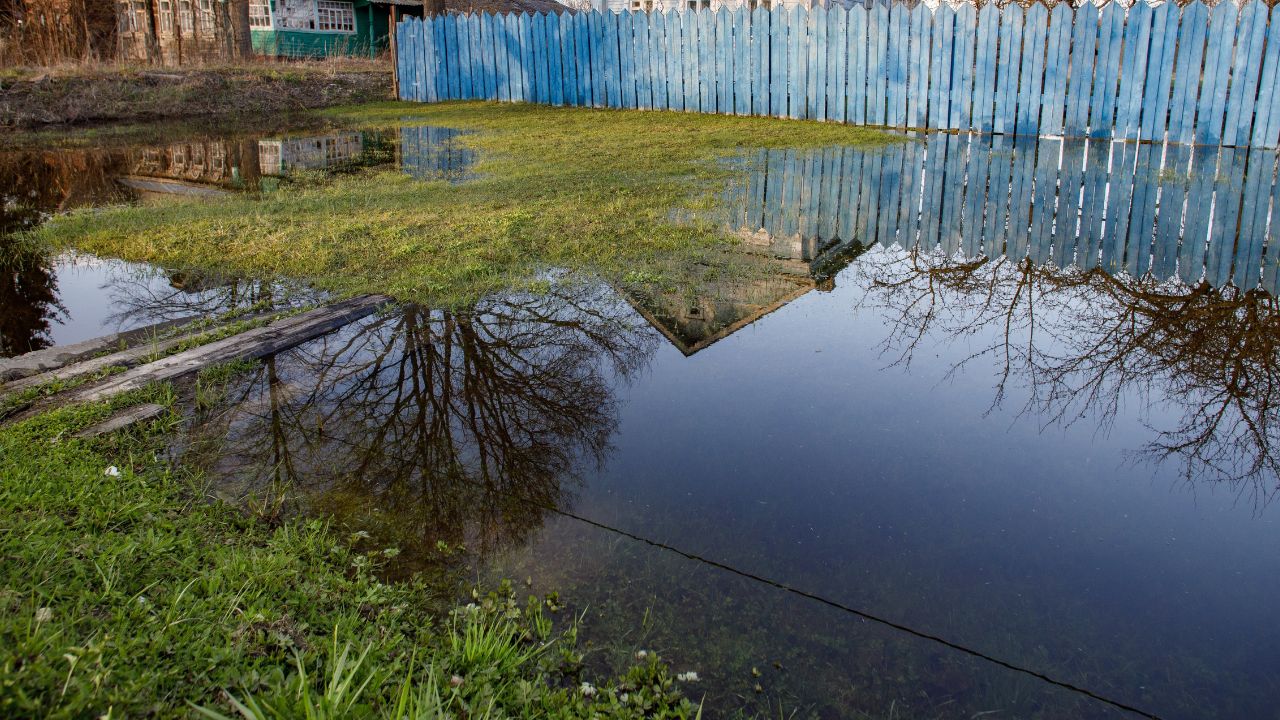
7 Drainage Rules That Put Ohio Neighbors Against Each Other

This past July, Ohio’s Supreme Court ruled on a fight over one ditch, with two counties and a homeowners association pointing fingers at each other over a $3.2 million repair bill.
Nobody agreed on who should pay.
These are the drainage rules that put Ohio neighbors against each other.
Note: This is general information, not legal advice. Property and drainage rules vary by county and township and are subject to change.
1. Reasonable-Use Rule
Ohio’s rule for surface water gives a landowner freedom to reshape how water moves across their property, even if a neighbor ends up wetter for it.
The Ohio Supreme Court set that standard in 1980, in a case called McGlashan v. Spade Rockledge Terrace Condo Development Corp.
It swept aside a far stricter rule that had barely let a landowner touch a natural drainage pattern at all.
The word is reasonable.
A judge weighs how much good the change does against how much harm it causes the neighbor, then decides after the fact whether it crossed a line.
One boundary inside that flexible rule stays hard, though.
A landowner can’t pipe in water from a different watershed and dump it onto a neighbor who only ever agreed to take what nature sent their way.
Two neighbors can read the same facts and land on opposite conclusions, and Ohio’s rule lets both of them believe they’re right until a judge says otherwise.
2. County Ditch Petition
Ohio’s county ditch law lets one landowner set a big drainage process in motion.
A single petition can also come from a group of owners, a school board, or a township.
The county then assesses every landowner whose land benefits from the project for part of the cost, whether they signed the petition or not.
That pits the landowner who filed the petition against every other neighbor along the route, including you if your property happens to sit on it.
Nobody has to agree first.
That’s exactly what played out this year with the Cole Ditch, a project spanning Franklin and Licking counties that carried a $3.2 million price tag.
Landowner Julie Dockter and Jefferson Township’s trustees filed the petition, and 411 property owners across the watershed ended up assessed for it.
The Colt’s Neck Homeowners Association was one of them, and it argued its members never got proper notice and tried to challenge the plan.
Ohio’s Supreme Court sided with the neighborhood this summer.
The justices let the case move forward instead of throwing it out on a technicality.
The ditch isn’t finished yet.
A landowner who never wanted the project can still end up years into a legal fight over a bill they never agreed to.
How Ohio Calculates a Ditch Assessment
Ohio’s county engineer doesn’t split a ditch bill evenly among the landowners along its route.
The engineer figures out how much each individual parcel benefits from the project, then bills that owner a share sized to match.
A landowner can still object with formal exceptions at a final hearing.
The law lets counties spread the bill across as many as thirty semiannual installments instead of one lump sum, with a floor of at least two.
3. 21-Year Tile Rule
State law treats a buried drain tile the way it treats almost nothing else on a property: Age gives it rights.
When a clay or plastic drain tile runs across a property line and stays flowing for more than 21 years, the tile changes legal status.
Ohio law then treats it the same as a creek or a ravine.
You can’t just cap it.
That surprises people.
The tile stays invisible until a backhoe finds it or a wet spot won’t drain.
By then, the neighbor on the other end of that line already has a legal claim to keep the water moving.
Blocking it can turn into a lawsuit over an easement nobody remembers agreeing to.
4. Helfrich’s Two Right Answers
A Licking County drainage tile dispute shows that Ohio law can rule two neighbors both right at once, and still leave them suing each other.
The case reached Ohio’s Fifth District Court of Appeals in 2022.
One landowner had replaced part of a decades-old buried drain, and the neighbor on the other end argued that changed rights nobody had agreed to.
The court ruled the replacement didn’t violate the reasonable-use rule, since it hadn’t sent any more water downstream than the old tile always had.
The old tile and the replacement moved the same amount of water, and the court said that was enough.
At the same time, the court recognized the other landowner’s decades of relying on that tile as grounds for an easement, a doctrine courts call estoppel.
Both sides won something.
If you share a drain tile with a neighbor, that’s the risk you’re both carrying.
The case, cited as 2022-Ohio-3446, shows that a drainage dispute isn’t always about who broke a rule.
Sometimes Ohio law hands both landowners a winning argument, and they still end up suing each other.
Psst! How drainage-dispute-proof is your Ohio property? Run through this checklist and see where you stand.
5. Roadside Ditch Law
Ohio makes it illegal to wrongfully block or divert a roadside drainage ditch, and it gives a township teeth to enforce that.
Ohio Revised Code 5589.06 bans wrongfully blocking a ditch, drain, or watercourse along a public road, and it bans diverting water from someone’s land onto that road.
A neighbor’s complaint starts it.
A township highway superintendent who learns about a blocked or diverted ditch has to serve the responsible landowner with written notice ordering it fixed.
Ignore that notice, and the township can remove the obstruction itself, then sue the landowner to recover what the cleanup cost.
The township can send someone the bill.
Many of these complaints start with one neighbor reporting another to the township, not with a state inspector showing up on their own.
6. No Government Referee
State law gives a drainage fight between neighbors surprisingly few places to go for help.
County engineers, township trustees, and local soil and water conservation districts all field these calls sooner or later.
None can force a fix.
That authority sits with the court of common pleas alone, and Union County and the city of Louisville both say so plainly in guidance they publish for property owners.
If your yard is the one flooding, you’re left with the same three choices that guidance keeps repeating: Accept it, work out a voluntary fix with the neighbor, or sue.
There’s no fourth option.
Psst! How much do you know about Ohio drainage and property-line law? Take our quiz and see if you can ace it.
Quiz
Ohio Property Law IQ
Answer these questions on Ohio’s drainage and property-line laws. We bet you can’t get them all right. Prove us wrong?
Before Ohio adopted the reasonable-use rule in 1980, what was the older, stricter rule for surface water called?
7. New-Construction Grading Rule
The state building code's grading rules step in the moment a shovel breaks ground for a new house, addition, or driveway.
The Residential Code of Ohio requires the ground within the first 10 feet of a new foundation to fall at least 6 inches.
That drop sends water away from the house instead of letting it pool against the foundation.
That part protects the house.
The code stops short of where the water crosses into the yard next door.
Some Ohio cities pile a grading ordinance on top of the state rule, with numbers for how steep a new lot has to slope toward the street.
Nobody downhill gets a say in it.
A finished basement two lots over can start taking on water the same spring a new driveway goes in three doors down.
No code violation shows up anywhere on the paper trail.
5 Household Items Ohio Thrift Stores Struggle to Sell

Not everything an Ohio thrift store puts on the floor sells.
Some things sit there marked down for weeks before an employee finally pulls them for the dumpster, and a few items never even make it out of the sorting room.
5 Household Items Ohio Thrift Stores Struggle to Sell
6 Purchases Ohioans Make Because They Feel Guilty Saying No

Ohio gives buyers three business days to back out of an in-home sales pitch worth $25 or more.
Lawmakers wrote that rule because so many people sign anyway rather than ask a salesperson to leave.
