
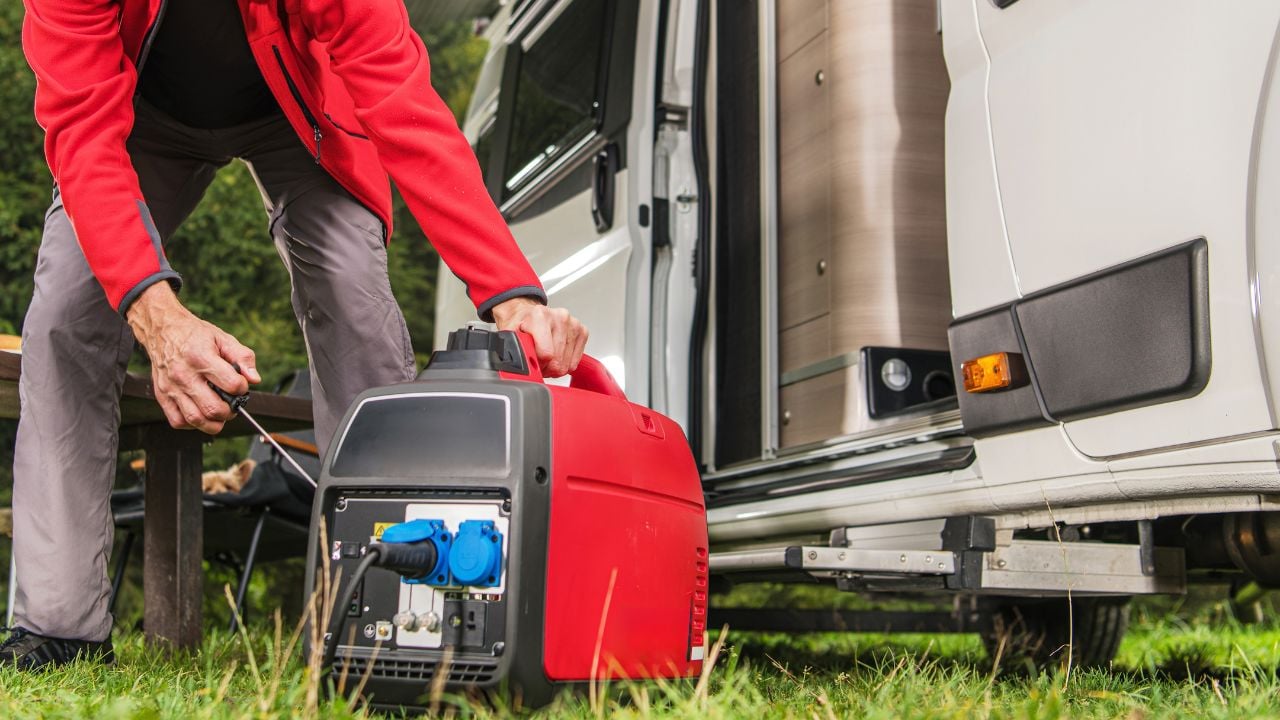
7 Generator Settings Louisiana Homeowners Should Test Before Storm Season Ends

The worst time to find out your generator has a problem is the night the lights go out.
A generator that’s sat unused for months can surprise you, and a few checks now can save a lot of stress later.
Here’s what Louisianans can test before storm season ends.
1. CO Shutoff Sensor
A newer generator can shut itself off the moment carbon monoxide (CO) rises too high, a feature federal regulators have spent years pushing the whole industry toward.
The Consumer Product Safety Commission has pressed toward a mandatory shutoff rule for portable generators since 2023, and many major manufacturers already build the sensor in ahead of any deadline.
Briggs & Stratton calls its version CO Guard, and it lights an LED indicator and blocks the engine from restarting indoors until the sensor confirms the air’s cleared.
That’s the point.
A homeowner who hasn’t touched the generator since last season won’t know if that sensor still works.
Check the manual for a carbon monoxide sensor or auto-shutoff feature, and press the test or reset button once before a storm forces the question.
2. Generator Clearance Distance
Distance is the setting on a generator that saves lives.
A standby generator sitting too close to the house is what let carbon monoxide creep through windows and vents into 105 homes across Southeast Louisiana after Hurricane Ida.
That’s the case that pushed regulators to act.
The old safety standard from the National Fire Protection Association called for just 5 feet between a standby generator and a home’s windows, doors, or vents.
Not anymore.
Louisiana’s Office of State Fire Marshal now points homeowners toward at least 25 feet.
A federal review found the exhaust had traveled that far and spread sideways by another 6 feet before anyone noticed.
Measure the actual gap from the generator to the nearest window or vent, not just to the closest wall.
Hurricane Season’s Back Half
Louisiana’s hurricane season runs from June 1 through Nov. 30, the same window the National Oceanic and Atmospheric Administration (NOAA) sets for the whole Atlantic basin every year.
The season’s back half still carries risk.
Hurricane Zeta made landfall near Cocodrie, Louisiana, on Oct. 28, 2020, as a Category 2 storm that tracked straight over New Orleans.
A generator that passes every test in October may still run for days come November.
3. Weekly Self-Test Schedule
Set the day and time once, and a generator’s automatic transfer switch will run a weekly self-test without anyone lifting a finger.
Skip that programming, and the switch might never test itself at all.
That’s unsettling.
On a Generac system with an Evolution controller, a homeowner presses OFF, then ESC, then works through the sub-menu to Exercise Time.
From there, the arrow keys set the frequency, the time, and the day.
Older Generac units use a simpler method: Hold the Set Exercise button for 10 seconds, and the generator locks in a weekly test at that exact time.
Pull up the manual once, find the exercise schedule, and confirm it’s set to a day someone will notice if the test fails.
4. Fuel Selector Switch
A dual-fuel generator carries a switch that decides whether the engine burns gasoline or propane, and it’s built so only one fuel runs at a time.
That’s a safety feature, not an accident.
On a Champion dual-fuel unit, a full gasoline tank runs the engine for around 8 hours at half load.
A standard 20-pound propane tank lasts 4 to 5 hours at that same load.
Gasoline goes stale in the tank within a few months.
Propane doesn’t.
Flip the switch, run the generator on whichever fuel is on hand, and check which tank sits closer to empty before a storm makes that decision.
Psst! How storm-ready is your generator? Run through this checklist and see where you stand.
5. Eco-Throttle Switch
Many portable generators built by Honda and other makers carry an Eco-Throttle switch that lets the engine idle down instead of holding a constant 3,600 revolutions per minute (RPM).
Flip it on, and the engine only works as hard as whatever’s plugged in needs.
Honda says the feature cuts fuel use by up to 40 percent and lowers the noise at the same time.
Forty percent adds up fast over a multi-day outage.
Every watt counts.
The trade-off shows up when something big kicks on all at once, a window air conditioner or a well pump.
The engine has to spin back up from idle before it can deliver full power.
Leave Eco-Throttle on for lights and a refrigerator, and switch it off before starting anything with a motor that jolts on hard.
6. Load Priority Dial
A generator smaller than the whole house’s electrical draw can’t run everything at once.
A Load Manager assigns each circuit a priority from 1 to 8 that decides which ones come back first.
Set the air conditioner and the refrigerator to priority 1, and they power up within minutes of the generator kicking on.
Leave everything on the same setting, and whichever circuit demands power first gets it, in no particular order.
That’s not the plan.
On a Generac system, each priority level recovers on a staggered timer, from about 5 minutes for the top priority to nearly 7 minutes for the lowest.
Walk the breaker panel once, decide what matters in an outage, and set the dial before the whole house tries to turn on at the same moment.
7. GFCI Test Buttons
The National Electrical Code requires every generator built after Jan. 1, 2015, with a standard household outlet to carry ground-fault circuit interrupter (GFCI) protection, the same shock protection built into a bathroom outlet.
That protection has a test button and a reset button, and both sit right on the generator’s control panel.
A generator that’s been stored since last season can trip that protection the first time it’s plugged back in.
Press the test button first.
The outlet should cut power immediately, and pressing reset should bring it right back.
A generator whose outlets won’t reset needs a repair before the next outage, not during one.
8 Louisiana Beach Access Rules That Confuse Residents and Tourists Alike

Grand Isle charges $150 a year for a tag just to drive on its beach, and a violation runs $200 to $500 plus a mandatory court date.
Louisiana’s coast runs on a mix of state law and parish decisions that don’t always agree with each other.
8 Louisiana Beach Access Rules That Confuse Residents and Tourists Alike
6 Rouses Markets Habits That Cost Louisianans Every Week

A shopper’s cart at Rouses can ring up like a win and still leave money on the table.
Rouses earns loyalty for good reason, but that loyalty doesn’t erase a habit that drains a grocery budget every week.
