
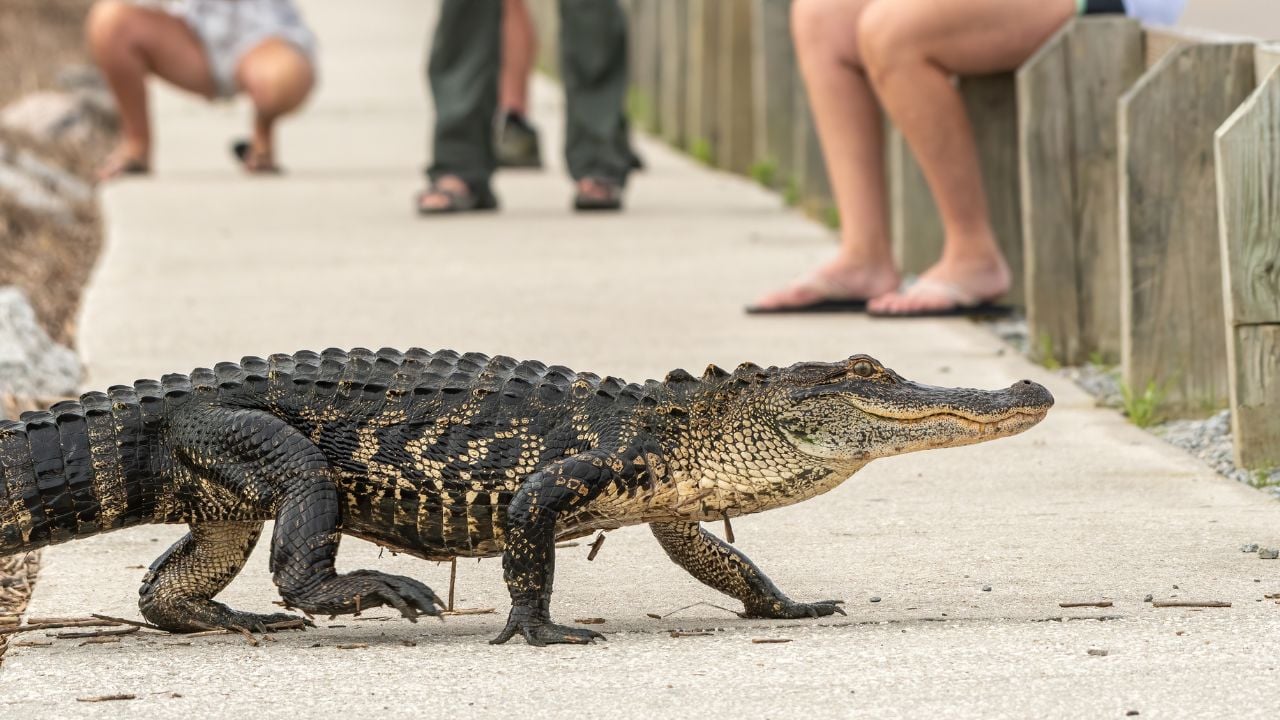
7 Precautions South Carolinians Should Take Around Alligators

Living in South Carolina means sharing the water with a neighbor who never waves back.
Getting along with alligators mostly comes down to what you do, not what they do.
Here are the precautions South Carolinians should take around alligators.
Note: This is general information, not legal or safety advice. Wildlife rules and penalties are subject to change, so confirm the current guidance with the South Carolina Department of Natural Resources.
1. Not Feeding Alligators
Fed alligators lose their natural fear of people, according to the South Carolina Department of Natural Resources (DNR).
After that, they can start approaching people and expecting food.
If you toss an alligator a bite of your sandwich, you’ve taught it to link people with food.
That’s a bad trade.
If you feed an alligator in South Carolina, you’ve broken the law.
What the Alligator Feeding Ban Covers
South Carolina’s alligator law also bars you from enticing or molesting an alligator.
A violation is a misdemeanor with a fine of $100 to $150, up to 30 days in jail, or both.
Magistrates court hears these cases.
If you see someone feeding an alligator, DNR asks you to call 1-800-922-5431.
2. Keeping Fish Scraps Out of the Water
Dumping fish waste into water where alligators live can feed them without you meaning to, and so can feeding the turtles, birds or fish there.
Rinsing off a cutting board doesn’t feel like feeding anything.
So keep your fish scraps out of the water at boat ramps, docks, and swimming and camping areas.
Guts and carcasses from your catch count, and so does crab bait.
Take your scraps home.
3. Leashing Pets Near Water
To an alligator, a small pet can be hard to tell apart from its usual prey.
So keep your leashed pet away from the edge of the water, and watch it closely.
Your pet shouldn’t go in the water at all when alligators are around, even in a designated swimming area.
The hard part?
If an alligator grabs your pet, let go of the leash.
4. Swimming Only in Daylight
Between dusk and dawn, stay out of the water where alligators live, whether you’re swimming or playing.
That includes a quick dip.
In daylight, stick to areas designated for swimming, and bring someone along, since swimming alone is a bad idea even without alligators.
If kids are with you, keep a close eye on them whenever they play in or near the water.
5. Giving Alligators Room
Along a bank, an alligator can surge out of the water to catch prey, so keep a safe distance from the edge.
DNR calls staying at least 10 feet from the water’s edge a good starting point, though the right distance depends on the situation.
That means no close-up photos.
Never approach an alligator of any size, including small alligators.
If an alligator hisses, you’re too close, so back away and give it space to leave.
What about running?
Zigzagging would only let an alligator catch up with you quicker, and chases on land are rare anyway.
6. Calling DNR Instead of Moving an Alligator
Never try to capture or move an alligator yourself, even if it’s somewhere hazardous like a road, school, pool or parking lot.
Call Operation Game Thief instead, at the same number as in the first section’s box.
Don’t play hero.
An alligator living in your neighborhood pond isn’t automatically a nuisance.
A nuisance alligator has lost its fear of humans through feeding, may harm people or property, or is trapped somewhere it shouldn’t be.
So who do you tell?
If you live in a neighborhood with a homeowners association (HOA), report a nuisance alligator to the HOA first.
Without an HOA, report it to your regional nuisance alligator coordinator.
7. Keeping Your Distance on Warm Winter Days
Cold weather slows alligators down, but they don’t go away.
They begin preparing once the water drops below 70 degrees, and at that point they stop eating and move a lot less.
Winter isn’t a free pass.
On a 70-degree day in January, you may spot alligators out sunning themselves.
A warm afternoon on the trail can fool you.
So on a mild day, give any alligator near the water the same room you’d give it in summer.
DNR’s Advice for Neighborhood Ponds
If alligators live in the pond behind your street, the state’s at-home guidance has a few jobs for you.
A sign at a shared pond should warn people that alligators may be present and that feeding them is illegal.
If the pond borders your yard, clear out the brush along the water.
Alligators prefer to come out on land where there’s cover, and brush along the water provides it.
It’s time for yard work.
Psst! How much do you know about alligators and their reptile neighbors? Take our quiz and see if you can ace it.
Quiz
Gator Country IQ
Answer these questions on alligators, snakes and sea turtles. We bet you can’t get them all right. Prove us wrong?
According to South Carolina’s wildlife agency, alligators are more closely related to which animals than to modern-day reptiles?
What DNR Says About Alligators on the Beach
If you spot an alligator on a beach, give it room instead of crowding around to try to help it.
Call your regional nuisance alligator coordinator if it seems to be in distress or a crowd has formed, and the coordinator will decide the best course of action.
Selfies can wait.
What DNR Says After a Bite
Alligator bites can result in serious infections.
If you're bitten, get medical attention right away, however minor your injury looks.
Save the story for later.
11 South Carolina Squatter Laws Every Homeowner Should Understand
Many homeowners haven't read the squatter laws that cover their property.
They're worth knowing before a vacant house turns into a courtroom fight.
11 South Carolina Squatter Laws Every Homeowner Should Understand
8 South Carolina Laws Visitors Break Without Realizing It
Visitors can run into trouble in South Carolina without meaning to.
It helps to know what to watch for before you pack the car.
