
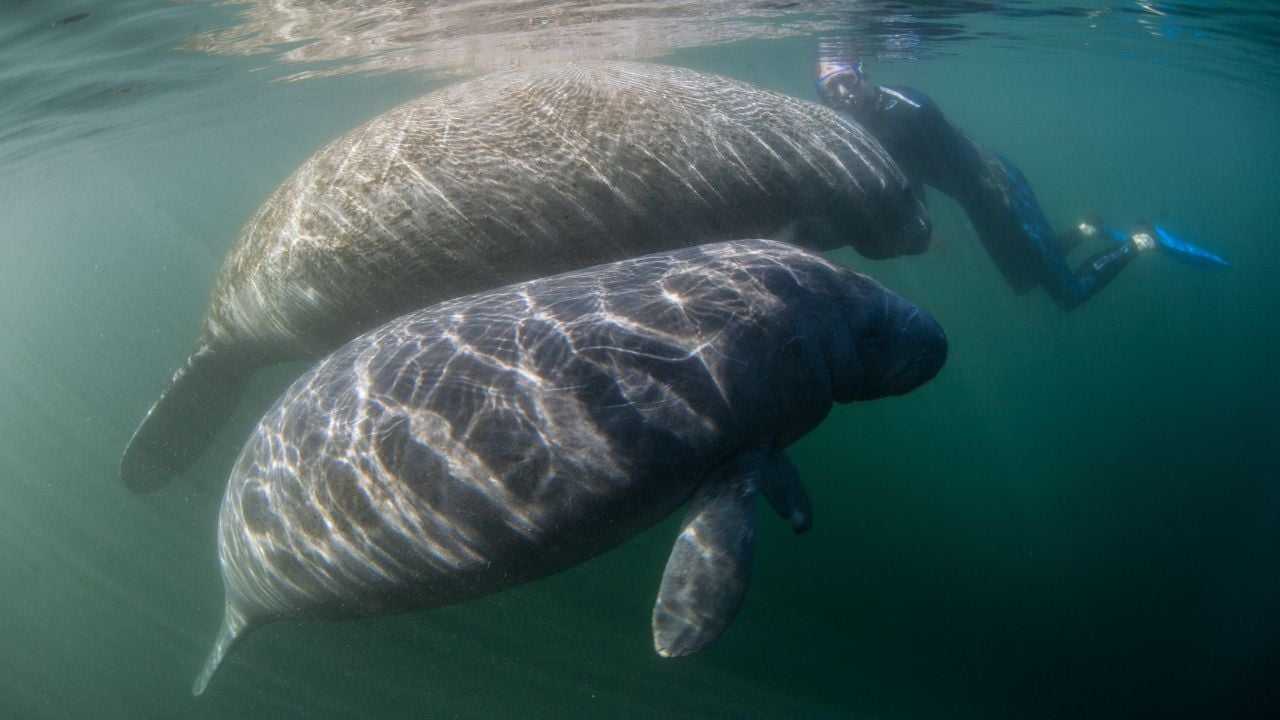
7 Things Manatees Do in Florida Once the Water Turns Cold

Manatees don’t just tough it out when the water starts to cool.
Tourists who spend time near the water notice them gathering in surprising spots, sometimes in big crowds.
Here’s what manatees do to make it through Florida’s cooler months.
1. Heading for Natural Springs
Once the water drops below about 68 degrees Fahrenheit, manatees head for warm-water refuges, such as springs, according to the Florida Fish and Wildlife Conservation Commission (FWC).
A 2013 peer-reviewed study of winter surveys from 1999 to 2011 counted 17.5% of manatees at springs.
If you’re wondering which springs those are, the Marine Mammal Commission names Blue Spring on the St. Johns River and Kings Bay at the head of the Crystal River as the main spring sites.
Laist, Taylor and Reynolds also compared the recovery sites of 713 manatees killed by cold stress between 1999 and 2011 with known refuges.
Their results indicate that springs appear to offer manatees the best protection against cold stress.
2. Gathering at Power Plant Outfalls
Where power plants discharge warm water, the same study counted 48.5% of all manatees.
If you picture manatees wintering only at springs, you’re missing the bigger crowd.
FWC says many hundreds of manatees can be found together at some industrial warm-water sites during the cold season.
They didn’t always winter there.
Researchers David Laist and John Reynolds reported in 2005 that all the power plant outfalls manatees used had been built between the 1940s and early 1970s.
Before that, manatees spent winters in southern Florida and gathered at springs or moved farther south during cold snaps.
The Marine Mammal Commission says it took about 50 years for manatees to develop today’s dependence on power plants.
3. Arriving After a Cold Front
On Friday, November 22, 2024, a cold front dropped the river temperature at Blue Spring to 69 degrees Fahrenheit, Save the Manatee Club reports.
The count at the spring went from 9 manatees on Thursday to 43 on Friday and 130 on Saturday.
Sunday’s count topped 300.
If you’re timing a visit, counts there can rise fast as the river cools.
There were 59 manatees on November 28, 2025, then 136 on November 29, as the river cooled from 68.9 to 65.8 degrees Fahrenheit.
As of October 2026, the park’s page ends swimming season on November 14.
Hundreds of manatees congregate in the spring run from mid-November to March.
The club recorded 770 manatees at roll call there on January 21, 2026, a record for its counts, with the river at 58.8 degrees Fahrenheit.
4. Traveling Out to Feed
Warm-water sites typically have no food, FWC says, so manatees must travel into cooler water to feed.
There’s considerable variation, with some manatees traveling 22 miles or more to feed and others staying close to the power plant.
Save the Manatee Club says some power plants, such as those in the Indian River Lagoon, operate in areas where manatee forage is extremely limited.
During cold snaps there, manatees face a choice between staying at a warm-water site and traveling out to find food in the cold.
Where food is limited, manatees searching in the cold for long periods are susceptible to cold stress and starvation.
At Blue Spring on November 7, 2025, most manatees were close to the river, probably ready to go out and feed for the warm weekend.
On a warm day, you may find fewer manatees at Blue Spring.
Counts fell from 179 to 66 between November 17 and 20, 2025, as the river warmed from 64.8 to 66.7 degrees Fahrenheit.
5. Returning to the Same Winter Site
FWC’s tracking research finds that individual manatees generally return to the same winter location year after year.
Calves learn those locations by following their mothers during the first year of life, the 2013 study reports, and typically keep using those sites as they age.
Strong fidelity to refuges has created four relatively discrete subpopulations of Florida manatees.
The Four Groups of Winter Manatees
Manatees form four winter groups, in the upper St. Johns River, the Atlantic Coast, Northwest Florida and Southwest Florida.
In the 1999 to 2011 counts, 99.2% of the upper St. Johns River group relied only on springs, as did 88.6% of the Northwest Florida group.
The Atlantic Coast and Southwest Florida groups relied principally on power plants, at 66.6% and 47.4% of their manatees, the study reports.
Those two groups made up 82.2% of all manatees counted.
6. Moving Back to Warm-Water Sites
As water temperatures decrease in the fall, the U.S. Fish and Wildlife Service says, manatees return to peninsular Florida and their warm-water sites.
Their summer range is wide.
FWC says manatees are widely dispersed in Florida’s waterways in the summer months and can be found on rare occasions as far north as Massachusetts.
Once winter sets in, the population is concentrated mostly in peninsular Florida.
7. Settling Into Passive Thermal Basins
In the southern part of the state, passive thermal basins give some manatees a place to wait out the cold.
If you’ve never heard the term, it describes a spot that temporarily traps relatively warm water for a week or more, according to the 2013 study.
There are two main types, deep basins that the sun warms during the day and basins where warm, salty water sits beneath a layer of fresh water.
Examples of basins where manatees gather each winter, with neither power plants nor springs nearby, include Ten-Mile Canal, Port of the Islands marina and Matlacha Isles.
34.9% of the manatees counted were at basins or at sites with no known warm-water features, a single combined category that doesn’t show the basins alone.
Basins like these can support manatees through brief cold periods, but prolonged cold can cool them to potentially lethal temperatures.
Psst! How much do you know about Florida wildlife? Take our quiz and see if you can ace it.
Quiz
Florida Wildlife Pop Quiz
Answer nine questions on manatees and other Florida wildlife. We bet you can’t get them all right. Prove us wrong?
How old was Snooty, the Bradenton museum manatee that Guinness World Records recognized as the oldest in captivity, when he died in 2017?
Cold Stress
Prolonged exposure to lower water temperatures makes manatees lose body heat and inadequately digest their food, according to FWC.
That can lead to a condition called cold stress, which can eventually be fatal.
Most, if not all, Florida manatees rely on warm-water refuges.
FWC says many power plants may be retired in the coming years, and losing those refuges could increase cold-stress deaths.
The 2013 study also warns that long-term survival will require better access to and protection of warm-water springs as power plant outfalls are shut down.
7 Things Floridians Stop Doing the Week the First Cool Front Arrives
Cool fronts change routines for people in Florida too.
These are the things Floridians may stop doing once the first cool front arrives.
7 Things Floridians Stop Doing the Week the First Cool Front Arrives
8 Florida State Parks Floridians Guard From Tourists
Not every Florida state park draws the crowds that make the headlines.
This list looks at the parks that get less attention.
