
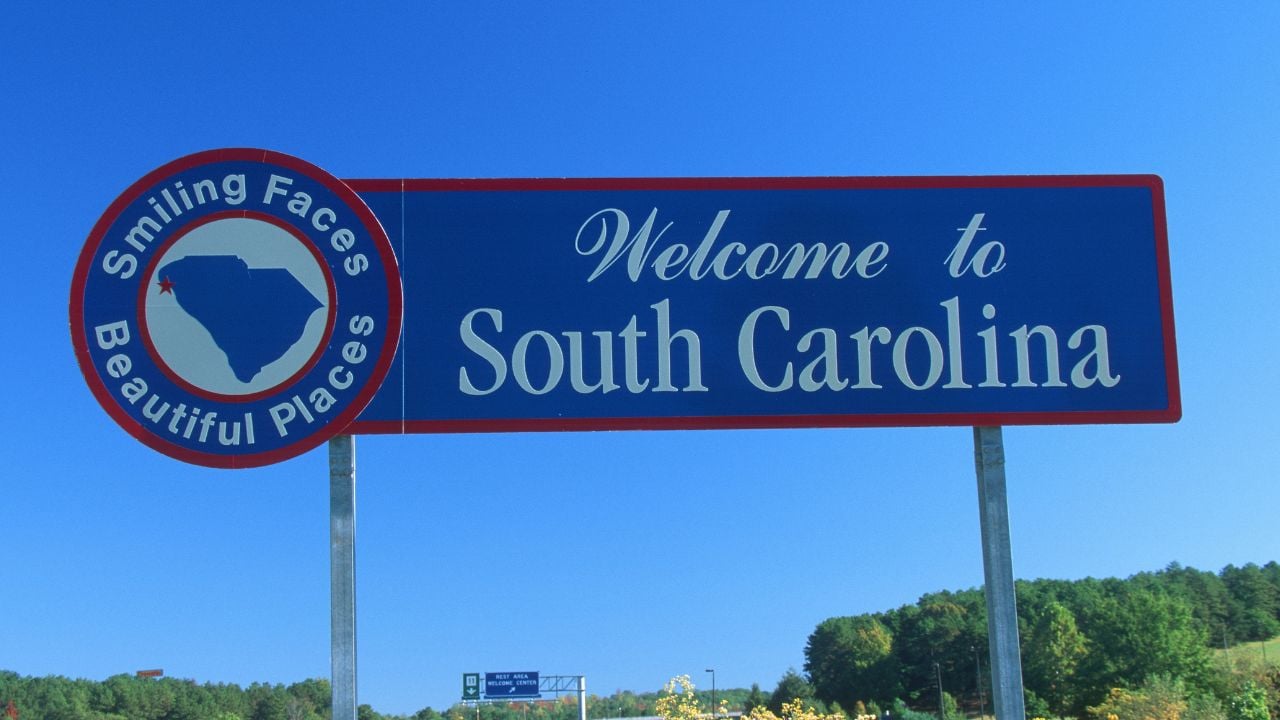
7 Things That Change the Second You Cross From North Carolina Into South Carolina

Crossing a state line doesn’t change the road, but it can change what you pay and what you’re allowed to do.
North Carolinians and South Carolinians who make the trip may be surprised by what’s different on the other side.
Here’s what to know before your next drive from North Carolina to South Carolina.
Note: This is general information, not legal or tax advice. Laws and tax rates are subject to change.
1. Fuel Tax
Your state fuel tax is 13 cents a gallon lower in South Carolina than in North Carolina.
North Carolina’s motor fuel tax is 41 cents a gallon in 2026.
South Carolina calls its version a motor fuel user fee, and it has been 28 cents a gallon since July 1, 2022.
On a 15-gallon fill-up, you pay $1.95 less in state tax.
It’s a small break.
2. Holding Your Phone
If you’re driving in South Carolina, you can’t hold or support your phone with any part of your body.
South Carolina’s Hands-Free and Distracted Driving Act took effect on September 1, 2025, and a 180-day warning period pushed ticketing to February 28, 2026.
Voice-based communication and hands-free use are allowed as long as the phone isn’t held or supported by any part of your body.
A first offense costs $100 plus court fees.
North Carolina differs.
G.S. 20-137.3 bars drivers under 18 from using a mobile phone while the vehicle is moving.
G.S. 20-137.4A bars every driver from typing or reading a text or email, and the fine is $100 plus court costs.
3. Aerial Fireworks
Public radio station WFDD’s Carolina Curious series reports that people cross the state line to buy aerial fireworks, which South Carolina sells and North Carolina bans.
If you’re one of those shoppers, buying them is the easy part.
Bringing Fireworks Back Across the Line
North Carolina’s fireworks statute reaches past the sale.
It makes it unlawful to buy, transport or possess pyrotechnics of any description.
So aerial fireworks you buy in South Carolina don’t become legal for you to carry back into North Carolina.
The exemptions are small.
The law allows wire sparklers coated with a nonexplosive mixture that produces a shower of sparks, up to 100 grams of that mixture per item.
It also allows hand-held or ground-based sparkling devices that don’t explode, spin or leave the ground, with up to 75 grams of chemical compound per tube.
4. Liquor Stores
The store where you buy a bottle of liquor changes at the state line.
North Carolina sells liquor through Alcoholic Beverage Control (ABC) stores run by local boards, apart from the exceptions in Articles 10 and 11 of the same chapter.
South Carolina limits full bottles to retail liquor stores, and only license holders can sell them.
Those stores can’t keep or sell other merchandise, with limited exceptions such as drinking glassware packaged with the liquor.
So the tonic for your drink has to come from another store, unless the producer sealed it in with the liquor.
Pick up mixers elsewhere.
5. Motorcycle Helmets
A motorcycle helmet is required in North Carolina, but in South Carolina it depends on your age.
North Carolina requires the operator and all passengers to wear a safety helmet with a retention strap properly secured.
The North Carolina helmet has to comply with Federal Motor Vehicle Safety Standard 218.
That requirement doesn’t apply to operators or passengers in autocycles with enclosed seating or a roll bar or roll cage.
South Carolina requires a helmet only if you’re under 21.
Age decides it.
The South Carolina helmet needs a neck or chin strap and must be reflective on both sides.
If you ride back into North Carolina, the helmet requirement applies to you again.
6. Cigarette Tax
If you smoke, a pack costs you 12 cents more in state tax on the South Carolina side.
North Carolina taxes cigarettes at 2.25 cents each, which comes to 45 cents on a pack of 20.
South Carolina charges 3.5 mills on each cigarette, plus a surtax of 2.5 cents on each cigarette.
A mill is a tenth of a cent, so that’s 0.35 cents plus 2.5 cents, or 2.85 cents a cigarette.
Across a pack of 20, South Carolina’s state tax comes to 57 cents.
If you buy 10 packs, the difference is $1.20.
It’s a modest gap.
Psst! How much do you know about the Carolinas? Take our quiz and see if you can ace it.
Quiz
Carolina Line IQ
Answer these questions on North Carolina and South Carolina law. We bet you can’t get them all right. Prove us wrong?
How long before a South Carolina marriage license is issued must the application be on file with the probate judge?
7. State Sales Tax
North Carolina's state sales tax rate is 4.75%, while South Carolina's statewide rate is 6%.
If you spend $100 on taxable items in South Carolina, you owe $6 in state sales tax instead of $4.75.
Both states allow local taxes on top of the state rate, so the total on your receipt depends on where you shop.
Bigger purchases feel it more.
Window Tint and Your Registration
Window tint limits don't flip at the state line the way the items above do.
On paper, North Carolina requires a tinted window to let through at least 35% of light.
South Carolina's floor is 27% when you count any factory tint on the glass.
South Carolina's tint law covers any motor vehicle required to be registered in South Carolina.
North Carolina's law exempts a window of a vehicle that is registered in another state and meets the requirements of the state where it is registered.
So the limit that applies to your windows follows your registration, not the state line.
Your plate decides.
Shared Headlight Rule
For rain, sleet and snow, the wipers rule for headlights is the same on both sides of the line.
North Carolina's headlamp statute requires your headlamps to be on whenever your windshield wipers are in use, and it adds smoke and fog to the list.
South Carolina's version covers rain, sleet and snow.
Headlights follow the wipers.
Wipers that run only intermittently in misting rain, sleet or snow don't trigger the rule in either state.
In both states, the rule also covers any weather that severely cuts how clearly you can see people and vehicles 500 feet ahead.
7 Property Tax Mistakes That Double What South Carolinians Owe
South Carolina homeowners carry one of the lowest effective property tax burdens in the country, yet not every homeowner ends up paying that rate.
Paperwork slips and missed deadlines are behind much of the difference.
7 Property Tax Mistakes That Double What South Carolinians Owe
8 Password Habits Putting South Carolinians' Accounts at Risk
State investigators traced a hacker into South Carolina's tax computers after a Department of Revenue worker opened one email.
Everyday password habits can leave your accounts just as exposed.
8 Password Habits Putting South Carolinians' Accounts at Risk
