
7 Things That Happen at a Louisiana Sugar Mill During Grinding Season

Grinding season’s in full swing at sugar mills, and most of what happens inside is hard to see from the road.
Here’s what happens at a Louisiana sugar mill during grinding season.
1. Trucks Around the Clock
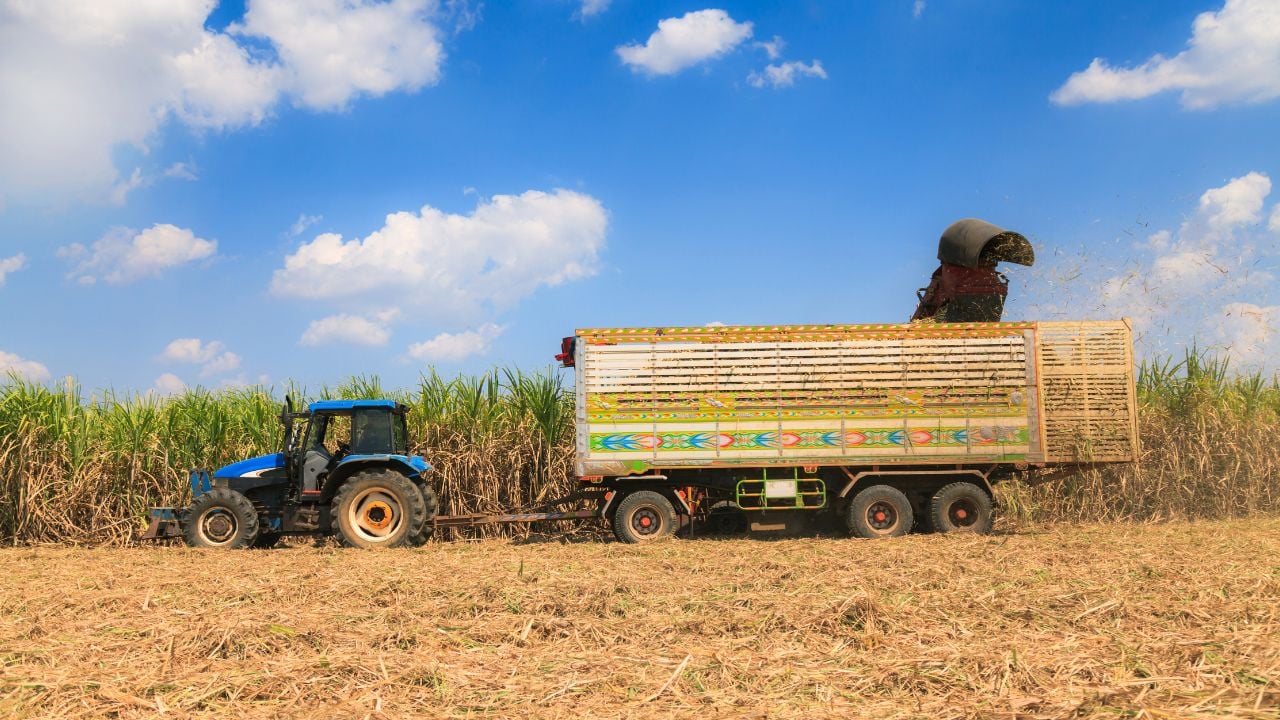
Sugar cane goes sour if a mill doesn’t process it within 24 hours, according to a 2023 report in The Advocate.
The Louisiana State University (LSU) AgCenter says the state’s raw sugar factories supply cane to the carrier 24 hours a day.
In 2023, Cora Texas, a mill in the town of White Castle, had about 150 trucks on the road around the clock during harvest.
Cora Texas samples every truck.
Workers send each sample to a lab to determine its sugar content.
At Cora Texas, farmers are paid by sugar content per ton.
In 2023, the mill bought about $1 million worth of cane a day during harvest.
If you’ve ever been stuck behind a slow cane trailer, that load may have been headed for a sugar test like this one.
If you watched a truck pull up to be weighed and tested, the mill could use its farm tag to track which farm is owed what.
2. Chopping and Crushing
Inside a sugar mill, revolving knives chop the cane into very small pieces as it rides the carrier.
Cora Texas ran cane through three sets of knives in 2023, and about 800 tons an hour could pass through the cutting process.
The AgCenter says some factories add shredders that tear the cane apart, but neither knives nor shredders extract any juice.
Then comes the squeeze.
If you’re picturing a single press, think bigger.
Most Louisiana factories extract the juice with heavy-duty mills, typically six in a row that pull out about 95 to 96% of the sucrose in the cane.
Water helps, too.
Cane entering the last mill gets water to dilute the juice, which improves how much sugar comes out.
Picture a juicer and you’re close, though the rollers at Cora Texas ran on 3,000-horsepower turbines in 2023.
That year, the mill pressed about 3,500 gallons of juice a minute.
3. Cleaning the Juice
In the process the AgCenter describes, the mill strains the juice, adds lime and heats it to about 215°F.
The lime raises the pH, which makes sucrose more stable for the steps that follow.
Heated juice then moves to clarifiers, where flocculating agents help impurities settle out.
If you could look into a clarifier, you’d see the muddy juice settling at the bottom while the clear juice moves on to the evaporators.
Filters come next.
They separate the mud into clear filtrate and a solid filter cake, and the filtrate goes back through the heaters and clarifiers.
You might expect the filter cake to be waste, but it’s hauled to local cane fields and spread as fertilizer.
4. Boiling Syrup Into Sugar
So how does a sugar mill turn clear juice into crystals?
Water leaves first.
Evaporators remove most of it and leave a thick syrup, which vacuum pans then boil at low temperatures under a partial vacuum with seed crystals added.
If you walked up to a syrup tank at Cora Texas, you’d see foam, and more foam means a higher sugar content, The Advocate reported in 2023.
Crystallizers slowly stir some of the mix as it cools to keep the crystals developing, and centrifugal machines then spin it in perforated baskets.
The crystals left in the basket are raw sugar.
Psst! How much do you know about Louisiana’s sugarcane industry? Take our quiz and see if you can ace it.
Quiz
Cane Country Trivia
Answer these questions on sugarcane and sugar-making. We bet you can’t get them all right. Prove us wrong?
Pasture mealybug, a new threat to Louisiana cane, doesn’t appear to be a sugarcane pest in its native country. Which country?
5. Where the Molasses Goes
The molasses that spins out goes back into the process for reboiling, so the mill can pull out more sugar.
Once the commercially recoverable sugar is gone, what you're left with is blackstrap molasses.
You may not buy molasses, but the AgCenter says blackstrap goes into animal feed and into making alcohol, yeast, citric acid and vinegar.
One mill ships it far.
The Advocate reported in 2023 that Cora Texas ships all of its molasses, about 10 million gallons, to a feed company in Wisconsin to be used as cattle feed.
6. Leftover Fiber as Fuel
If you've ever juiced an orange, you know the pulp left behind, and cane at a sugar mill leaves some too.
That pulp is bagasse.
The AgCenter says the fibrous residue from the last mill is burned in boilers to provide all the steam required to operate the entire factory.
In 2023, Cora Texas used the last mill's bagasse as boiler fuel to power the factory.
As of 2018, one Louisiana factory also used a diffuser, which leached the juice out of shredded cane before two conventional mills dewatered the wet bagasse.
What One Ton of Cane Makes
A gross ton of Louisiana sugarcane makes about 225 pounds of sugar.
It also yields about 6 gallons of blackstrap molasses and 270 pounds of bagasse.
That bagasse weight is bone-dry, and bagasse leaves the last mill at about 50% moisture, so the wet pile weighs more.
7. Storing and Shipping Raw Sugar
In October 2023, The Advocate reported that one warehouse at Cora Texas would have about 85 million pounds of raw sugar by late December.
At the time, a belt there moved about 5 million pounds of sugar a day into the warehouse.
That raw sugar isn't white.
It still carries a film of molasses, and refineries treat it to remove the molasses and impurities, which gives you the white table sugar on store shelves.
In 2018, the AgCenter counted two sugar refineries in Louisiana and said raw sugar ships to refineries in bulk by truck or barge.
If you're curious about the scale, Louisiana made more than 2 million tons of raw sugar in 2022, the most in the country, according to the American Sugar Cane League.
Smoke From the Fields
Mills aren't the only source of smoke in cane country.
Farmers burn cane in some fields as part of the harvest, TV station WBRZ reported in December 2025.
The AgCenter calls prescribed burning a common harvest management tool.
The state also has a voluntary smoke and ash management program, built by the Louisiana Department of Agriculture and Forestry and the AgCenter.
Its guidelines say to keep smoke and ash from blowing across public highways and away from schools, hospitals and doctor's offices.
In late December 2025, residents of East Baton Rouge Parish and parts of Ascension Parish reported ash and soot in their yards.
A WBRZ meteorologist said weekend weather likely kept the smoke closer to the ground.
If you're in the path, fire departments advise limiting outdoor activity, keeping windows and doors closed and bringing pets inside.
Sweep, don't blow.
If ash lands in your yard, experts recommend vacuuming or sweeping the soot, since a leaf blower can blow it back into the air.
Pasture Mealybug
Pasture mealybug was first found in Louisiana sugarcane in 2025, in Vermilion and Iberia parishes.
Adults look white and waxy.
In July 2026, the AgCenter said the insect can cause leaf yellowing that may progress into crop dieback.
By October 2026, the insect had been detected in every parish that grows sugar, most severely in West Baton Rouge, Iberia and Vermilion, Louisiana Radio Network reported.
Insecticides have helped with control, but they don't kill the insects in the soil, so reinfestation can occur within a couple of weeks.
If you think you've found it in a field, report suspected infestations in sugarcane to the AgCenter's Department of Entomology.
Season Dates
The grinding season starts in late September, and the AgCenter says it can continue into mid-January.
The dates can shift.
In early October 2026, the director of the AgCenter's Audubon Sugar Institute said acreage has been expanding north and west.
The grinding season is being stretched to mid-January and brought earlier to mid-September.
If you're on a south Louisiana road near harvest activity, the state's agriculture commissioner urged drivers like you to drive with care in October 2026.
As of Oct. 8, 2026, all but one of the state's 11 mills were running, the Louisiana Radio Network reported.
8 Louisiana Dishes That Change Two Parishes Over
Think a bowl of gumbo tastes the same no matter which Louisiana parish it's ladled in?
Along Louisiana's southwestern prairie, gumbo traditionally leaned on poultry and sausage, while cooks near the coast and waterways leaned on seafood, according to 64 Parishes.
8 Louisiana Dishes That Change Two Parishes Over
13 Signs Someone Was Raised in Louisiana No Matter Where They Live Now
Some Louisiana habits can follow you, even far from home.
Lagniappe, a little something extra a merchant tosses in for free, is one of them.
13 Signs Someone Was Raised in Louisiana No Matter Where They Live Now
