
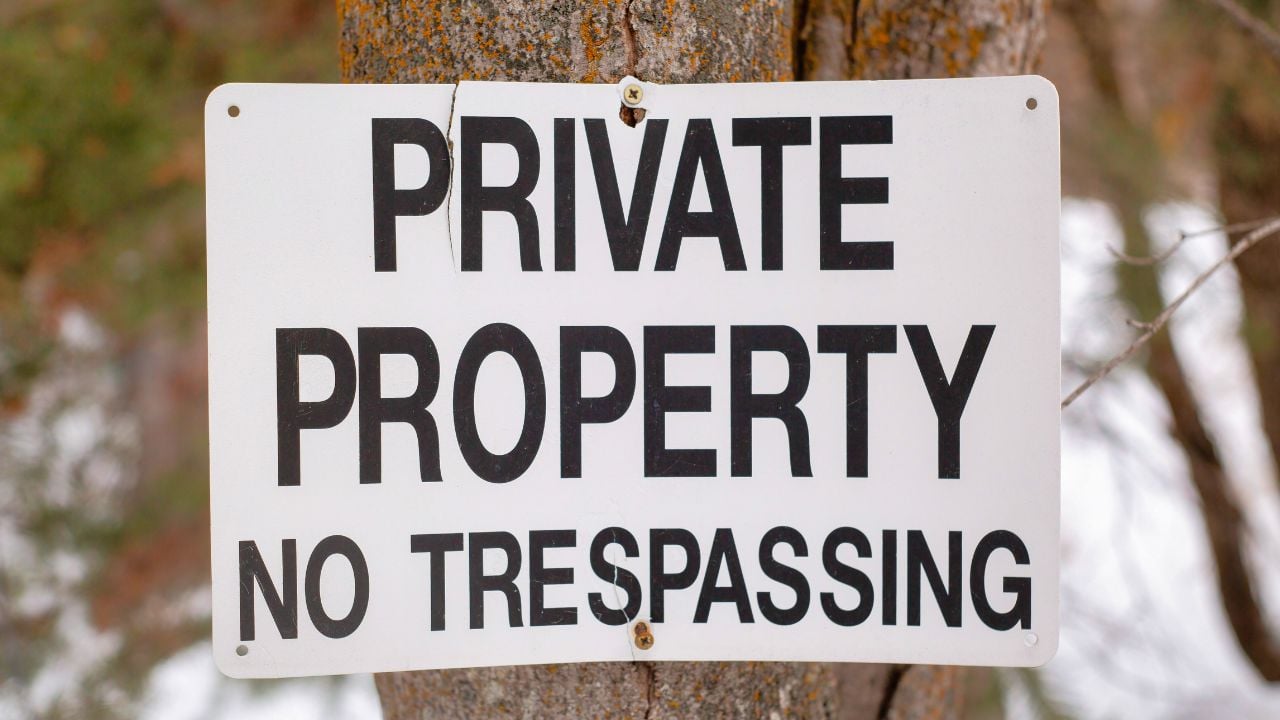
7 Trespass Laws Washington Landowners Get Wrong

It’s your land, so you make the rules.
That’s how many of us figure it works.
But the law has rules of its own about who counts as a trespasser, and some of them aren’t what you’d expect.
These are the trespass laws Washington landowners often get wrong.
Note: This is general information, not legal advice. Property laws and penalties are subject to change.
1. Unposted Land
Washington’s trespass law presumes that someone walking on unimproved, apparently unused land has permission to be there.
Many landowners picture an empty acre as off-limits to strangers.
It isn’t.
That presumption ends when you tell the person to stay out in person, or when you post notice where anyone can see it.
A fence ends it too because land that’s fenced or enclosed to keep intruders out doesn’t count as unimproved.
That includes a field fenced in any manner, so even a modest fence around your pasture can do the job.
Farmland with a crop or any other sign of cultivation clearly visible doesn’t count as unimproved either.
If you want a stranger on your land to count as a trespasser, you need a fence, a visible crop, a posted notice or a word to their face.
2. Second-Degree Trespass
Second-degree criminal trespass reaches onto open land in Washington, not only into buildings.
It applies when someone knowingly enters or remains unlawfully on premises of another and the situation doesn’t amount to first-degree trespass.
If a stranger ignores your posted sign and keeps walking across your land, that can be the charge.
It’s a misdemeanor, with up to 90 days in county jail and a fine of up to $1,000.
Intent matters.
The charge requires that the person acted knowingly.
If the stranger knowingly goes into a building on your property without permission, the charge can move up a degree.
3. Fenced Yards as Buildings
Your fenced yard can count as a building for first-degree criminal trespass, the more serious of the state’s two degrees of criminal trespass.
That charge covers anyone who knowingly enters or remains unlawfully in a building, and the criminal code defines a building to include any fenced area.
First-degree trespass is a gross misdemeanor, which carries up to 364 days in county jail, a $5,000 fine, or both.
So a stranger who climbs into your fenced yard can face a heavier charge than someone who wanders across an unfenced pasture.
What Counts as a Building in Trespass Law
Washington’s first-degree trespass law relies on the criminal code’s definition of a building, which includes any dwelling, vehicle, railway car, cargo container or fenced area.
That’s a wider net than the word “building” suggests.
Courts that apply the same definition in burglary cases have said a fenced area must be completely enclosed.
If your fence has a gap, your yard may not count.
A building with two or more units that are separately secured or occupied counts as a separate building for each unit.
If you own a duplex, each side may qualify.
4. Cutting Down Trees
Cutting down a tree on someone else’s land without lawful authority is a trespass in Washington, and it can cost the cutter triple the damages.
It covers anyone who cuts down, injures or carries off a tree.
It names the Christmas tree outright, which is worth knowing over Thanksgiving weekend.
It also covers trees on the street or highway in front of your house.
So a tree at your curb falls under the same rule as a tree in your yard.
A companion statute limits the cutter to single damages if the trespass was casual or involuntary.
The same goes when the cutter had probable cause to believe the land was theirs.
5. Defenses a Visitor Can Use
Anyone charged with criminal trespass has four possible defenses.
That surprises many landowners.
Three of the four work against both the first-degree and the second-degree charge.
If the person reasonably believed you, or someone else empowered to license access, would have let them in, that’s a defense.
If your premises were open to the public at the time, a visitor who followed every lawful condition for access has a defense.
So a trespass charge isn’t automatically open and shut.
An abandoned building is a defense too, but only against the first-degree charge.
Someone serving legal papers has a defense as well, as long as the entry was reasonable and necessary.
That defense ends at the door of your home because the person can’t have entered a private residence or a non-public building.
6. Suing Over Land Damage
If someone goes onto your land and removes crops, minerals or other valuable property, a Washington statute lets you sue them for the damage.
It also reaches anyone who wrongfully damages the land, your belongings on it or the improvements built there.
The word “wrongfully” carries a legal meaning: The person acted intentionally and unreasonably, while knowing or having reason to know you hadn’t authorized it.
A harmless walk across your land doesn’t qualify because the statute requires removal, waste or injury.
Damages include the market value of what’s removed or injured and the cost of restoring your land, and the statute triples that total.
The person also has to pay your reasonable costs, including investigation and attorneys’ fees.
If the property is a tree, the tree-cutting law above applies instead, so the two claims don’t stack.
Psst! How much do you know about owning land in Washington? Take our quiz and see if you can ace it.
Quiz
Property Line IQ
Answer ten questions on Washington fences, trails, hunting signs and land deadlines. We bet you can’t get them all right. Prove us wrong?
A neighbor builds a tall fence to annoy you. What can a Washington court order under the state’s spite-structure statute?
7. Removing Unauthorized Occupants
A declaration you sign under penalty of perjury can start the removal of people who are trespassing in your single-family home, condo or co-op unit.
If a peace officer gets your declaration, the officer may remove the people, with or without an arrest, and order them to stay off or face arrest for criminal trespass.
It isn't an eviction, though, and it can't remove a tenant who's entitled to live there under a rental agreement.
You have to swear the people aren't tenants or owners on title, and haven't been either in the last 12 months.
Then you swear you demanded they leave and they haven't.
If you sign it falsely, you can be sued for damages, costs and attorneys' fees.
Finally, you promise to hold the officers harmless for acting on your declaration in good faith.
An officer has to give the people in your home a reasonable chance to show they're tenants, legal occupants or guests, and has to consider what they show.
Your declaration doesn't settle the question, so be sure who's in your home before you sign.
8 Reasons a Washington Landlord May Be Allowed to Enter Your Rental

Your rental can feel like a locked door.
Some situations let a landlord walk in with little notice.
8 Reasons a Washington Landlord May Be Allowed to Enter Your Rental
9 Reasons People Are Leaving Washington, According to Those Who Left

Many people love Washington, and some of them left anyway.
These are the reasons they gave on the way out.
9 Reasons People Are Leaving Washington, According to Those Who Left
