
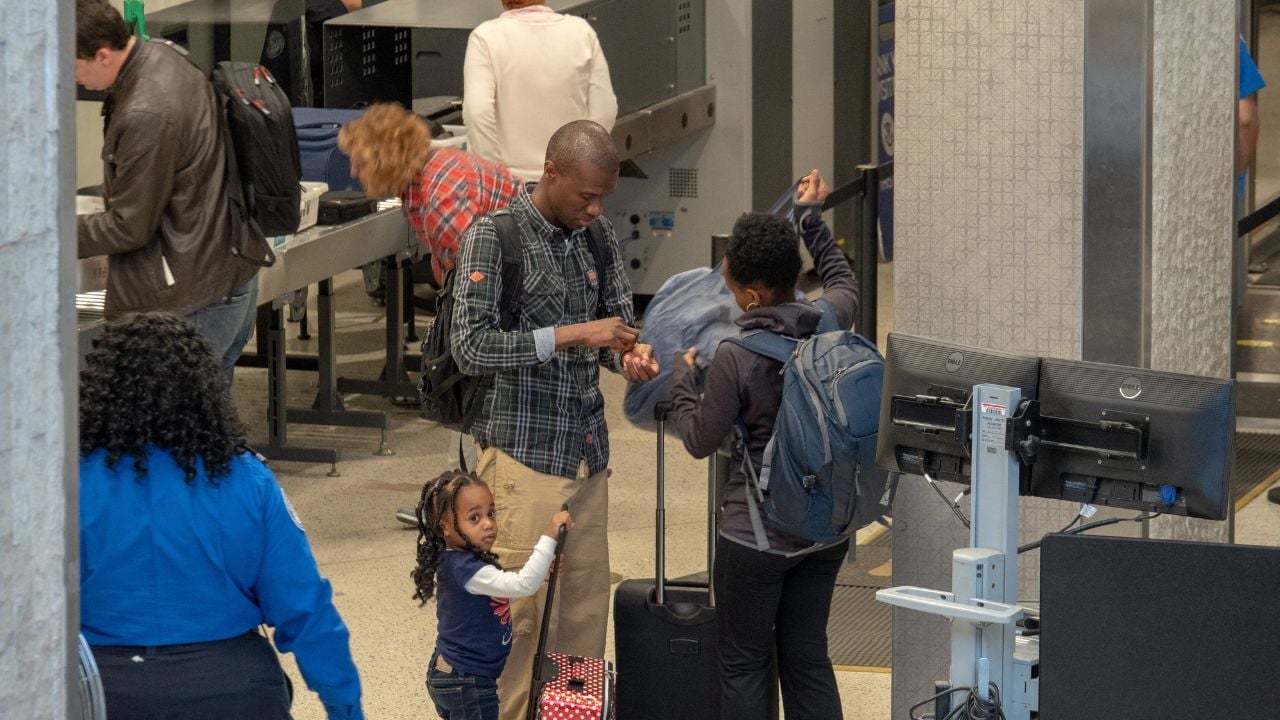
8 Airport Security Mistakes That Cost Texas Travelers Their Belongings

Four of the ten U.S. airports where the Transportation Security Administration (TSA) catches the most guns at security checkpoints are in Texas.
But travelers pack far more banned items in their carry-on bags than guns.
These are the airport security mistakes costing Texas travelers their belongings before they ever reach the gate.
Note: This is general information, not legal advice. Screening rules and civil penalties are subject to change, so confirm the current requirements with the Transportation Security Administration.
1. Carrying a Pocketknife
TSA doesn’t care that Texas lets you carry a pocketknife, a Bowie knife, and a sword down Main Street without a permit.
That’s not the case at the airport.
Any multi-tool or knife carrying a blade of any length is banned from carry-on bags at every U.S. airport, DFW and Bush Intercontinental included.
The knife clipped inside a backpack pocket and forgotten there doesn’t get a warning.
It goes straight into the bin under the X-ray belt. It isn’t coming back either.
Pack the same knife in a checked bag instead, and it flies just fine.
2. Forgetting Your Firearm Is Packed
TSA’s numbers put four Texas airports among the ten U.S. checkpoints that catch the most guns every year.
DFW alone stopped 390 firearms in 2024, second only to Atlanta nationwide.
Houston’s Bush Intercontinental caught 272. Dallas Love Field caught 143. Austin-Bergstrom caught 126.
TSA officers at Bush Intercontinental found a shotgun zipped inside a golf bag, hidden under the head covers, in April 2025.
Local police take custody of that firearm and decide what happens to it next, not TSA.
The traveler walks away without it either way.
3. Packing Loose Ammunition
Texas airport security treats ammunition and gun magazines as their own separate problem, even when the firearm itself is packed exactly right.
Bullets, clips, and magazines, loaded or empty, are barred from carry-on bags no matter what’s true about the gun they belong to.
A traveler who checks a firearm correctly, then tucks a spare magazine into a jacket pocket for the flight, still loses that magazine at the checkpoint.
Same result.
Same paperwork.
Pack the ammunition in the checked bag, right alongside the firearm, and none of this happens.
What “Confiscated” Means at a Texas Checkpoint
TSA doesn’t always seize a prohibited item the instant it shows up on the X-ray.
A traveler who catches the mistake before the bin clears the belt can usually step out of line, then check the item, hand it to a companion who isn’t flying, or walk it back to the car.
That option disappears the moment the item is left behind in the bin or the traveler is already past the metal detector.
At that point, the knife, the magazine, or the bottle of salsa becomes abandoned property, and TSA can destroy it, hand it to the state, or sell it.
Firearms skip this whole process. TSA calls local police the moment one shows up on the screen.
4. Packing a Stun Gun or Spray
Texas doesn’t require a license to carry pepper spray or a stun gun.
TSA draws a different line entirely.
Not one exception.
Pepper spray and stun guns are banned from carry-on bags outright, regardless of size or brand.
A keychain-sized canister loses the same way a full-size canister does.
Checked baggage is the only place either belongs.
Even there, pepper spray tops out at 4 ounces with a safety cap, and a stun gun needs its battery pulled and carried separately.
Skip that step. TSA officers keep whatever’s inside the bag.
Psst! How TSA-ready is your carry-on before you leave for a Texas airport? Run through this checklist and see where you stand.
5. Overpacking Texas Hot Sauce
A jar of salsa or a bottle of hot sauce is one of the easiest gifts to grab on the way to a Texas airport.
TSA’s liquids rule caps any single container in a carry-on at 3.4 ounces, no matter what’s inside it.
A jar of Pace, the picante sauce a San Antonio shop started bottling back in 1947, runs well past that limit.
So does a full bottle of Stubb’s, the barbecue sauce a pitmaster began hand-bottling in repurposed whiskey bottles, corked with a jalapeño, after moving his barbecue joint from Lubbock to Austin in 1986.
No exceptions for gifts.
TSA pulls either container at the tray and tosses it straight into the trash.
Check it instead, or mail it, and the gift makes it to the table.
6. Letting Your Phone Ride Alone
Texas airport security checkpoints see the same small theft play out again and again.
A phone or wallet drops into its own bin, separate from its owner’s bag.
It disappears somewhere between the belt and the pat-down line.
Gone.
Sen. Chuck Schumer’s office has pressed federal officials over hundreds of reported thefts at checkpoints nationwide.
Prosecutors charged three TSA officers at Miami International in 2023 with distracting travelers and pulling cash straight out of their wallets.
Texas checkpoints run the same bins, the same rush, and the same blind spot.
Keep the phone in a zipped pocket until it clears the X-ray, and it stays yours.
7. Rushing off Without Checking
Travelers leave 90,000 to 100,000 items behind at airport security checkpoints nationwide every month, TSA’s own numbers show.
A ring pulled off before the metal detector.
A belt. A boarding pass. A watch set down next to the tray while a jacket goes back on.
None of it comes back.
TSA holds every item for a minimum of 30 days.
After that, it’s destroyed, handed to the state as surplus, or sold.
Texans flying out of DFW, Bush Intercontinental, Austin-Bergstrom, or San Antonio International all feed the same nationwide pile.
8. Packing a Torch Lighter
TSA bans torch lighters completely at every Texas checkpoint, and everywhere else, cigar case or not.
One regular disposable or Zippo-style lighter is allowed per passenger, and only in a carry-on.
TSA pulls a second lighter at the checkpoint, even an ordinary disposable.
So does any torch or jet-flame style, the kind cigar smokers often reach for.
One lighter, one kind.
That’s the whole rule, and anything past it stays behind at the checkpoint for good.
What a Checkpoint Gun Costs
TSA fined travelers a record $23 million in 2024 for firearms caught at checkpoints, a 10% jump from the year before.
That’s just the fines.
Add up every civil penalty TSA has issued for guns since 2018, and the total tops $89 million, a 13-fold jump over six years.
A single first-offense fine can run as high as $14,950, the maximum TSA charges for one firearm caught at a checkpoint.
TSA officials tie the rise to permitless carry laws, now active in 29 states including Texas, which let more people carry a handgun without a license or training requirement.
More people carrying day to day means more people forgetting a gun is still in the bag on the way to the airport.
The fine isn’t the only cost either.
Losing TSA PreCheck for five years, sometimes for life, means standing in the regular line on every flight after.
Psst! How much do you know about TSA’s history and its strangest checkpoint catches? Take our quiz and see how many you can get right.
Quiz
Checkpoint History IQ
Answer these questions on TSA’s history and its strangest catches. We bet you can’t get them all right. Prove us wrong?
What year did the Aviation and Transportation Security Act create the TSA?
Where Left-Behind Items End Up
Texas travelers won't find one central TSA lost and found for the whole country.
DFW, Bush Intercontinental, Austin-Bergstrom, and San Antonio International each run their own, and some checkpoints hand the day's unclaimed items over to the airport by closing time.
A traveler who realizes something's missing has 30 days to file a claim and describe the item well enough to prove it's theirs.
Thirty days, no more.
Six months, sometimes longer, is how long TSA says a full investigation can take once a claim is filed.
TSA wipes or destroys electronics before that 30-day clock runs out, so a stranger's laptop or phone doesn't hold onto someone else's passwords and photos.
Anything TSA sells instead of destroying doesn't go back into airport budgets or officer paychecks.
That money goes to the U.S. Department of the Treasury, applied toward the national debt.
10 Small-Town Texas Diners Worth the Detour
Some of the best meals in Texas rarely turn up in Austin, Dallas, or Houston.
They turn up down a two-lane road, in a diner with a counter that seats a dozen and a cook who's been there since the Carter administration.
10 Small-Town Texas Diners Worth the Detour
8 Reasons People Are Leaving Texas in 2026

No state added more new residents last year than Texas.
But the net gain from other states has shrunk to under 70,000, and U-Hauls are leaving from El Paso to Texarkana just as fast as they're arriving.
