
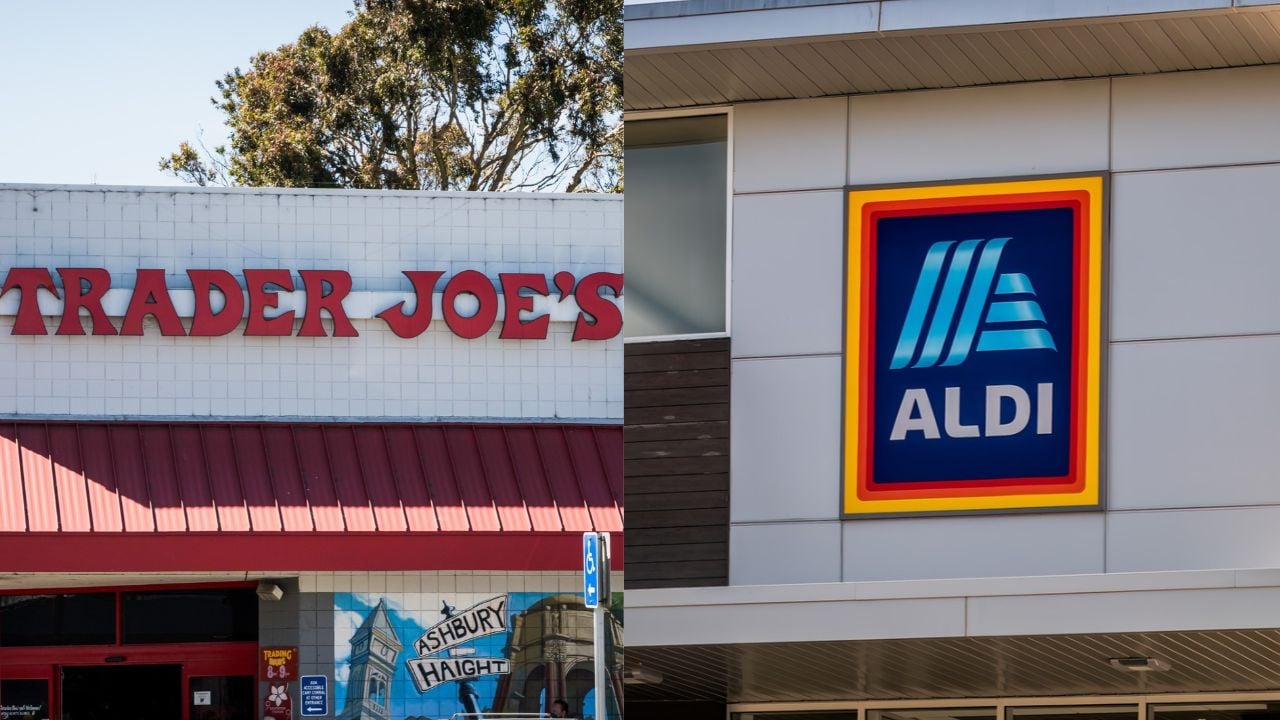
8 Big Differences Between Trader Joe’s and Aldi Every Californian Needs to Know

Trader Joe’s and Aldi get compared so often you’d think they were twins.
Spend enough time with twins, though, and you start to see how much they differ.
These are the biggest differences between Trader Joe’s and Aldi that Californians need to know.
1. Price Gap
Consumers’ Checkbook, a nonprofit, priced both Trader Joe’s and Aldi in three cities, and Aldi’s prices ran well below the all-store average each time.
Because both chains mainly sell store brands, Checkbook used a modified survey in each city instead of its standard 150-item basket.
Aldi’s prices came in 41% below that average in the Twin Cities, 33% below in Chicago and 28% below in Boston.
Those gaps add up.
Trader Joe’s ran higher than Aldi in all three, though it still undercut most traditional supermarkets.
None of those cities is in California, and Checkbook’s pages never mention it, so the gap at your two stores could look different.
A March 3, 2026 Tasting Table price check, which didn’t name its store, found Aldi’s creamy peanut butter at about 11 cents an ounce against 16 cents at Trader Joe’s.
Trader Joe’s won the ketchup round, with organic ketchup at about 10 cents an ounce against Aldi’s 12.
How Checkbook Priced Aldi and Trader Joe’s
Consumers’ Checkbook built a special survey for Aldi and Trader Joe’s because both chains mainly sell store brands.
For conventional supermarkets, Checkbook’s team substituted the cheapest comparable store brands.
Checkbook compared everything by unit price, so package size doesn’t change the result.
Checkbook’s percentages compare each chain with the average of every store it priced, so they measure Aldi against that average and not against Trader Joe’s directly.
2. Sales and Specials
Trader Joe’s says its everyday prices leave no room for sales, specials or coupons.
Aldi runs the other way, with seasonal price cuts layered on top of its everyday prices.
This fall’s round began Sept. 23 and ran until at least Nov. 3, and Aldi estimated it would save shoppers $86 million.
Aldi priced Honeycrisp apples at $1.99 for a two-pound bag, 35% below last year.
Kirkwood chicken breast family packs went for $1.99 a pound, which Aldi called its lowest everyday price since 2022.
Dinner, solved.
Aldi says prices and availability may vary by store, so confirm yours before you drive over.
3. Online Ordering
Trader Joe’s doesn’t offer online ordering, curbside pickup or delivery.
Aldi does, with delivery partnerships through Instacart, DoorDash and Uber Eats.
When Aldi launched curbside pickup in 2020, it noted that fees apply and that sale items may not be on sale through Instacart.
Watch the total.
Trader Joe’s representatives say they’d rather invest in employees and the in-store shopping experience than build a delivery operation.
So at Trader Joe’s, you’re the one filling the cart.
7 Precautions Californians Should Take When Shopping at Trader Joe’s
A Trader Joe’s run can be one of the more cheerful errands on your list.
That good mood is a fine reason to slow down because a few habits can protect your health and your wallet while you shop.
7 Precautions Californians Should Take When Shopping at Trader Joe’s
4. Carts and Bagging
At Aldi, you unlock a cart with a quarter and get it back when you return the cart.
You’ll bag your groceries there too, and Aldi sells bags at checkout if you forget yours.
At Trader Joe’s, crew members bag your items at checkout.
Pack a quarter.
5. California Start Dates
Trader Joe’s opened its first store in Pasadena in 1967, surrounded by college campuses, a hospital and big engineering firms.
Founder Joe Coulombe, a Los Angeles convenience store owner, aimed it at well-educated, well-traveled shoppers.
Aldi didn’t arrive in Southern California until March 2016, nearly 50 years later.
That’s a long wait.
If you live in Southern California, you may remember the first wave.
Eight of 45 planned Southern California stores held grand openings on March 24, including Beaumont, Fontana and Moreno Valley.
Aldi’s first Fresno store opened in January 2021, after stores in Hanford and Clovis.
That head start could explain why many Californians know Trader Joe’s better than Aldi.
6. Store Counts
Trader Joe’s started 2025 with 579 stores in 42 states and Washington, D.C.
Nearly 200 of them were in California, slightly more than one-third of the chain.
That’s a big share.
Aldi says it has more than 2,600 stores nationwide, more than four times Trader Joe’s start-of-2025 count.
Trader Joe’s still reaches more states, though, with 42 at the start of 2025 against Aldi’s 40.
If your city lacks a Trader Joe’s, the company’s website has a “Request a Trader Joe’s” page.
7. Customer Satisfaction
Trader Joe’s wins this one if you’re counting smiles instead of dollars.
In the American Customer Satisfaction Index (ACSI) 2026 results, based on data collected from January through December 2025, Trader Joe’s scored 86 and Aldi scored 81.
Aldi isn’t far behind.
Aldi ties Costco and Whole Foods at 81, while Trader Joe’s rose two points from the year before.
Aldi held steady.
The index lists Trader Joe’s at 87 in the West but gives Aldi no West score.
8. Separate Owners
Trader Joe’s and Aldi share a family tree but not a parent company.
Aldi Süd runs every Aldi store in the United States, so the Aldi you shop at answers to that side.
Aldi Nord bought Trader Joe’s in 1979.
The Albrecht brothers split their German grocery business into Aldi Nord (north) and Aldi Süd (south) after a quarrel over selling cigarettes.
Two stops, two owners.
Psst! How much do you know about Trader Joe’s and Aldi? Take our quiz and see if you can ace it.
Quiz
Grocery Chain IQ
Answer these questions on Trader Joe’s and Aldi. We bet you can’t get them all right. Prove us wrong?
Before a new Trader Joe’s product reaches the shelf, it reportedly has to win what share of a tasting panel’s vote?
Where They Match
Trader Joe's and Aldi look alike in a few ways that have nothing to do with ownership.
Neither has a rewards program, since Aldi says it doesn't offer rewards cards and Trader Joe's says it has no loyalty program, so you won't need a card at either.
Aldi says nearly 90% of the items on its shelves are exclusive brands.
Trader Joe's says more than 80% of its products are private label, though the two count differently.
Both are store-brand shops.
California's 2026 bag rule covers many grocery stores, which would include both chains: Stores may only provide recycled paper carryout bags, for at least 10 cents each.
Aldi's FAQ asks shoppers to bring their own reusable bags or buy bags at checkout.
Disneyland Raised 4 of 7 Ticket Tiers by $5. The Date Californians Visit Matters
The cheapest Disneyland ticket didn't go up, and it's still $104.
Four other tiers rose $5 each in October, so the date you pick decides what Californians pay.
Disneyland Raised 4 of 7 Ticket Tiers by $5. The Date Californians Visit Matters
