
8 Birds That Refuel on Alabama’s Coast Every October Before Flying Nonstop Across the Gulf

Right now, tiny travelers may be stopping along the Alabama shore to eat and rest.
Ahead of them is open water with nowhere to land.
Here are the birds who are fueling up before their big trip south.
1. Ruby-Throated Hummingbird
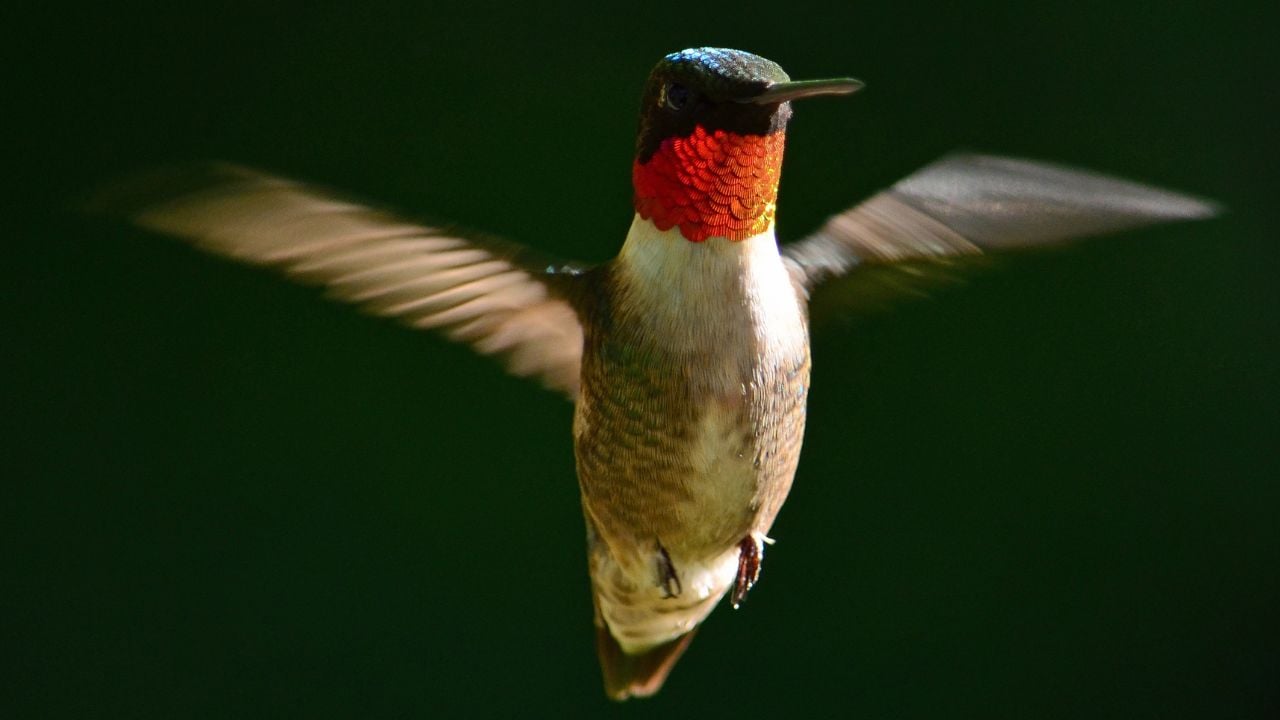
The ruby-throated hummingbird is the smallest bird on this list, and it nearly doubles its weight before the crossing.
Texas wildlife officials list the ruby-throated hummingbird among the trans-Gulf migrants, the species that cross the Gulf of Mexico between the Yucatan Peninsula and the U.S. Gulf Coast.
A healthy hummingbird can increase from about 3.25 grams to more than 6 grams before it takes off, according to the migration-tracking program Journey North.
That’s nearly double its weight, and all of it goes on as fuel.
You could hold the extra weight between two fingers.
It still has to carry the bird across roughly 500 miles of open water, in a single flight of 18 to 22 hours.
It can’t turn back halfway.
The hummingbird’s next meal already waits on the far side of the Gulf of Mexico, past the point where your feeder stopped mattering.
2. Blackpoll Warbler
The blackpoll warbler weighs roughly 10 to 12 grams.
It’s a trans-Gulf migrant too, one of the species that cross the Gulf of Mexico.
Set it on a kitchen scale next to two quarters, and you’d barely notice the difference.
A write-up of the Fort Morgan banding project quotes a Mississippi State researcher comparing the migration of a 12-gram bird to a car getting 500,000 miles per gallon.
That kind of flight runs on fat the bird builds up beforehand.
Before its fall flight, a blackpoll can nearly double its mass, from roughly 10 to 12 grams up to around 20 to 24.
Every gram counts.
Its famous fall launch happens over the Atlantic from New England and Maritime Canada.
Once the water starts, there’s nowhere left for a bird this size to land.
3. Chimney Swift
The chimney swift eats on the wing, and it gathers into big groups before it heads south.
Before it leaves, swifts gather into roosts that researchers have counted at up to 10,000 birds circling a single chimney at dusk.
You’d never guess that many birds fit inside a single chimney flue.
The chimney swift is a trans-Gulf migrant as well, one of the species that cross the Gulf of Mexico.
One chimney, one enormous flock.
You won’t find chimney swifts working a feeder the way hummingbirds do.
They snap up flies, beetles, and ants in midair before heading for wintering grounds in the upper Amazon basin.
Once that roost empties out, the flock is on its way to South America.
4. Gray Catbird
The gray catbird leans on fruit when insects get scarce.
It turns to berries, including holly, elderberries, and blackberries.
You can hear it before you see it, a cat-like mew from deep inside a bush.
Catbirds are among the birds caught in the nets at the Fort Morgan banding station.
Cornell’s Lab of Ornithology maps its winter range from the Gulf Coast all the way down through Central America and the Caribbean.
It’s a trans-Gulf migrant too.
For a bird with a long trip ahead, fruit is fuel, not a treat.
The catbird you were listening to all week may be gone by the time your bush stops rustling.
The No-Refill Problem
Trans-Gulf migrants like ruby-throated hummingbirds and chimney swifts face the same problem once they leave your coast behind.
There’s very little to land on near the middle of the Gulf of Mexico.
Fat is the fuel that gets a bird across, and researchers say some species pack on twice their normal body weight just to make that math work.
Every gram a bird packs on before takeoff gets burned as energy during the flight, not stored for later.
If you’re watching from the beach, picture it this way: A bird that leaves without enough fuel can run out with hours of open water still ahead of it.
5. Yellow-Billed Cuckoo
The yellow-billed cuckoo eats thousands of caterpillars in a season, according to Cornell.
Banders at Fort Morgan have caught it too.
The yellow-billed cuckoo is a trans-Gulf migrant, one of the species that cross the open water.
You’d never guess a bird built for hunting caterpillars in the treetops has a second life as a long-distance flier.
But it does.
Over open water, there are no caterpillars to pick off.
There’s no snack break coming.
6. Great Crested Flycatcher
The great crested flycatcher hunts from a perch, darting out after flying insects.
Fort Morgan banders have caught it alongside catbirds and cuckoos.
You can pick out its rising whistle before you ever spot it in the leaves.
That perch-and-dart hunting style works fine over dry land.
It’s useless over open water.
It’s a trans-Gulf migrant, one of the species that cross open water.
Out over the Gulf, there are no perches at all.
7. Northern Waterthrush
The northern waterthrush walks the edges of wetlands bobbing its tail, picking insects off wet mud instead of catching them in the air.
Fort Morgan banders have caught it, though you would probably never spot it on the beach.
The northern waterthrush is a trans-Gulf migrant, one of the species that cross the Gulf of Mexico.
Despite looking more like a small thrush than a warbler, it still makes the trip.
It is a warbler that forages by walking, so the wet edges along your coast are where it can feed before moving on.
There’s no mud left to work once the water starts.
8. Rose-Breasted Grosbeak
The rose-breasted grosbeak is a chunky songbird, larger than a House Finch, and a bigger body means a bigger fuel bill.
Texas wildlife officials list it among the confirmed trans-Gulf migrants that cross the Gulf of Mexico.
Alabama’s fall birding calendar puts the grosbeak moving back through the state in mid-fall too, right as coastal fronts start pushing migrants toward spots like Fort Morgan.
You’ll spot it by the heavy, seed-cracking bill before you ever notice the rose-colored patch on its chest.
Before it leaves the coast, it packs on seeds, fruit, and insects wherever it can find them.
A body that size doesn’t run on scraps.
Your feeder may empty out right about when that grosbeak moves on, running on whatever it managed to store.
Psst! How many of these Gulf-crossing migrants have you spotted along Alabama’s coast? See how your birdwatching stacks up.
When the Fuel Runs Short
Storms and high winds can catch a migrant mid-crossing over the Gulf of Mexico.
Researchers who study the offshore oil platforms scattered across the Gulf have documented weaker songbirds landing on them for refuge.
Some are too weak to continue once they touch down.
Not all of them survive.
About 46% of the deaths researchers logged on those platforms came from starvation after landing, according to a 2005 study.
You won’t see any of that from the beach.
