
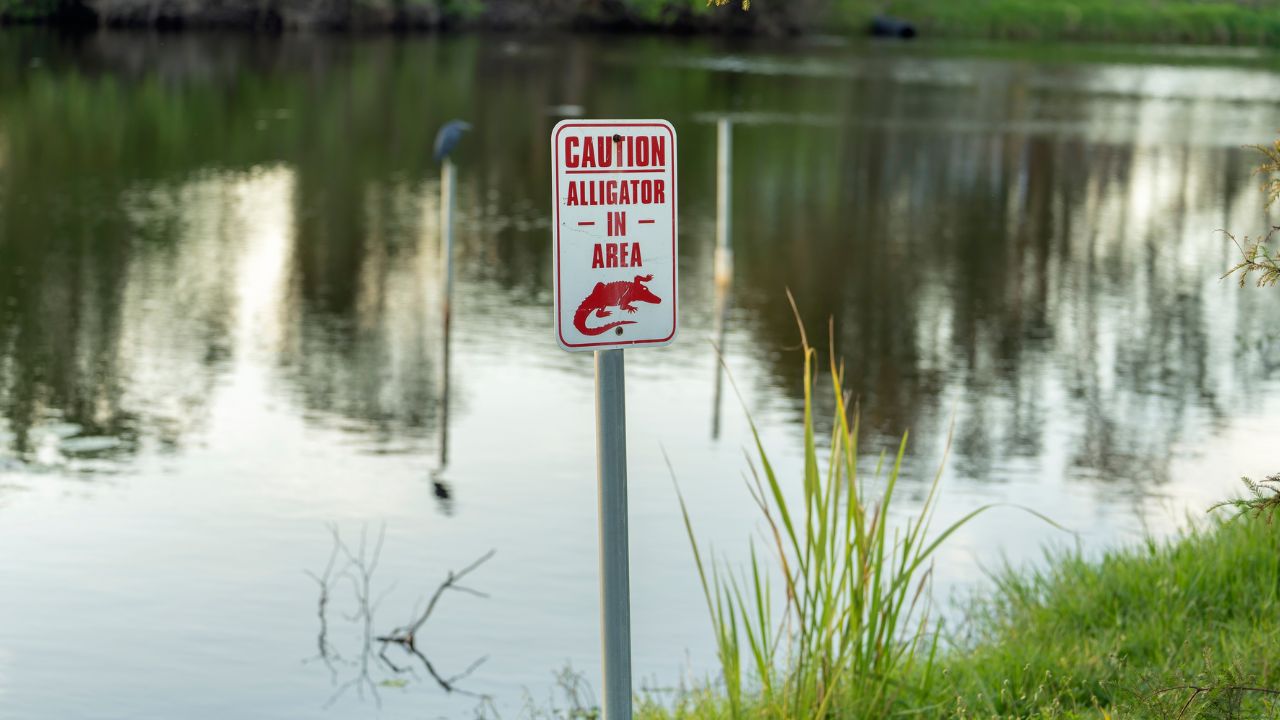
8 Common Florida Wildlife Encounters, and What the State Tells You to Do About Them

Florida’s Fish and Wildlife Conservation Commission says there were 13 unprovoked alligator bites statewide in 2025.
Two of them were fatal.
This is what the state recommends to do if you encounter any of the following animals in Florida.
Note: This is general information, not legal advice. Wildlife rules and penalties are subject to change, so confirm current requirements with the Florida Fish and Wildlife Conservation Commission.
1. Black Bear at the Trash Cans
Florida’s black bear population has been growing for decades, and a lot of that growth has landed in neighborhoods that didn’t exist a generation ago.
Florida wildlife officials say the safest move if a bear gets close is to stand tall, back away slowly, and never run, play dead, or climb a tree.
Florida’s stand-your-ground bear law lets a homeowner use deadly force on a bear that’s actively threatening a person, a pet, or property on their land.
The homeowner then has 24 hours to report the kill to the state.
Many longtime residents secure the cans the night before pickup and bang a pot lid if a bear lingers nearby.
Run from a bear, and curiosity turns into a chase.
2. Shark in the Surf
Florida logged 11 bites from sharks in 2025, and 6 of them happened along one stretch of Volusia County beach.
New Smyrna Beach, the stretch in question, has earned the nickname the shark bite capital of the world.
State wildlife biologists recommend staying in groups, skipping the water at dawn and dusk, and getting out fast when baitfish start jumping nearby.
None of that keeps a local out of the water on a Saturday morning.
A tourist who spots a fin from the sand is far more likely to clear the beach and wave down a lifeguard.
The rest of the vacation usually stays out of the water.
Locals read the water instead of the shoreline.
3. Alligator in the Yard
Florida’s Fish and Wildlife Conservation Commission (FWC) breaks those 2025 numbers into 8 major bites, two of them fatal, and 5 minor ones, according to its data.
The tally only tracks confirmed, unprovoked encounters, not the nuisance calls that never turn into a bite.
Florida generally sends a trapper for an alligator that’s at least 4 feet long and considered a threat to people, pets, or property.
FWC will remove a smaller gator too, though, when it turns up somewhere unacceptable, like a pool or a garage.
Anything else, or anything just passing through, doesn’t qualify.
That’s not a big deal.
A gator sunning by a retention pond doesn’t rate a phone call for many locals.
A local glances at a gator near the dock and keeps mowing the lawn.
A visitor is far likelier to grab a phone, call 911, or inch closer for a photo, and none of that is what the state wants from a bystander.
How Many Alligator Calls Get a Trapper
In 2017, Florida’s wildlife commission logged 13,210 nuisance-alligator complaints.
Trappers ended up removing 8,455 of those alligators, a conversion rate of about 65 percent, so roughly a third of the calls turn out to be nothing worth the drive.
4. Green Iguana by the Pool
Florida’s wildlife commission gives homeowners a green light many states would never allow: A green iguana can be humanely killed on private property year-round, no permit needed.
Many longtime residents treat an iguana sunning on the pool deck as pest control, not wildlife, and scoop it out with a net instead of calling anyone.
An out-of-stater who spots the same lizard often assumes it’s protected, calls animal control, or tries to relocate it somewhere safer.
None of that matches how the state treats the species.
Green iguanas showed up in the state back in the 1960s and have since spread across South Florida, chewing through landscaping and burrowing under sidewalks and seawalls.
That’s how an invasive species turned into a neighborhood fixture.
Psst! How Florida-wildlife-ready are you? Run through this checklist and see where you land.
5. Manatee Near the Dock
Touching, feeding, or chasing a manatee is a crime in Florida under three separate federal and state laws.
The penalties reach $100,000 and a year in federal prison for the worst violations.
That’s steep.
Many longtime boaters idle down, watch the water for a snout, and give a feeding manatee all the room it needs.
Someone visiting is more likely to jump in for a closer look, try to pet one, or offer it lettuce over the side of the boat.
Any of those moves can draw a federal violation.
Florida asks boaters to report a sick, injured, or tagged manatee instead of trying to help it themselves.
6. Venomous Snake in the Garage
Florida has six native venomous snake species among its wildlife.
Wildlife experts say most snakebites happen to someone trying to handle or kill the snake, not to someone who left it alone.
Leaving it alone is also the official advice.
There are no exceptions.
A local who finds a snake coiled by the garage door usually backs up, gives it a path outside, and lets it go on its way.
A newcomer is more likely to reach for a hoe or a broom, and that’s usually how a bite happens.
Distance is what keeps both sides safe.
7. Wild Hog in the Yard
The state’s wildlife commission classifies wild hogs as unprotected, unlike many of the state’s native species.
With landowner permission, anyone can trap, shoot, or hunt a wild hog on private property year-round, no license, fee, or permit required.
There’s no paperwork to file.
A rural resident who spots a hog rooting through the yard sets a trap that weekend or calls a neighbor who hunts.
A transplant is more likely to call the state and expect a wildlife officer to come handle it, and that call usually ends with instructions to handle it themselves.
Relocating a trapped hog without permission is the one part of this that still needs a permit.
8. Coyote in the Neighborhood
Florida’s wildlife commission calls unprovoked coyote attacks on people very rare, even as coyote sightings spread into nearly every county.
Pets are a different story.
The official guidance for a close encounter is to stand tall, shout, wave your arms, or use a noisemaker, and never run.
Feeding a coyote is illegal in Florida, since a fed coyote stops being afraid of people fast.
A local who spots a coyote crossing the yard at dusk claps, yells, and keeps walking the dog on a short leash.
A new resident is more likely to assume it’s a lost dog, ready a phone for photos, or leave out food to keep it around.
That’s exactly how a shy coyote turns bold.
12 Things Florida Grandparents Did That Their Kids Would Never Allow Now
Consumer safety rules for kids’ gear barely existed until the Consumer Product Safety Commission showed up in 1972.
Everything Florida grandparents bought, built, or let a toddler climb on before that answered to nobody but the store shelf.
12 Things Florida Grandparents Did That Their Kids Would Never Allow Now
7 Florida HOA Fees That Have Doubled for Many Since 2020

One Seminole County homeowners association paid $91,000 for its building insurance in 2023.
The next year, that same bill came to $233,000, and insurance is only one piece of what’s gone up for Florida HOAs since 2020.
