
8 Day of the Dead Traditions in New Mexico That Have Nothing to Do With Halloween

Halloween ends, and for many New Mexicans, another kind of holiday is just getting started.
It’s about remembering loved ones, and the customs are full of color, food and candlelight.
Here’s how New Mexicans honor the people they’ve lost.
1. Ofrendas for Loved Ones
At the center of Día de los Muertos is the ofrenda, an altar built to remember someone who mattered to you.
Muertos y Marigolds, the South Valley arts group behind the parade, set up an ofrenda exhibit at the Gutierrez-Hubbell House on Isleta Boulevard.
The exhibit opened Oct. 3 and closes Nov. 7.
In Mesilla, near Las Cruces, New Mexico Magazine reported, some local families have built shrines to their ancestors every year for more than a century.
Who would you honor?
If you’re building an altar at home, keep it simple: The purpose is remembrance, and what goes on the altar is up to you.
What Goes on a Day of the Dead Ofrenda
Muertos y Marigolds lists seven essentials for a Day of the Dead ofrenda, beginning with a picture of the person and items they cherished.
The other five are their favorite foods, fresh water, candles, flowers and salt.
Marigolds or chrysanthemums are preferred for the flowers.
Optional touches include papel picado, sugar skulls, pan de muerto and books.
Candy and toys are welcome for children being honored.
2. Marigold Garlands
Smithsonian Folklife Magazine lists marigolds among the essential elements for building an altar to loved ones, alongside salt, water, candles, food and photographs.
Old Town Albuquerque’s Día de los Muertos celebration runs Oct. 30 through Nov. 8 this year, and a Marigold Mile is one of its daily features.
As you walk through Old Town, you’ll see over 15,000 feet of marigold garland on the beams, vigas and adobe of the historic buildings.
That’s hard to miss.
Santa Fe’s Plaza celebration, set for Oct. 30 and 31, features hundreds of marigolds, a candlelight parade and decorative skulls.
Even the South Valley parade has the flower in its name.
3. South Valley Parade
The South Valley’s Día de los Muertos parade steps off at noon this Sunday, Nov. 1.
If you go, plan on a celebration that runs from noon to 4 p.m. at the Westside Community Center on Isleta Boulevard Southwest.
The Albuquerque Journal’s 2024 coverage featured giant puppets in a wedding stroll down Isleta Boulevard.
Organizers say they want the public to laugh and perhaps cry, but never leave feeling they saw something gory or ghoulish.
4. Papel Picado
Papel picado is the intricately cut paper you’ll see on many Día de los Muertos altars.
The National Hispanic Cultural Center hosted a papel picado workshop on Oct. 10, one of seven Saturday workshops Muertos y Marigolds ran from Sept. 12 through Oct. 24.
Smithsonian Folklife Magazine lists papel picado among the innovations that joined the traditional altar.
In Mesilla, the Las Cruces Bulletin described Mesilla altars ornamented with colorful papel picado and bright yellow marigolds.
Psst! How much do you know about Día de los Muertos? Flip these cards and see how many you can get right.
5. Pan de Muerto
Pan de muerto is the sweet bread of Día de los Muertos.
New Mexico Magazine describes the bread as scented with anise and orange and decorated with bread bones.
In 2014, Golden Crown Panaderia in Albuquerque, famous otherwise for its green chile cheese bread, planned to offer pan de muerto in at least three sizes.
If you’re in Mesilla on Nov. 2, the town’s 2026 schedule invites you to pan de muerto after the procession to the cemetery.
6. Catrina Dress and Calavera Paint
Smithsonian Folklife Magazine says José Guadalupe Posada’s La Catrina satirized Mexicans who looked to abandon their indigenous roots.
Old Town’s event page says his calavera designs symbolize both death and celebration.
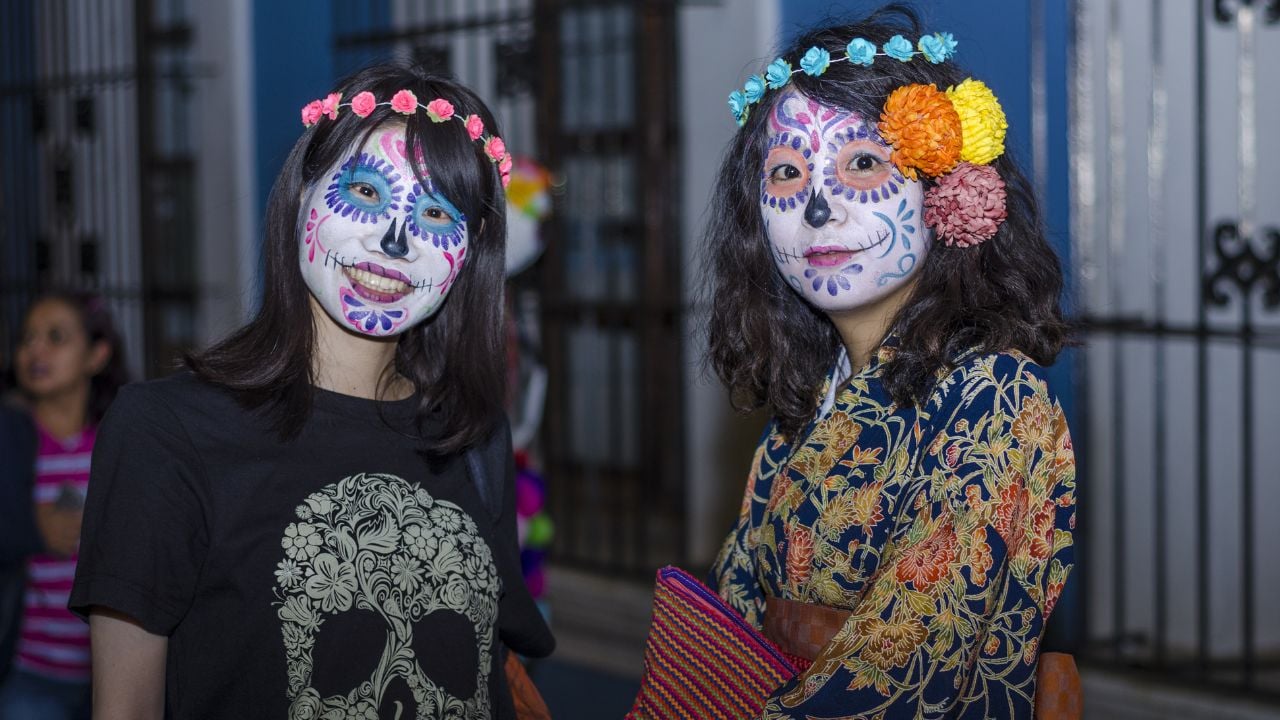
Día de los Muertos in Old Town Albuquerque includes a Catrina Procession on Nov. 1, an invitation to dress in traditional Catrina skull attire and walk the streets.
In Mesilla, attire runs from bright colors to the traditional black and white of calavera (skeleton) dress, according to Las Cruces tourism.
In 2023, organizers of the South Valley parade told marchers to wear calavera face paint or a mask and to decorate themselves with marigolds.
If you’d rather have your face painted than paint it yourself, Santa Fe’s Plaza celebration lists free face painting on Oct. 31.
7. Sugar Skulls
Mesilla’s Día de los Muertos altars, which represent love and remembrance for the deceased, are decorated with sugar skulls, pan de muerto, tissue paper and candles.
Muertos y Marigolds’ altar guidelines also list sugar skulls among the optional items for an ofrenda, so you can set them on yours.
Sugar skulls are made of sugar and decorated with frosting.
In October 2025, you could decorate sugar skulls at the National Hispanic Cultural Center’s 25th anniversary celebration, free and for all ages.
The next day, Santa Fe’s Museum of International Folk Art offered sugar skull decorating, mask-making and pan de muerto with chocolate Mexicano, with free admission.
8. Candlelight Processions
Candlelight processions are part of Día de los Muertos in Santa Fe, Albuquerque’s Old Town and Mesilla this year.
The dates differ, though.
Santa Fe’s Plaza parade starts at 8:15 p.m. on Saturday, Oct. 31, led by Las Catrinas de Xochitl Ballet Folklorico y Las Mojigangas.
In Old Town, you can join a procession to remember loved ones that begins 30 minutes after sundown on Nov. 2.
If you head to Mesilla on Nov. 2, the candlelight procession starts at the plaza and heads to the cemetery; Las Cruces tourism says it travels along Calle de Guadalupe to San Albino Cemetery.
The nonprofit Calavera Coalition has coordinated Mesilla’s celebration since 1998.
