
8 Florida Towns Retirees Are Moving to Instead of Miami

Plenty of retirees still want Florida. They just can’t stomach Miami anymore.
The sun’s the same a few hours up the coast, and so are the palm trees.
What changes is the price tag, the traffic, and, perhaps, your blood pressure.
Note: This is general information, not financial or tax advice. Home prices, insurance, and tax rules change and vary by county, so confirm the details with a professional before acting.
1. Punta Gorda
Punta Gorda sits on Charlotte Harbor, a sailor’s town with palm-lined paths and a fraction of Miami’s price tag.
Home prices here have run below Florida’s statewide median, which keeps the place within reach on a fixed income.
It regularly ranks among the country’s top retirement spots.
You get Gulf access, fishing, and a walkable downtown without the South Beach markup.
The whole town was rebuilt on a master plan after Hurricane Charley flattened it in 2004, so it feels newer than its years.
The pace is slow on purpose.
2. The Villages
The Villages is less a town than a self-contained world built for retirees.
It’s the largest age-restricted community on earth, with more than 130,000 residents and golf-cart paths in place of sidewalks.
A typical home runs around $335,000, well under a single-family place in Miami.
Pools, pickleball, and live music fill the square every night of the week.
Residents rack up millions of golf-cart miles a year on more than 100 miles of dedicated paths.
For some, it’s paradise.
For others, it’s a bit much.
But one thing’s for sure: Nobody ends up bored.
3. Ocala
Ocala trades the coast for horse country, and the savings show up fast.
Median home prices hover near $240,000, and Marion County keeps property taxes among the lowest in the state.
Sitting inland also means far less exposure to storm surge than a Miami high-rise on the bay.
You’re 15 minutes from The Villages when you want the buzz, and surrounded by oak-shaded horse farms when you don’t.
It bills itself as the Horse Capital of the World, with hundreds of farms spread across the county.
It’s one of Florida’s better-value retirements.
4. Venice
Venice gives you a Gulf Coast beach town without Sarasota or Naples prices.
Sale prices here tend to land just under the state median, with 55+ communities and condos all over town.
The walkable downtown looks like a postcard, and the beaches are famous for fossilized shark teeth.
Venice even calls itself the Shark Tooth Capital of the World, and beachcombers show up with little mesh scoops.
It’s calm, tidy, and a world away from Miami traffic.
Snowbirds and full-timers both settle in without much fuss.
Quiz
Florida Retiree IQ
Eight questions on the money side of retiring in Florida. We bet you can’t ace them all. Care to find out?
5. Cape Coral
Cape Coral was practically built for retirees who love the water but can't stomach Naples prices.
More than 400 miles of canals wind through town, more than any city on earth, so a boat in the backyard is normal.
Over a fifth of residents are already 65 or older.
Homes and lots still cost far less than a comparable spot on Florida's southeast coast.
Trade the Miami skyline for a calm dock and a sunset.
6. Sarasota
Sarasota costs more than its neighbors, but next to Miami it still reads like a deal, with a calmer rhythm.
The draw is culture: theaters, museums, the Ringling estate, and the sugar-white sand of Siesta Key.
That Siesta Key sand is nearly pure quartz, which is why it stays cool underfoot even in July.
You get big-city arts without big-city sprawl.
Plenty of 55+ neighborhoods ring the city for nearly every budget.
It's Florida polish without the South Florida frenzy.
7. Vero Beach
Vero Beach proves the Atlantic coast doesn't have to mean Palm Beach prices.
This Treasure Coast town keeps a low-key, old-Florida feel, with calm beaches and a small downtown.
Costs sit well below Miami's, and the crowds never reach South Florida levels.
The Dodgers held spring training here for decades at the old Dodgertown complex.
Retirees come for the calm and tend to stay for good.
8. St. Augustine
St. Augustine swaps Miami's neon for cobblestones and 450 years of history.
The nation's oldest city sits on the northeast coast, where summers run a touch milder than down south.
Spanish settlers founded it in 1565, decades ahead of Jamestown or Plymouth.
A walkable old town, broad beaches, and a steady arts scene keep things interesting.
The Castillo de San Marcos, a 17th-century Spanish fort, still guards the bayfront downtown.
Home prices land below the Miami market, even close to the water.
It's history, beach, and value in one package.
Your Tax Break Moves With You
One detail makes a move within Florida especially smart.
The state's homestead exemption shaves up to $50,000 off your home's taxable value.
And Save Our Homes caps how fast your assessment can climb at 3% a year.
Better yet, Florida lets you carry that built-up tax savings to your next house through a rule called portability.
Leave Miami for Ocala, and you can take the break with you rather than starting from scratch.
After years under that 3% cap, the savings can add up to thousands a year.
Run the numbers on insurance, too, because a 1970s ranch in Ocala and a waterfront condo in Cape Coral carry very different premiums.
But trade the Miami median near $600,000 for a paid-off place inland, and the same retirement income suddenly has room to breathe.
6 States Floridians Pick When Hurricane Insurance Gets Too High
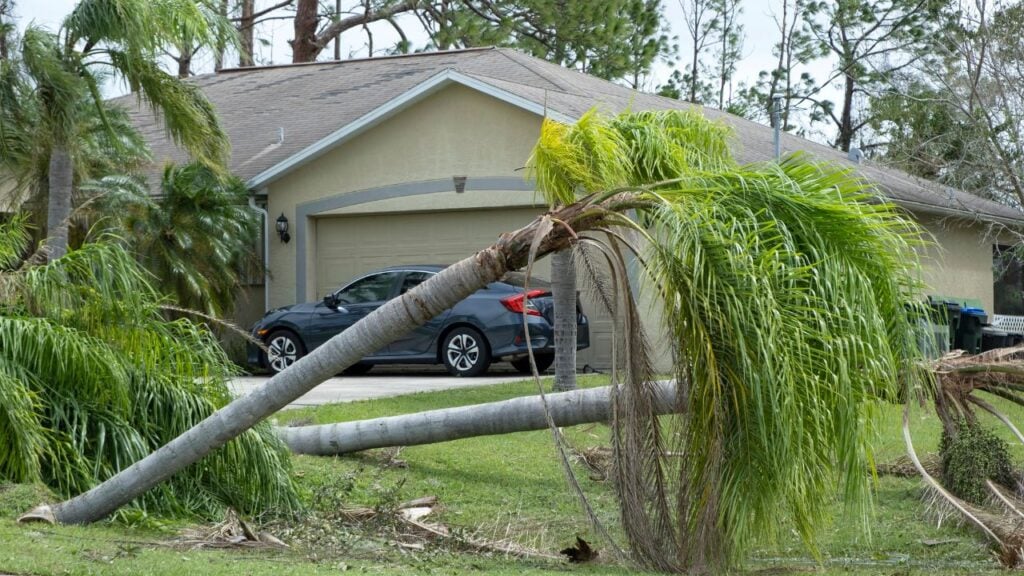
Florida's home insurance bills now top every other state in the country.
For many households, that one line can blow up their whole budget.
6 States Floridians Pick When Hurricane Insurance Gets Too High
10 Benefits Florida Retirees Leave on the Table Every Summer

You already know how to survive a Florida summer: Park in the shade, dodge the 3 p.m. downpour, and brace for the AC bill.
What you might not know is that the state and the feds set money aside for retirees in those exact months.
Most of it goes unclaimed.
10 Benefits Florida Retirees Leave on the Table Every Summer
